
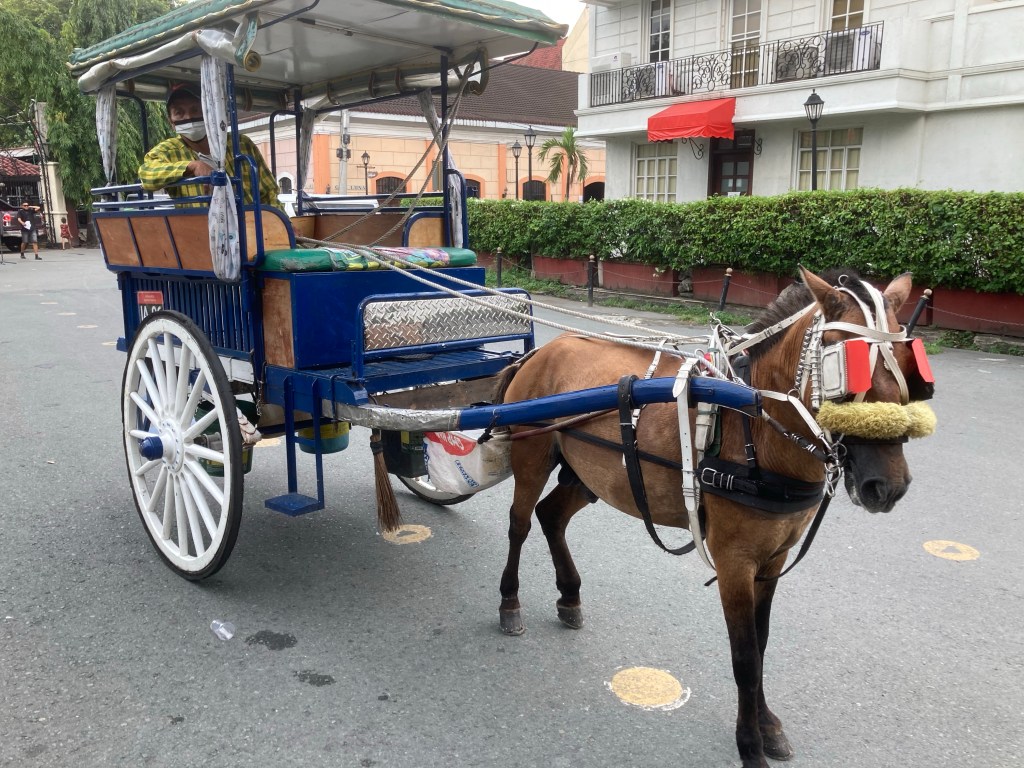
I am in awe of how Filipinos navigate traffic. It’s not just the drivers in their delivery trucks and vans and the passenger cars. But it’s also the jeepneys, motorcycle and scooter drivers, bicyclists, bike taxis, and pedestrians, many of whom push or pull carts and trolleys overladen with goods on delivery. And it’s also the kalesas—horse drawn, two wheeled carts that can fit about six people, plus the driver.
My sense of traffic is that anything smaller than a car just slides in between the rows of anything car-sized or larger, then everybody jockeys for position toward the next intersection where traffic merges in the exact same fashion—scooters and bicycles zooming inches away from delivery trucks and automobiles. Everybody stopping nearly against reach others’ bumpers (literally inches, again) to ensure a place in the pecking order once traffic resumes. It’s not for the faint of heart.
But I’m a little ahead of myself. Intramuros means “within the walls”. In this case, it’s the old city of Manila, a district of colleges and universities and several barangays (think of them as districts or villages, or perhaps more appropriately, barrios) housed within the fortress walls that also contains Fort Santiago. Because it was built as the seat of power by the Spaniards, it contains a number of historical sites, including the former home of the Governors General, San Agustin Church and the Manila Cathedral, as well as the Fort, which presents portions of the narrative detailing the imprisonment and 1896 execution of Dr. Jose Rizal, a Philippine national hero whose writing and political activity encouraging Spanish reform in part led to the creation of the Philippines as an independent nation. Our tour guide suggested Rizal was to the Philippines what Gandhi was to India. As part of the Commonplace Book theme of this blog, I’ve included an excerpt from Rizal’s Farewell, written before his execution. The full text may be found here, in its original Spanish as well as English and Tagalog.
Farewell, my adored Land, region of the sun caressed,
Pearl of the Orient Sea, our Eden lost,
With gladness I give you my life, sad and repressed;
And were it more brilliant, more fresh and at its best,
I would still give it to you for your welfare at most.
After the tour of Fort Santiago and the kalesa ride, we crossed the Binondo-Intramuros Bridge, dropping into the the oldest Chinatown in the world (well, outside of China. Our destination was the Ying Ying Teahouse which serves wonderful family style meals—chicken and pork “cold cuts”, lechon, a small mountain of fried rice, pancit and vegetables, and bowls of calamansi, which we learned how to squeeze and mix with water: our own calamansi juice drink, far less sweet than what can be purchased in premade bottles, though each are tasty in their own way.
Outside the store a white-haired and wrinkled man, hunched under the burden of a large pack, blew a sort of non-tune on a harmonica. It seemed to be a mix of his regular breathing with a mild effort at pentatonic notes, but I could be sure. He held out his hand for change, which we gave. Then, as he asked from a group emerging from the store, one of the customers handed him their bag of leftovers. And this, we were told, is part of the Filipino culture of giving. It doesn’t matter how much or how little you have; if you can give a little, you give. It recalled for me something Nanay always said: “If I can help, I will help. If you need, I will give little bit.”
Now, Nanay was, in her own neighborhood in Olongapo, a person who gave to the children if they stopped by her door. She helped the neighbors. She did what she could. This was what she always told us. Knowing this spirit of giving is a cultural value offers more insight into another principle Nanay operated with—utaang na loob—a type of indebtedness. For me, as a writer, watching the spirit with which this culture offers help, says thank you, and attends to the old children’s prayer Mom taught us:
ato aming kaunting kanin
ato ato kaunting sabaw
siya nawa
Literally, every day a little rice, every day a little soup. It will be done.
I see in this day the complications my mother’s spirit of giving created when she married a poor man who didn’t have the wealth to give. I can see Nanay bringing the same spirit of giving to bear a shield. already on the first day, I am learning how complex my mother and grandmother were. Not that I didn’t know, but simply that I didn’t understand.
When we closed our day at Binondo Church (Minor Basilica of Saint Lorenzo Ruiz and Our Lady of the Most Holy Rosary Parish), I recalled my mother once again. Inside, we found a range of depictions of Christ, from child to martyr, “Mama Mary”, a Black Nazarene, and a wood and wax body Christ under glass, akin to the incorruptible saints on display in churches across Europe. In fact, until I did further research into the Good Friday ritual “Santo Entierro”, I thought the body under glass had once been a living breathing person. To the Catholic faithful of the Philippines, of course, it was the body of Christ, which the take through the streets on Good Friday to mourn. Near each of these depictions, statues, glass encased effigies usually stood two other items: votive racks of various sizes with any number of lit candles, and a donation box. Instantly I stood in my mother’s Florida sewing room again, at the single bookshelf she had crowded with statuettes and photos of Christ, The Virgin Mary, Saint Philomena, and the Buddha in his various poses. Her rosary lay there near her incense sticks and cones. Inspiring messages and prayers to be repeated had been taped to the front face where she could read them quickly and regularly.
When we stopped at a street altar in a little alleyway behind the church, we saw the merger of these two faiths as people took three incense sticks, lit them, said prayers, and planted them in a copper bowl of deep sand before a shining cross adorned in garland and flanked by both live and dried plants. Signage indicated what to do, what to say, and how many times to repeat, depending on the strength needed. And I saw my mother again, in her sewing room, seated on a cushion, the candles lit and the incense burning, praying for the cancer to go away.
 Nicanor Abbott
You must be logged in to post a comment.