
This is my mother’s country: a symmetry of canyons, the first bedecked in Tagalog, Chinese, and English signage amidst a tangle of cables; the second sedimentary rock in striated layers, purple and white streaks cutting toward the river below, a lush and wild arrangement of tropical life draped, bushy, twitching with birds and dragonflies in black, neon blue, and yellow. A baby monkey crouches on a rock, watchful, then leaps into the green river and swims away. My mother grew up in Quezon City and lived in Manila. Her mother—we called her Nanay because she didn’t like Lola—grew up in a farming village of rice paddies and coconut palms, then moved to Manila, then to Olongapo. No doubt her island was just as green when she left it.
Gilbert and Ben meet us in a dugout canoe at the Casa del Rio dock, a concrete and stone ledge two dozen steps below a cliff side resort. The backyard pavilion, close and green and overlooking the river gorge, feels naturally grown from a grove of kamagong and palm. They wave to us from their boats, two of the six boatmen, two boatmen per canoe. We are nine tourists, and they load us three per boat, for balance, to ferry us upstream through the rapids to the Pagsanjan (the j has a y sound) Falls. This was Nanay’s country. The boatmen keep count—of weight, of balance, of distance and rapids, of rocks and steps and strokes of the paddle and a thousand other calculations. And this was Nanay counting: strawberries from the patch, strokes of a broom on the walk or buckets of grass snipped from the patch in front of the porch, the vinegar and soy, the pieces of meat and chicken. The dollars she kept in her white envelopes.
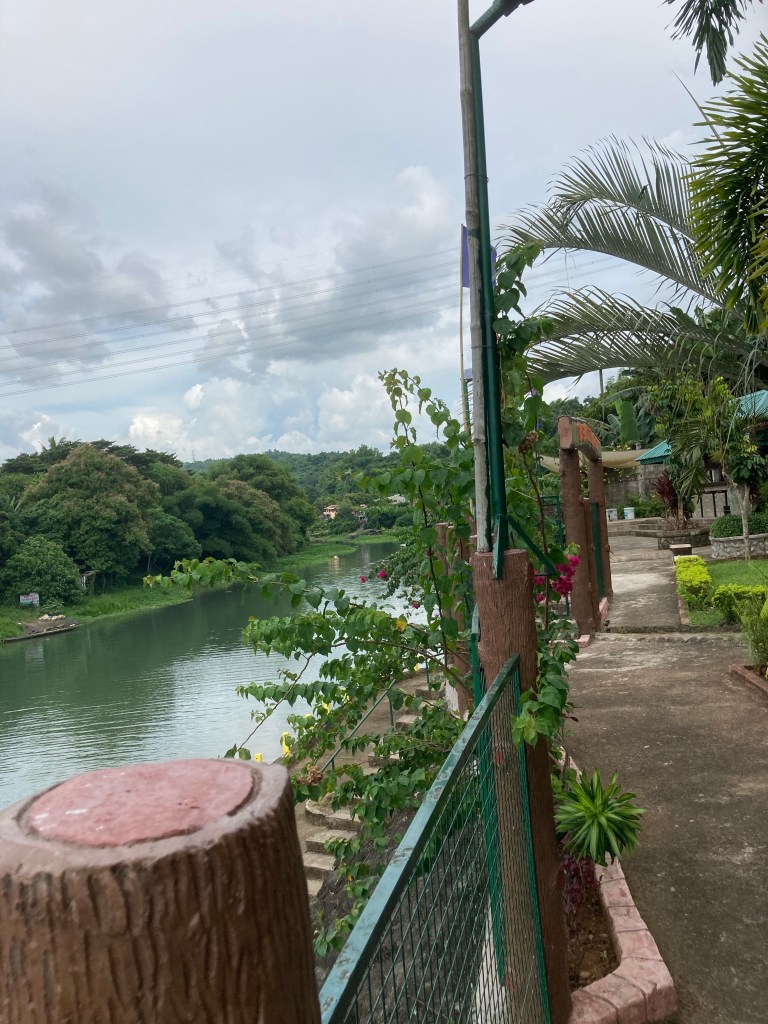
They paddle swiftly against the current. A man in a plaid shirt arrives in a canoe fitted with a small motor. Gilbert, a sinewy young man with a silky black ponytail, grabs a rope from the back and attaches it to the front of our canoe. After all three canoes are linked, the boatman motors us up toward the first rapids. We cut through the Lillies and swarms of dragonflies. He pulls us through the a punishing stream of engine fumes. The motor sound echoes off walls resembling pebbly dinosaur skin, it rattles inside little alcoves and niches in the rock. A yellow butterfly flits across vines against black rock.
The rapids are low; the water shallow. Gilbert and Ben jump out of the boat. Barefoot, Gilbert deftly pushes us off the rocks with his feet as he pulls us upward. Sometimes there are pipes embedded in the rock across the water, creating a set of risers that make it easier to slide us upward. Gilbert dances across them. Had I tried it, I would have but cut and bruised and twisted and sore. Ben pushes from behind, from the side, and once, her and Gilbert both pulled us from the front of the boat. When he climbs back in, sometimes he grunts or exclaims, as if in pain. He’s got a belly, though I can’t see how.
In the pools between rapids, Gilbert sinks in neck deep, cooling quickly. Behind me, Ben scoops out excess water with a sandal. We bought them drinks from an old woman who paddled out on the river to sell them: bottled water and coke. She does this a lot. We are to pay her after, 350 pesos per boat. At one point, they ask how much I weigh. I give them the number in pounds. They ask for it in kilograms. Metric conversion is not one of their calculations; I am going up the river either way. I give Ben my unopened water. It’s the least I can do.
When we reach the falls, the men take a break while another group put us on a thick bamboo raft and float us right under the falls and into the cave beyond. We swim a while, take photos. The water is warmer here. The spray is sharp, pounding and great on the back and shoulders. Hot springs are popular in this part of southern Luzon, and we benefit. Relaxed, rejuvenated, and thoroughly saturated, we load up and the boatmen take us back. The trip is faster, and they need to disembark less frequently. The call ahead, Tagalog syllables to let others know we are coming down the rapids. A call back from another boatman at the bottom would bring us to a temporary halt. We pass now familiar sites: A tower of some kind leftover from the Americans or Japanese. White cows grazing on both banks. A few huts with only two or three walls to keep out the rain. Down the river we race, and soon there are children swimming beside us. Houses on the cliffs in Japanese or Spanish styles. A white statue of the Virgin Mary tall as the neighboring trees, gazes down serenely as we pass below her. This is my mother’s country: when I see the Virgin Mary at home, I think nothing of it. When I see the Virgin Mary here, I think of her prayer altar, second shelf from the bottom of her sewing room bookcase, bedecked in Catholic and Buddhist imagery, Mary prominent among them not by size but by frequency.
Gilbert and Ben work one day a month. There are a thousand boatmen in need of work, but no tourists. The trip takes about two and a half hours. It is grueling and it is dangerous, especially for the feet and legs. The pay is low. A good tip makes all the difference when you must provide for a family on one day of work a month. Back in the Casa del Rio, the staff of young women and a couple women who know better than to get old serve us homemade chicken BBQ, lumpia, stewed vegetables, rice, mushroom soup, and a tapioca with bananas and jackfruit. We drink buko water straight from the coconut.

The people of the resort are friendly, generous, kind, and in a state of perpetual smiles, but they, too, operate under a harsh climate. No tourists. They ask us to return and invite us to stay in their poolside cottages. One could hardly say no to their hospitality, and that seems to be the way of things here. This is my mother’s country. This is Nanay’s land. It is as beautiful as they said it would be. It is sometimes as painful as their lives suggested.
 Nicanor Abbott
You must be logged in to post a comment.