
Nanay was a farmer’s daughter from Dapa, an island off the coast of Mindanao, in the Surigao del Norte region. She moved to Manila and then Olongapo City, both across the Visayas, over 700 kilometers from her home. I hardly expected to find any hints about her life at a hydroelectric plant-turned-sugarcane plantation-turned coconut plantation. But at Villa Escudero, I was in for a surprise.
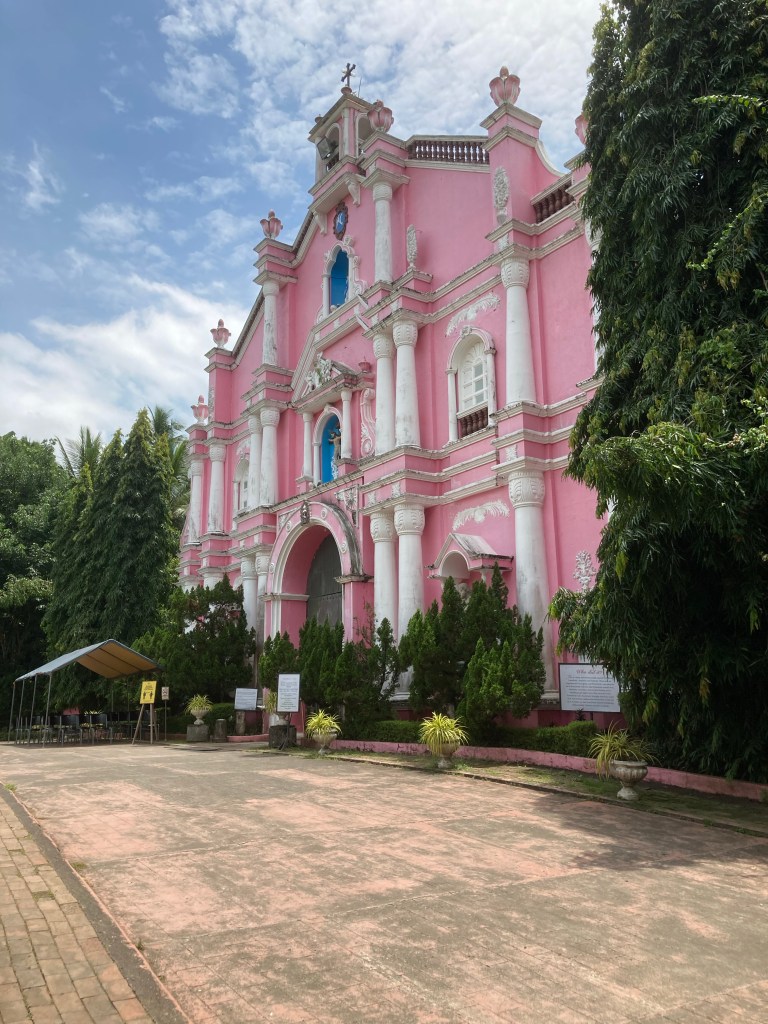
Our guide brought us there because we wanted a sense of the diverse cultural heritage and history of the Philippines. Of course this can be done in many ways. Books are one way, though they don’t give the reader lived experience. Slowly touring the countryside over many visits is an expensive and authentic way to get at the culture, but it would be slow, and there is lots of room for error in language and meaning. Because Filipinos are a people whose hallmark identity has been deep and friendly hospitality, it came as no surprise that our guide chose this plantation resort with a waterfall buffet as a place to get a sense of the agricultural history while spoiling us a bit. But we did not expect the “pink cathedral,” the former plantation church turned private museum, home of art, historical and political artifacts, and scientific specimens from across the Philippines.
The main floor of the museum is dedicated to the Escuderos’s extensive collection of Christ figures, many life-sized, and the majority carved in the Islands. Most look distinctly Spanish, with sharp features and narrow faces. An adjacent aisle holds the family collection of animal specimens—everything from spiders and crabs to birds, leopards, and snakes. Most of the collection dates back to the late 19th and early 20th centuries; I couldn’t help thinking of Don Placido and his son Don Arsenio as game hunters in the model of Teddy Roosevelt. They were all contemporaries, at any rate. But in the next wing, the museum displayed the cultural trappings and artifacts of the major indigenous people of the nation.
“I am Ilocano,” our guide explained, “and here you can see the kinds of things that we have at home, even today.” The mannequin woman on display stood outside her hut overlooking vast rice paddies. On the ground beside her sat a figure of a man carved from dark wood, the size of a nine or ten year old. His knees were pulled up to his chin, and his arms wrapped around his legs.
“This is the representation of our ancestors,” our guide said. “To help ward off evil.”
At the next display she stopped.
“Did you say your Nanay was from Surigao?”
I nodded. “Surigao del Norte.”
“Well, this would have been her people!” She was very excited. “Unlike the Ilocanos, who worried about the next world, the Surigaonons are showier. They like to display what they have.” The mannequin was dressed in more colorful attire than any of the others, in this case wide stripes. A sunka board (similar to mancala) nestled in an ornately carved stand nearby. I reviewed the photos of Nanay—she always wore colorful clothes, at times mismatched or clashing, and was proud of her accomplishments.
“I may be old woman, But I have de money. I am not estupid,” she would remind us every visit. her old sunka board now sits in my living room.
I looked to my sister, who shared a knowing look. we both saw Nanay there behind the glass. her style, her trappings, the traces of her customs were suddenly revealed to us. Well, the corner of the page was pulled back a bit, and we could tell there was a richness there we could never fully know. But a little more of who Nanay was had been revealed.
 Nicanor Abbott
You must be logged in to post a comment.