
We landed at Puerto Princesa Airport, Palawan, on a blue day in late June. In truth, all of Palawan is deep azul y verde. Crayola had the Philippines in mind when they developed their blues and greens. Cirrus clouds feathered the deepest, almost space blue. Cumulus white cotton formed a bed upon which the lighter tones rested. Gulls and herons glided in that space between blue-of-sky and green-of-jungle, of beech and palm, ficus and mangrove. Birds of paradise unfolded everywhere, it seemed. Rainforest green and its trim of tan sand gave way again to blue-green sea. Sulu Sea. Western Sea. Places where sky and earth gave way to water.
We set out the next day from the New Casamila Hotel, a dozen people in a white van bouncing and jostling through Puerta Princesa and into the mountain rainforests. Skirting Honda Bay to the east and Ulugan Bay to the west. We followed a concrete slab road, little sari sari stores here, farms over there. A carabao grazing under a palm. Limestone formations revealed the oceans’s affect on the vertical mountain cliffs.
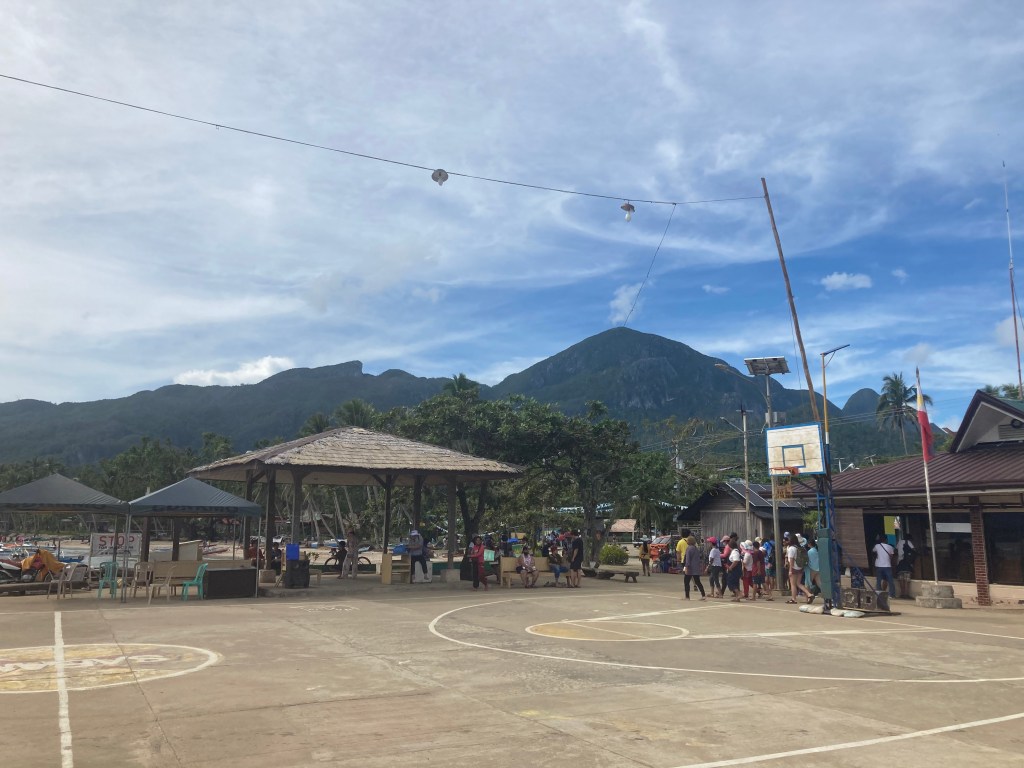
Cabayugan is a little village on Saint Paul Bay. Mostly dirt roads and crowds, though there was a resort off to the left. Not our speed. We waited on a concrete expanse, flat on top and sloping into the Bay. A beach house of sorts good at one end, where we were encouraged to take care of business.
“Once you’re on the boat, you’ll have to hold it. There’s no place to go until you get back,” we were warned. A basketball court had been painted between the beach house and the bay. Teenagers shot hoops and talked smack about each other’s skills. We didn’t know the words; we knew the tone. Vendors waved their bracelets and necklaces, floppy hats and t-shirts at us from the moment we stepped out of the van.
“Five dollar! Ten dollar!” They said pressing them into our hands.
“Hindi! Walang peso!” We were taught to reply.
All of us seemed to have exchanged shoes—the locals turned English-speaking capitalists; the westerners borrowing limited Tagalog to avoid an unnecessary sale. There would be time for gifts after the visit.
We were ushered down a ramp and on to a little platform, from which they loaded us into small banca boats—motorized fishing boats stabilized by bamboo outriggers attached to both sides. We bounced across the bay to the rhythm of the waves, arriving soon at a wide sandy beach secluded behind a limestone cliff. The beach and the river entrance are on opposing sides of a small peninsula, so up the beach and through a little jungle of palms we trod, receiving helmets and life jackets from pavilions at either end of the wood plank and beach sand trail.
The Subterranean RIver is a UNESCO World Heritage Site. We paired up by twos, heaviest toward the center, and another guide paddled our boat into the cave. The acidic smell of bat guano was immediate; I remembered the grain silos and dairy barns I had visited or walked past in my youth. Soon we operated with only the headlamp from the guide, a monotone man with a dry sense of humor who described every formation—color and shape— in terms of his culture. The market place’s color suggested fruits and vegetables—reds and yellows and greens. In the cathedral, shrouded women prayed to the face of a bearded man beneath a high ceiling. Mushrooms. Carabao. Bats, both figurative and real. The swallows that darted around the entrance quickly ceded space to the swooping rodents.
“The light colors are from water through the mountain. The dark colors are from the bats,” he said.
Some time later, in the middle of a dripping cavern with a ceiling several stories high, he asked if we wanted to see what the trip was like in the dark.
“Sure,” my nephew said.
“Close your eyes,” the guide deadpanned, then switched off his light. We sat in the boat in the darkness beneath the mountain for a minute or two, feeling the cool of the earth and the drip of water and the squeak flap of bats. I could not help but feel a certain momentousness upon emerging from the darkness. Was it a birth? An expulsion from the earth? The knowledge that we had gone into a place extraordinary in the rhythm of our lives? Indeed, the whole trip had been extraordinary. I wonder what my mother, and what Nanay would have thought?
They were not from Palawan. Mom was born in Manila. Nanay in Surigao del Norte. But this land was their land. Mom had complained about the lakes and rivers in our home state, describing them as muddy and gross. Now we knew why. And Nanay? She had crossed these blue-green waters alone when she was little more than a girl. Surely she had watched the fish beside her boat, just as I was doing now? Did she travel by banca, or was there a larger boat to transport her from her home?
 Nicanor Abbott
You must be logged in to post a comment.