
Mom hated the lakes and rivers that we loved as children.
“They’re shitty,” she insisted. “That’s a dirty, muddy river. Don’t go in there.”
Once while camping, she evaluated the lake. “It’s freezing! And you can’t see a thing if a fish swim up and bite your pecker. The damn thing is a shitty green.” To this day, I remain uncertain if the green was the water or her predicted outcome for a bitten penis.
All this from the woman who taught us that the tidal canal separating Subic Bay Naval Station from Olongapo City was colloquially known as the Shit River. We simply never understood her vehement disgust and refusal to step into the waters of our home state, especially when we didn’t have anything that sounded as horrific as the Shit River.
Once she described the beaches of her childhood and teenaged years, perhaps hoping we would understand. “We have a white sand, and the water is clear. You can see to the bottom, and all the fish, and the lobster that will bite your toe. Our beaches are clean, and the water is warm.”
It was one thing for mom to say it, and another to see it in pictures. But for someone who has never experienced the soft white sand and endless blue sky and sea and the warm clear water of the Visayas, or Palawan, not even a picture does it justice. (Note that I call it white because she did. I have been on the white coral sand of the Florida Keys; it is hard, scratchy, unforgiving, and not a blessed thing like the sand of Honda Bay, Palawan). So here is a photograph from the trip, and I share it knowing that no matter how beautiful it may look to you, it was ten times more beautiful when I stood there.
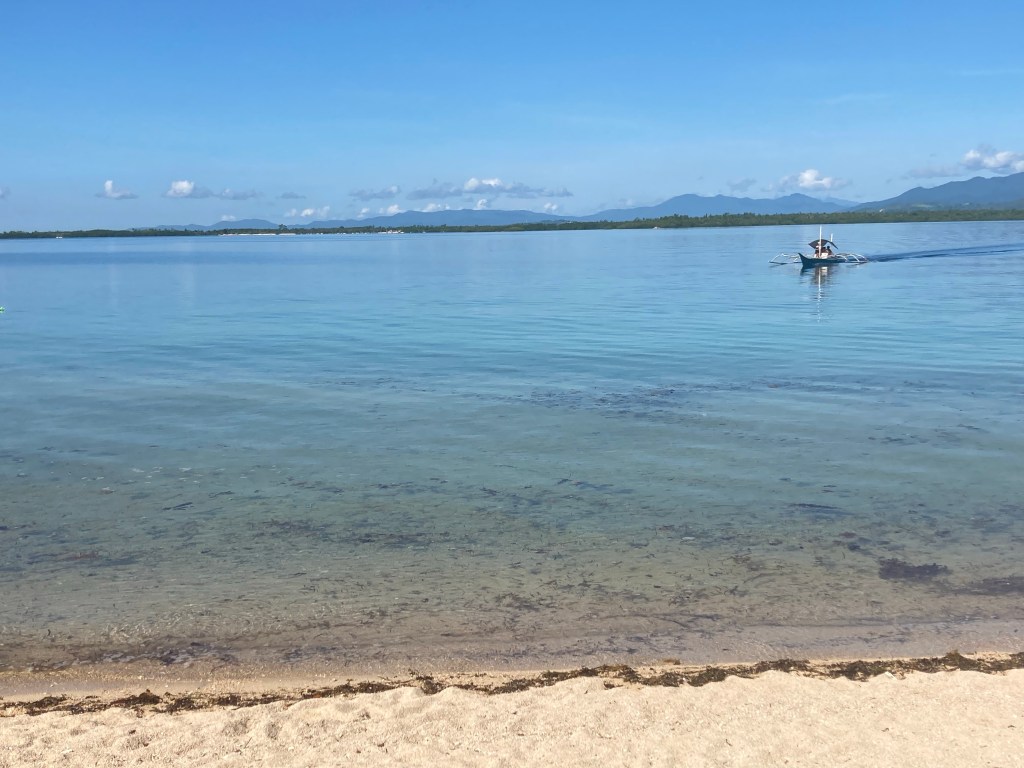
I can only guess that my mother or grandmother visited Palawan. Mom was raised in Quezon City and spent her time between Manila and Olongapo. I know she visited a couple beaches in central and southern Luzon. Nanay crossed the islands on her own at twelve years old, from an island near Surigao del Norte to Manila to Olongapo. No doubt she grew up seeing this kind of scene. But for those of us who knew them, fought with them, loved them, mourned them, and now remember them, this was as close as we will ever get to knowing what Mom so clearly treasured.
We spent the day island hopping on the Trishia Mae, a banca large enough to hold not only our party of nine but another party of four and three crew members: Capt. Roy, Jody, and John Lee. First they took us to Starfish Island, where we swam around the net-protected area and tried snorkeling a little, though none of us in our group were so brave as to venture out past the drop off.
While we swam and searched for starfish among the rocks and coral remnants, our guide, Jake, prepared a picnic lunch: Sisig, shrimp, cucumber, bitter melon and shrimp paste, whole tilapia, and fresh pineapple. I did not know how much I loved pineapple, but I think this was the day when I became certain of two things: first, I love pineapple; second, until I went to the PI, I had never eaten a properly ripened pineapple. No candy is as sweet.
From Starfish Island, we traveled to Luli Island, where I found myself feeding bread to a school of black fish with hints of vertical stripes. Again, we stayed among the rocky patches where the coral had died—the thriving reef areas were not accessible to those of us on the boat tours, which is a good thing, given how delicate a reef ecosystem is and how quickly people have destroyed them through careless interaction.
By the time we reached Cowrie Island, I opted to remain in the shade of a thatched pavilion, one of many beneath a grove of palms. I had worked myself into the worst case of sunburn I’d had since childhood, but it was well worth it. Back on Palawan, dark clouds had rolled over the mountains.
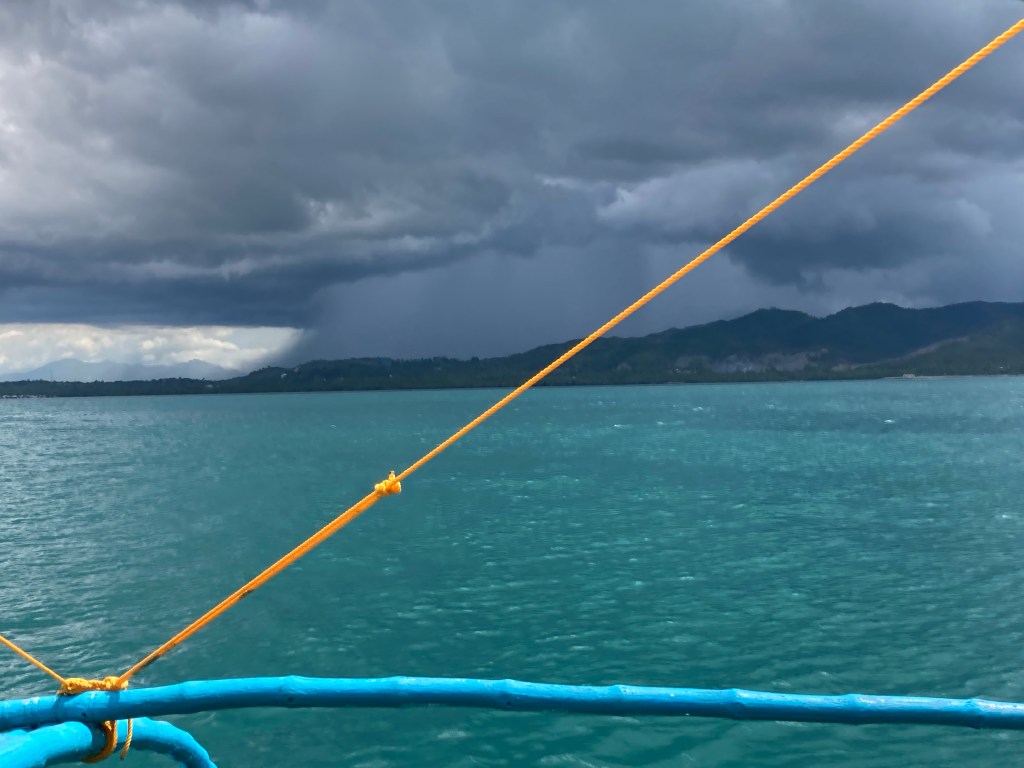
By the time I took this photo, we were already on the Trishia Mae headed back to port. Nearly all the bancas loaded and left together in an effort to beat the weather—a flotilla of blue and white, confident boatmen, sure in their lives on the sea, returning skittish tourists to the city.
I won’t ever fully understand my mother or grandmother. When I was young, I didn’t listen. Neither of them could explain what it was like to live immersed in this tropical world. But I laughed as I reflected on the fact that none of my appendages had been bitten that day. I finally think I understood them a little bit more. Why Mom wouldn’t go in the water in the states. Why Nanay, even as her health deteriorated, still dreamed of going home to the PI. I can’t regret not sharing with them; they were both dead and gone long before I had the means and incentive to make the trip. But with our vacation nearing its end, we had one more stop to make, to a place where I hoped I might discover the most about who my people were: Olongapo City. The place Mom and Nanay had called home.
 Nicanor Abbott
You must be logged in to post a comment.