The Twelve Days of Christmas: Mayhem of Prepositional and Conjunctive Proportions

On the first day of Christmas, my True Love gave to me a partridge in a pear tree.

Well this is nice, I thought. She’s a pretty bird, and I’ve heard the eggs are quite good, though smaller than chicken eggs. I’ve read that pear trees need to be planted in early spring, so I’m hoping that it will be alright in its container until then. Just to be safe, I’m keeping it on the porch.

“What kind of pear is it?” I asked.

My True Love shrugged.

On the second day of Christmas, my True Love gave to me two turtledoves and a partridge in a pear tree.

I ran out to the big box pet store and returned with a couple cages. I put the partridges in one and the doves in the other. The tree went on to the porch with the first.

“Good thing you bought a second,” I said, “because you need at least two to guarantee pollination.”

My True Love smiled.

On the third day of Christmas, my True Love gave to me three French hens, two turtledoves, and a partridge in a pear tree.

“Bresse chickens,” my True Love said. I was grateful they were already caged.

“Thank you, Love.” I stuffed the two newest turtledoves in with the other couple, and tossed the third partridge into the last cage. “You really want us to have some pears, don’t you?” The third tree went out on the porch as well.

On the fourth day of Christmas, my True Love gave to me four calling birds, three French hens, two turtle doves, and a partridge in a pear tree.

“You’ve really got a thing for birds, don’t you?” I asked. “Good thing we’ve got a bit of garden out back. Should we build a coop?” The four calling birds had their own cage as well, and they happily chirped away. But with a half dozen French hens and another half dozen turtledoves, I thought we might need to begin construction soon. The four partridges were certainly getting plump on the feed I bought, and the back porch was a bit crowded.

On the fifth day of Christmas, my True Love gave to me five golden rings, four calling birds, three French hens, two turtle doves, and a partridge in a pear tree.

“Now this is a bit more reasonable,” I admitted as I slid the rings on to my ring fingers, pinkies, and left index finger. The eight calling birds crowded their cage and we had to buy a second cage for the nine French Hens–“Bresse chickens,” My True Love reminded me.

We also purchased an extra cage for the eight turtle doves. The five partridges had needed another cage as well, and the entire living room began to take on a foul–pardon the pun–odor. I strung a clear sheet of heavy plastic against the house and moved the five trees under it.

“We need to buy lumber,” I announced, and began surfing the web for chicken coop blueprints.

My True Love said nothing.

On the sixth day of Christmas, my True Love gave to me six geese a-laying, five golden rings, four calling birds, three French hens, two turtledoves, and a partridge in a pear tree.

“Love,” I insisted, “you’ve really gone too far. What are we going to do with these geese?” My fingers shone brilliantly–ten gold rings on ten digits–but we had twelve calling birds, twelve … Bresse chickens, I reminded myself dutifully … ten turtledoves in two cages, but because we didn’t want to break up the couples, one cage held four and the other six, and a half dozen partridges, all befouling the house.

My True Love shrugged and smiled and began filling a plastic kiddie pool with water..

“Oh well, there’ll be plenty of eggs. That’s for certain.”

On the seventh day of Christmas, my True Love gave to me seven swans a-swimming, six geese a-laying, five golden rings, four calling birds, three French hens, two turtledoves, and a partridge in a pear tree.

“But this is simply too much!” I cried. “The seven swans not only swim, but snap and hiss at the neighbors, their dogs, and cats. I placate the neighbors with eggs from our twelve geese and our eighteen Bresse chickens. But the honks of our geese drown out the sixteen calling birds. I wish they might be quieter, like the cooing of the twelve turtledoves or seven grouse. Yes, those are grouse, which are similar to partridges but not quite the same.” I wrangled the seventh tree under the clear plastic, then wondered how my coop, still only half-built, had already become obsolete in the face of such numbers.

My True Love didn’t say a word, only diligently collected the scraps from our half-built coop.

On the eighth day of Christmas, my True Love gave to me eight maids a-milking, seven swans a-swimming, six geese a-laying, five golden rings, four calling birds, three French hens, two turtledoves, and a partridge in a pear tree.

“How can you give me people?!” I stopped one of the women who led her Ayrshire into my garden-turned-barnyard. “You know there are laws against this sort of thing?” She shrugged and handed me a pail of milk as her cow chewed my lawn. My True Love had assembled a water trough out of coop scraps. The cows drank from it until the swans started swimming in it.

No amount of rings, I thought, though I glittered more than ever. Still, where would I put the milk? The refrigerator was full of eggs, and I feared we would need to convert the downstairs into an aviary.

On the ninth day of Christmas, my True Love gave to me nine ladies dancing, eight maids a-milking, seven swans a-swimming, six geese a-laying, five golden rings, four calling birds, three French hens, two turtledoves, and a partridge in a pear tree.

I holed up in the attic doing math on a pad stained with dove excrement. One of the maids brought a cow inside to warm her up, and the beast kicked over some cages. We managed to get the nine partridges and twenty-one Bresse chickens out to the coop. No help from the dancing ladies, thank you. But sixteen turtledoves and two dozen calling birds made their way upstairs. So did some of the … two dozen geese. We’ve been finding eggs between the cushions, on the pillows, under the beds… and my True Love? My True Love just smiles and gives the neighbors milk to go with the eggs to keep them from calling the police on our twenty-four hour racket.

On the tenth day of Christmas, my True Love gave to me ten lords a-leaping. Yes leaping. Over the furniture, through the house, across the cowpat-strewn former garden. And another nine ladies dancing, eight maids a-milking, seven swans a-swimming, six geese a-laying, five golden rings, four calling birds, three French hens, two turtledoves, and a partridge in a pear tree.

The lords and ladies quickly assembled a performance set to lowing, honking, and clucking. Well-choreographed, I think, though I’m no expert on modern dance. Not my thing, really. The eight ladies who weren’t matched up with lords began juggling and tossing and posing with the eggs and milk, so now there’s room in the refrigerator again, or so my True Love says. I haven’t come down from the attic yet.

That evening, my True Love placed rings twenty-six through thirty on my fingers. I can’t move them anymore. Good thing a simple waving away only requires the wrist.

I smell French toast. Or is that French hen? I’m sorry. Bresse chicken.

On the eleventh day of Christmas, my True Love gave to me eleven pipers. Piping. All of them. And yet another ten lords a-leaping, nine ladies dancing, and eight maids a-milking. Where is my True Love finding so many people willing to be sold? I’m sure there’s a law, and the constable will be knocking any moment. There are also an additional seven swans a-swimming and six geese a-laying. All of them adding to the ceaseless racket. Five golden rings aren’t enough. How about earplugs, a cot, and a pillow that’s not soiled, so that I could have one blessed night’s sleep? Oh, and yes, just for fun, four more calling birds, three more French hens, two more turtledoves, and–no, you don’t say? Another partridge in another pear tree. Joy!

I am surprised that we haven’t been arrested or evicted yet. If I check my True Love’s accounts, will I find that we are penniless? Destitute? But the pipers’ sound is soothing after the first four … five … six hours. The animals seem to have calmed somewhat, and the smell of chicken and waffles makes my mouth water even up here among the turtledoves a-pooping and calling birds a-flapping and a pair of maids a-milking who thought they were alone and then tittered away red-faced when they discovered that they weren’t.

On the twelfth day of Christmas, my True Love gave to me twelve drummers drumming. More loudly and consistently than the pipers piped. But then, of course, my True Love so thoughtfully gave me eleven more pipers to match the sound. And another ten lords a-leaping over the broken furniture and chicken coop, nine ladies dancing on the overturned trough, and eight more maids a-milking eight more Ayrshires a-lowing. Seven more swans a-swimming, six more geese a-laying, four more calling birds, three more French hens, two more turtledoves, and another partridge, all set loose in the house, now fully a barn. And another blessed pear tree under the plastic. Five more golden rings? My True Love has got to be a-kidding.

For the record, I’ve now hosted twelve drummers, twenty-two pipers, thirty lords and thirty-six ladies, some of whom also juggle. Forty maids and forty Ayrshire cows, though perhaps only thirty-eight as those two who stumbled across my attic hiding place seem to have disappeared entirely, along with their cows. Forty-two each of swans and geese. I have forty gold rings all safely tucked in a paper sack to pawn, either for bail or to start my life anew somewhere else. Thirty-six calling birds flapping through the eaves. We had thirty French hens, but many mouths to feed. The twenty-two turtledoves have mostly flown the coop as well. And the dozen partridges? Dinner, too, by the smell.

But it seems I also hosted a forty-eight hour music and dance extravaganza, during which time the drummers and pipers did a bit of community service and planted those dozen trees in that damp, muddy, well-trodden, well-fertilized earth. And it seems my True Love sold tickets, and food and drink besides. It was a smashing success, apparently, and all that remain in the new pear orchard are a real estate agent, my True Love, and I.

“The neighbor wants to buy,” the agent says. “The house is a barn now, true, but the land, the orchard, he wants it all. Strangely, he’s willing to pay top dollar.”

“Probably to get rid of us,” I say.

My True Love shows me the bank deposit slip from our impromptu celebration. It’s more money than I’ve ever seen.

I think I just had an epiphany. We may do it again–some place new– next year.

Day 8: Olongapo City

This was the day I had waited years for. For the first time, we would see for ourselves the place where my mother and father met, the place where our grandmother—Nanay—had lived for perhaps 30 years.

Our second cousin—Gigi—greeted us in the parking lot of a strip mall on the edge of town. First we get a massage, she insisted, so we had massages and jasmine tea in the flickering candlelight and low-lit lamps of a second floor suite. The incense was sweet, the literature on homeopathic remedies and eastern medicine piled high on the coffee and end tables, on the register counter.

We toured the city. The bars and clubs of Rizal and Magsaysay Drives were long gone, especially after the Filipinos voted to take back Subic Bay Naval base from the Americans. It’s now an industrial and tourist zone—the military buildings of Old Cabalan have been converted to hotels and casinos, not all of which survived the global Pandemic of 2020. We stayed on Waterfront Rd., in the presidential suite of the hotel. When Gigi wants something …

Gigi was Nanay’s favorite. She was a young girl when Nanay was in her prime. They went to restaurants and movies together, and Nanay really gave her everything. Well, Gigi grew up right there in Olongapo. She told us stories: Nanay would ask if she wanted to see a movie. “Yes,” Gigi would say. Then Nanay would finish her solitaire game and away they would go. “Or when her tenants would fight with their neighbors or friends, Nanay would threaten to throw a pot of boiling water on them if they didn’t stop.”

When Nanay came to us she was highly private, trapped in a white man’s world dominated by my father, and only escaped it when the older man who hired her as his housekeeper proposed. We were ancillary to Nanay. Only after our parents divorced did we start to learn anything about her, and then it was limited.

The Subic Bay waterfront monuments are dedicated to soldiers who had been POWs, slaughtered by friendly Allied troops who sank Japanese military vessels regardless, and often without knowing, who was actually on board. There is the worker’s monument, and the monument honoring the twelve senators who voted out the Americans. A mile down the road was the dock where ships like the USS America, my father’s carrier, would dock. From there, he would get a jeepney at the Spanish Gate, and from there to Mom’s Club or the Whiskey A-Go-Go. Mom’s Club—the place where my mother was a cashier and my father decided he would like to go short time with her—is long gone.

We took Gordon Ave. around the perimeter of the city, through East Bajac Bajac. I wondered where pinatubo was.

“You’re on it,” Gigi said. “It’s a long slope from the volcano to the sea.”

Nanay’s house was a string of three apartments where her female tenants lived with a sari-sari at the end. She lived in a shack behind them. The whole place is gone, and a restaurant stands where Nanay grew vegetables and herbs and fruit to sell in her sari-sari. Lost to history is the room where my mother fed my father “the old fish heads and rice” soup, as he called it years later.

Even White Rock Beach—where they used to walk together, before my father ignored the U.S. Navy and then the local magistrate, both of whom warned him against marriage— was no longer accessible to the public. Every last vestige of Nanay’s, mom’s, dad’s places were lost to us.

Except the Spanish Gate, where a young man who thought he had all the answers boarded the jeepney that changed his life in October, 1968.

The Spanish Gate, Olongapo City, Philippines

Day 6: Honda Bay

Mom hated the lakes and rivers that we loved as children.

“They’re shitty,” she insisted. “That’s a dirty, muddy river. Don’t go in there.”

Once while camping, she evaluated the lake. “It’s freezing! And you can’t see a thing if a fish swim up and bite your pecker. The damn thing is a shitty green.” To this day, I remain uncertain if the green was the water or her predicted outcome for a bitten penis.

All this from the woman who taught us that the tidal canal separating Subic Bay Naval Station from Olongapo City was colloquially known as the Shit River. We simply never understood her vehement disgust and refusal to step into the waters of our home state, especially when we didn’t have anything that sounded as horrific as the Shit River.

Once she described the beaches of her childhood and teenaged years, perhaps hoping we would understand. “We have a white sand, and the water is clear. You can see to the bottom, and all the fish, and the lobster that will bite your toe. Our beaches are clean, and the water is warm.”

It was one thing for mom to say it, and another to see it in pictures. But for someone who has never experienced the soft white sand and endless blue sky and sea and the warm clear water of the Visayas, or Palawan, not even a picture does it justice. (Note that I call it white because she did. I have been on the white coral sand of the Florida Keys; it is hard, scratchy, unforgiving, and not a blessed thing like the sand of Honda Bay, Palawan). So here is a photograph from the trip, and I share it knowing that no matter how beautiful it may look to you, it was ten times more beautiful when I stood there.

The clear water around Starfish Island, Honda Bay, Puerto Princesa, Palawan, Philippines

I can only guess that my mother or grandmother visited Palawan. Mom was raised in Quezon City and spent her time between Manila and Olongapo. I know she visited a couple beaches in central and southern Luzon. Nanay crossed the islands on her own at twelve years old, from an island near Surigao del Norte to Manila to Olongapo. No doubt she grew up seeing this kind of scene. But for those of us who knew them, fought with them, loved them, mourned them, and now remember them, this was as close as we will ever get to knowing what Mom so clearly treasured.

We spent the day island hopping on the Trishia Mae, a banca large enough to hold not only our party of nine but another party of four and three crew members: Capt. Roy, Jody, and John Lee. First they took us to Starfish Island, where we swam around the net-protected area and tried snorkeling a little, though none of us in our group were so brave as to venture out past the drop off.

While we swam and searched for starfish among the rocks and coral remnants, our guide, Jake, prepared a picnic lunch: Sisig, shrimp, cucumber, bitter melon and shrimp paste, whole tilapia, and fresh pineapple. I did not know how much I loved pineapple, but I think this was the day when I became certain of two things: first, I love pineapple; second, until I went to the PI, I had never eaten a properly ripened pineapple. No candy is as sweet.

From Starfish Island, we traveled to Luli Island, where I found myself feeding bread to a school of black fish with hints of vertical stripes. Again, we stayed among the rocky patches where the coral had died—the thriving reef areas were not accessible to those of us on the boat tours, which is a good thing, given how delicate a reef ecosystem is and how quickly people have destroyed them through careless interaction.

By the time we reached Cowrie Island, I opted to remain in the shade of a thatched pavilion, one of many beneath a grove of palms. I had worked myself into the worst case of sunburn I’d had since childhood, but it was well worth it. Back on Palawan, dark clouds had rolled over the mountains.

A storm crosses Palawan

By the time I took this photo, we were already on the Trishia Mae headed back to port. Nearly all the bancas loaded and left together in an effort to beat the weather—a flotilla of blue and white, confident boatmen, sure in their lives on the sea, returning skittish tourists to the city.

I won’t ever fully understand my mother or grandmother. When I was young, I didn’t listen. Neither of them could explain what it was like to live immersed in this tropical world. But I laughed as I reflected on the fact that none of my appendages had been bitten that day. I finally think I understood them a little bit more. Why Mom wouldn’t go in the water in the states. Why Nanay, even as her health deteriorated, still dreamed of going home to the PI. I can’t regret not sharing with them; they were both dead and gone long before I had the means and incentive to make the trip. But with our vacation nearing its end, we had one more stop to make, to a place where I hoped I might discover the most about who my people were: Olongapo City. The place Mom and Nanay had called home.

Day 5: The Subterranean River

We landed at Puerto Princesa Airport, Palawan, on a blue day in late June. In truth, all of Palawan is deep azul y verde. Crayola had the Philippines in mind when they developed their blues and greens. Cirrus clouds feathered the deepest, almost space blue. Cumulus white cotton formed a bed upon which the lighter tones rested. Gulls and herons glided in that space between blue-of-sky and green-of-jungle, of beech and palm, ficus and mangrove. Birds of paradise unfolded everywhere, it seemed. Rainforest green and its trim of tan sand gave way again to blue-green sea. Sulu Sea. Western Sea. Places where sky and earth gave way to water.

We set out the next day from the New Casamila Hotel, a dozen people in a white van bouncing and jostling through Puerta Princesa and into the mountain rainforests. Skirting Honda Bay to the east and Ulugan Bay to the west. We followed a concrete slab road, little sari sari stores here, farms over there. A carabao grazing under a palm. Limestone formations revealed the oceans’s affect on the vertical mountain cliffs.

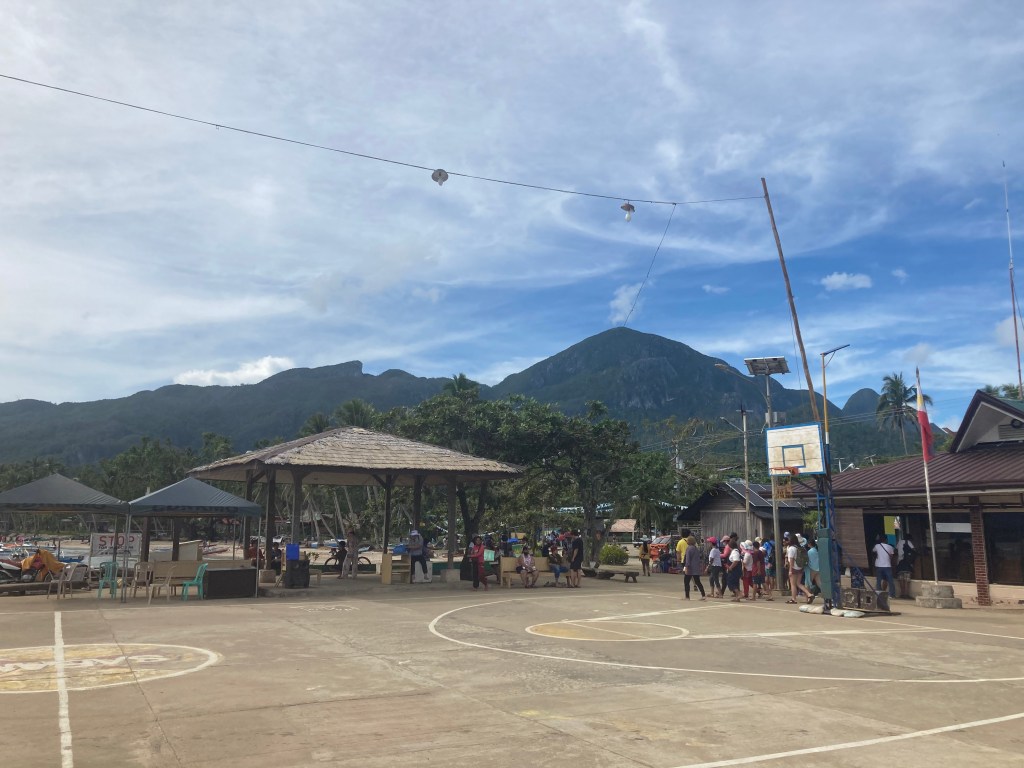
Cabayugan is a little village on Saint Paul Bay. Mostly dirt roads and crowds, though there was a resort off to the left. Not our speed. We waited on a concrete expanse, flat on top and sloping into the Bay. A beach house of sorts good at one end, where we were encouraged to take care of business.

“Once you’re on the boat, you’ll have to hold it. There’s no place to go until you get back,” we were warned. A basketball court had been painted between the beach house and the bay. Teenagers shot hoops and talked smack about each other’s skills. We didn’t know the words; we knew the tone. Vendors waved their bracelets and necklaces, floppy hats and t-shirts at us from the moment we stepped out of the van.

“Five dollar! Ten dollar!” They said pressing them into our hands.

“Hindi! Walang peso!” We were taught to reply.

All of us seemed to have exchanged shoes—the locals turned English-speaking capitalists; the westerners borrowing limited Tagalog to avoid an unnecessary sale. There would be time for gifts after the visit.

Awaiting the banca in Cabayugan

We were ushered down a ramp and on to a little platform, from which they loaded us into small banca boats—motorized fishing boats stabilized by bamboo outriggers attached to both sides. We bounced across the bay to the rhythm of the waves, arriving soon at a wide sandy beach secluded behind a limestone cliff. The beach and the river entrance are on opposing sides of a small peninsula, so up the beach and through a little jungle of palms we trod, receiving helmets and life jackets from pavilions at either end of the wood plank and beach sand trail.

The Subterranean RIver is a UNESCO World Heritage Site. We paired up by twos, heaviest toward the center, and another guide paddled our boat into the cave. The acidic smell of bat guano was immediate; I remembered the grain silos and dairy barns I had visited or walked past in my youth. Soon we operated with only the headlamp from the guide, a monotone man with a dry sense of humor who described every formation—color and shape— in terms of his culture. The market place’s color suggested fruits and vegetables—reds and yellows and greens. In the cathedral, shrouded women prayed to the face of a bearded man beneath a high ceiling. Mushrooms. Carabao. Bats, both figurative and real. The swallows that darted around the entrance quickly ceded space to the swooping rodents.

“The light colors are from water through the mountain. The dark colors are from the bats,” he said.

Some time later, in the middle of a dripping cavern with a ceiling several stories high, he asked if we wanted to see what the trip was like in the dark.

“Sure,” my nephew said.

“Close your eyes,” the guide deadpanned, then switched off his light. We sat in the boat in the darkness beneath the mountain for a minute or two, feeling the cool of the earth and the drip of water and the squeak flap of bats. I could not help but feel a certain momentousness upon emerging from the darkness. Was it a birth? An expulsion from the earth? The knowledge that we had gone into a place extraordinary in the rhythm of our lives? Indeed, the whole trip had been extraordinary. I wonder what my mother, and what Nanay would have thought?

They were not from Palawan. Mom was born in Manila. Nanay in Surigao del Norte. But this land was their land. Mom had complained about the lakes and rivers in our home state, describing them as muddy and gross. Now we knew why. And Nanay? She had crossed these blue-green waters alone when she was little more than a girl. Surely she had watched the fish beside her boat, just as I was doing now? Did she travel by banca, or was there a larger boat to transport her from her home?

A Flip in Dialogue Changes a Character

So I was a fan of Alice Oseman’s Heartstopper before it became a Netflix show and a cultural phenomenon. Like many other LGBTQ people, this is one of those stories I wish I had when I was a kid, along with Saenz’s Aristotle and Dante books and the Young Avengers. Since the Netflix release, I have re-read the comic and watched the show a few times, and I noticed a particularly jarring moment that keeps jumping out at me. Note that if you have seen the show but not read the comic, there will be spoilers here.

The scene takes place the morning after Harry Greene’s birthday party, when Charlie and Nick are interrupted by Charlie’s mom, Jane Spring. The dialogue in the comic and the graphic novels is as follows:

Jane: Nick I didn’t know you were coming over?

Nick: Um, Er, Yes.

Charlie: He’s just picking up a jumper he left here last week.

Jane: You could have at least changed out of your PJs, Charlie. Don’t forget we’re going to Grandma’s later.

She leaves them in the foyer.

In the Netflix adaptation, Oseman has flipped Jane’s last two lines of dialogue and altered the verb tense:

Charlie: He’s just picking up a jumper he left here last week

Charlie’s Mom: Right. Um, well don’t forget we’re going to Grandma’s this morning, Charlie. You could at least change out of your pajamas.

In the comic description, the change out of the PJs suggests a set of norms for how to appear when a friend comes to call, announced or otherwise. But in the program, Jane seems to temporarily put up with Nick’s presence, reminding Charlie that there are other priorities and he should be prepared for them. She knows something is up, but chooses to gloss over it for the time being.

This change in dialogue and the tone in which the actress (Georgina Rich) delivers them suggests a higher level of antagonism toward Charlie and Nick than appears initially in the comics. Of course Charlie and Jane do come into conflict later (and I can empathize, recalling all the conflicts I had with my mom on the road to acceptance and mutual respect). But this flip keeps chewing on my sensibilities as a reader and writer. I suspect it’s Oseman laying a firmer foundation for the dramatic tension to come in seasons 2 and 3 (and which follow in the comic). She has done this in other parts of the TV script as well, where the medium requires a greater build than what she provided in the original comics.

I am eager to see if my concerns about Jane Spring being a greater antagonist toward Charlie will be played out in the show, and I am amused by how just this little flip in dialogue has changed the way I perceive her, from overprotective parent in the comics to borderline disdainful of her son on TV.

Hide and Seek

Mel raced the wind, which picked up speed every second. He neared his goal, a little stone ruin—the remnants of a spring house—at the far edge of the cornfield. Behind him came shouts of warning, a girl’s scream. He pelted through the doorway, his lungs on fire.

Crouched in the most shadowy corner behind some grayed roof planks, he strained to listen. They could come at any moment. Cornstalks whispered and shushed when brushed against. Someone running would gasp for breath. Coughs. Whispers, should there be more than one pursuer.

But the wind worked against him. It drowned the sounds in a gray roar that matched the amassing clouds. Distant thunder rumbled.

He peeked through a broken window. No one. An ocean of cornstalks whipping in the wind. The sky a sickly green. Scattered droplets of rain turned into a deluge. Thunder rolled and fingers of lightning flashed. He counted the seconds between flash and boom, to estimate distance.

“One… Two…” he whispered.

Boom!

“One…”

BOOM!!

Then roared the sound of a freight train.

He grabbed a loose plank, pulled it toward him, and laid flat down. The sky roiled in angry black and sickly green. The world screamed.

When he awoke, the roofing that had given Mel shelter had fallen and swept everything against the wall. He crawled out on his belly, rusty roofing spikes scratched his back, butt, and thighs. He winced as he emerged, eyes blinking in the light.

One of the ruin walls had fallen in—he thanked the Maker he hadn’t been on that side of the spring house. The sky was blue, cloudless. Birds chirped in the border trees. He stepped back through the doorway. The corn had been swept flat.

“Who’re you?” asked a boy. Mel spun around to see someone who looked very much like himself peeking out from around the corner.

“Mel,” he coughed. “Who’re you?”

“Burt. You new?” the boy continued to eye him warily.

“No. You?”

“No. I lived her all my life.” Burt adjusted his Pirates ballcap and scowled at the sky. Finally he shrugged. “You wanna play hide and seek? We already got a game going.”

“That’s what I was doing,” Mel explained. “These ruins are great, aren’t they?”

“Yeah,” Burt agreed. “Best hiding place in the world.”

They hid there among the ruins, crouched below the window, until a third person—an older girl in a pair of overalls—peeked in and surprised them.

She swatted her hand downward through the window, slapping Bert on the head.

“Found you!” she yelled, then she turned and raced back through the corn.

“Bert’s it! Bert’s it!” she screamed.

The boys started back through the field. The Bert turned, a sly look on his face, and tagged Mel’s shoulder.

“You’re it!” he yelled and tore off between the rows.

Mel gave chase, back over the hill to the little dell with the big chestnut tree—home base. He ran as hard as he could, but the going became harder as he went. He broke into the clearing to find a group of eight kids gathered around the tree.

“Mel’s it! Mel’s it!” Bert yelled as he tagged the tree.

“Who’s Mel?” an older version of Bert asked.

“Him,” Bert pointed Mel’s way.

“Idiot,” said the older boy, slapping Bert in the head.

Poor Burt, Mel thought. The boy rubbed his scalp.

The older boy and the girl who had tagged Bert “it” approached him—not in the happy sprint of kids at play, but in the slow walk of those who had been chastened, or forced home at the end of the day.

“We’re sorry, sir,” the boy began.

“For what?” Mel asked. He coughed again. Paused. His voice sounded lower. Older. 

The two children exchanged nervous glances.

“For Burt… bothering you,” the girl said.

“It was no bother. I’m glad to finally—” Mel waved, then stopped. His hands were wrinkled and liver-spotted.

He looked to the pair. Burt. The others. The tree. Then back at his hand.

“I need to sit.” He sat with his back against the chestnut.

It came to pass, just as Mel suspected it would, that somehow he had been gone over seventy years.

“They still talk about the tornado as if it happened yesterday,” explained Allen, Burt’s older brother.

“It made the state news,” added another pudgy boy with a sheepish expression. “Especially because of the death toll—I mean, all the kids. everyone who died was a kid. My gram says she prays every day for those kids, and thanks heaven she got grounded for kissing Billy Blankenship the night before, or she might’ve been out there too—”

“Billy Blankenship?” Mel paused. “Your gram? Is her name Franny Dormont?”

“It was,” the boy seemed astonished. “But then she got married to Gramps, and now its Platt.”

“Platt, as in Mikey Platt?”

“No, sir. Marcus Platt. His little brother Mikey—my great uncle—died in the storm. He and two brothers who tried to outrun it.”

“—my guess is the boys who tried to run were the Farrelly brothers,” Mel said with a wistful smile. Gary and Greg were only a year apart. Daredevils. The bravest of their gang.

“A couple others were killed where they hid,” said the girl, whose name was Jolene. “The twister came right down the tree line, where all the kids were hiding. They still say the ridge and the spring house are haunted.”

“That’s why I hid there,” said Bert. “They’d never come looking—except for Jo, since she’s fearless.” Bert clearly adored the older girl.

“Funny,” said Mel. “I thought the same thing that day—they’d never come looking over there. Not that it was haunted, though I guess I must be the first ghost you’ve ever met.”

“But you can’t be dead,” Bert argued. “I mean, if you’re dead, we’re all in trouble.” 

“Seeing as how we can see you,” added Allen.

The other kids agreed.

“But what happened to Jeannie Anne? The little girl who was playing with us that day?” Mel asked.

Allen smiled. “She’s my grandma. Bert’s and Jolene’s, too. And she married Billy Blankenship.”

“She did? Why that rascal. I oughtta –” He stopped at the sight of the kids’ expressions.

“He passed on in 1997,” Allen said. “Heart attack.”

“And Jeannie Anne?” Mel asked, a hint of fear in his voice.

Allen smiled. “She’s still living in the same house her parents lived in.”

“Is she really?” He remembered the sounds and smells of that kitchen, especially on Sundays and holidays.

“She is.” Then Bert paused and studied Mel’s face. “You’re great uncle Melvin, aren’t you?”

Mel nodded.

The other children looked very serious. “She talks about you. They never found you. Great Gram — she never got over you.”

“Bert,” hissed Jolene.

“Well, that’s what Gram says,” Bert protested. “Never got over him, and died a year later. Left Gram and Great Grandpa alone in that house.”

Mel stared down at the dirt. A small beetle crawled alongside his foot. A slight shift, and he could crush it.

“So you’re coming home with us,” Jolene declared. “You’re living history. It’ll be a sensation. Our own ‘boy who lived!'”

“What?”

“Nothing,” Allen said. “Jolene spends too much time reading.”

“Oh, reading’s not such a bad thing,” she insisted. Mel agreed.

“But they’ll want to interview you, for sure,” Allen said. “Find out where you’ve been. Maybe even put you on the news. Meet the governor.”

“Or the president!” A little girl who had played with them exclaimed. “I’d love to see the First Lady.”

“And make a movie about you!” said Bert excitedly. “You’ll be famous!”

Mel smiled at the children’s excitement, then shook his head.

“When I left that day,” he said. “I really wanted to hide. I never wanted to be it, and I never wanted to be found.”

“What are you saying?” Jolene asked, not bothering to hide her frown. “You’re not coming home with us?”

“I don’t think it would be wise.” Mel watched the corn sway in the summer breeze. The town lay just over the hill. he wondered what Main Street would look like. If Corner General and the old school yard had changed much. But where would he even begin rebuilding a life that never really was.

“That’s not true,” Jo protested. “Gram would love to see you! You’re her brother!”

The other kids steadfastly agreed that Mel should go home with Allen, Jolene, and Bert, and accept the fame that was coming to him.

“I’ll tell you what,” said Mel. “We’ll make a deal. I want to visit the spring house one more time. Just once, and by myself. If I return, I’ll come home with you. Okay?”

“We’ll come with you,” Bert said quickly, but Mel shook his head.

“This is a game of Hide and Seek for one. Of course, if I come back, we’ll have a lot more time together. But think: everyone who loved me is gone, or has already mourned me and gone on with life. Would it be fair to dredge up the past on them, show up so late in the game? I don’t think so.”

“But we’ll miss you,” said Jolene.

“My dear,” said Mel, “take a lesson from Franny Dormont Platt, and don’t be so free with your heart. It’s easily broken.”

And the kids watched as he stood up, stiffly, and trudged his way toward the corn.

“We’ll wait for you!” called Bert.

Mel looked at the sky.

“Not past sundown. If I’m coming back, you’ll know by then. And if you’re late getting home, there’ll be hell to pay with your folks, I’m sure. Especially if they’re anything like my sister—like my parents.”

He paused once more.

“Besides,” he added, “you play here often, right? Whose to say I won’t be waiting at the spring house? Maybe even my old self—my young self—waiting for a game of Hide and Seek?”

Then he gave them a smile, and vanished between the rows.

The Box (Sick of Moving Variant)

AN: Hello readers: Sorry it’s been a while. The theme of the last three pieces–moving, is the tipoff. This is my last “moving” story for a while. I should be back to my regular writing schedule as of this week.

*****

“Sam!”

Toby eyed the box. Nondescript. Unlabeled, unmarred by packing tape or Sharpie. It wasn’t his. He was pretty certain it wasn’t his husband’s either.

“What?” Sam’s shout came from downstairs. He had been ensconced in the kitchen, unpacking ‘the most vital room in any house, according to Hart family ancestral tradition, thank you very much.’ That ancestral tradition Sam so espoused also meant that socks were folded, not knotted or rolled into an elastic-destroying ball, the windows were washed as part of the weekly cleaning, hyacinths were planted by the front door, and the Christmas tree went up on November twenty-sixth and came down on January seventh, hell or high water.

All this amused Toby, who left the socks in a pile on the bed, killed flowers by looking at them, and hadn’t celebrated his birthday since he was a kid. Christmas? What was Christmas? Well, it hadn’t been much before Sam.

His husband appeared in the doorway.

“Toby, love, we can’t have hot cocoa and snuggle by the fire until I find the hot cocoa. And I can’t find the hot cocoa if I’m standing up here worried because you called for me once then ignored all three of my replies.”

“Is that box yours?” Toby pointed.

“No. I don’t remember packing anything like that at all.” He picked it up. It was neither large nor heavy, about the size of a liquor box, but wasn’t exactly light either. It felt solid, more like a block than a container. He lifted the flap to see its contents.

“Wait!” Toby grabbed Sam’s arm.

“For what?”

“I just…” Toby took the box from him and set it on the bed. “I don’t think we should open it.”

“It’s hardly closed, honey.” Sam moved the flap as if it were a mouth and spoke in a high-pitched voice. “Open me, Toby! Open me!” 

“What if it’s something dangerous?”

Sam laughed. “The sellers probably left it. You think Old Lady Anderson left her portable meth lab behind?”

“Stop.”

Sam pulled Toby in close.

“Crack cocaine?” He said in that same playful tone.

“You’re mean,” Toby chuckled.

“Collection of severed fingers?” Sam whispered. “The murder weapon?” Now he sounded like a bad English butler. “She killed her husband in the bedroom with the mysterious cardboard box? Very good, sir. I’ll notify the guests.”

Still laughing, Toby pulled away. “Fine!” He flipped the flaps open and peered inside.

Sam looked over his shoulder.

“What the…”

“I know,” Toby whispered. Golden light emanated from within. He flipped it shut. The two exchanged glances. Toby leaned in and kissed his husband.

“Hide it,” Sam’s voice had gone hoarse. “We’ve got to protect it. We can’t let it be found.“

“Hide it… hide…” Toby glanced around the room. “Got it.”

The box ended up in the back of the closet, under a stack of spare pillows and comforters. Later that evening, as they watched the fire crackle, the couple discussed what to do with the sunroom, whether or not a sectional would work in the old house, and the success of a clean and organized kitchen. The box never entered the conversation; in truth, both men had forgotten about it completely.

*****

Sam found the box as he cleaned out the guest room closet.

“Toby?” He called out, then stopped. Sat on the bed. Cried again. Toby was everywhere in their house. Sam found it both comforting and stifling. Toby hadn’t believed in much, but after the diagnosis, warned Sam that if he didn’t move on, there would be a haunting until he did.

The box was unmarked, vaguely familiar. Sam flipped the lid up, peered inside, and smiled. 

“Oh,” he said as a gust of wind blew snow into his face. He smelled peppermint. “There you are.” The light inside twinkled. A familiar face beamed up at him. A rainbow scarf flapped as he pulled his hat lower. The figure motioned for Sam to join him.

Sam considered it.

The figure waved him in.

“I’d love to, honey. Really. But you also told me to live.”

The Toby-in-the-box encouraged him to enter.

“I wish I could. But it’s not time, is it?”

Toby-in-the-box offered a familiar look of frustration, then shrugged and turned. Beyond him, seated on a bench, was Old Lady Anderson, clutching her husband’s hand.  Sam cut off the jingle of sleigh bells when he closed the flaps.

“Keep it hidden,” Sam whispered. He put the box back in the closet, then pulled out everything else to pack or sell. 

*****

”Mom!” Kendra called. “Is this yours?”

She opened the flaps on the box that sat in the middle of her room. Inside, the silver and golden glitter and the twinkle of new fallen snow gave her a much needed sense of peace. There was an ice rink full of skaters, laughing racing and yelling and twirling and spinning. A couple held hands, one in a rainbow scarf. As she watched, he held tightly to the arm of his husband. Carolers sang on the bridge, and she smelled the pine.

Of course they are, she thought. How could they not be husbands.

“Is what mine?” her mother appeared in the doorway. Kendra closed the flaps quickly.

“Nothing,” Kendra said. “I didn’t recognize a box at first, but now I do. Sorry.”

Candace surveyed the room. The headboard and desk were scratched and chipped, a precious gift from their congregation. Kendra’s personal belongings filled three boxes taken from the shabby wine and spirits shop down from the charred ruin that had been home.

Whatever was in the box, Kendra would tell her in time. She hugged her daughter.

“You okay?”

Kendra nodded.

“We’ll replace what we can in time. It’s just gonna be tight for a while.” 

Candace felt the wetness of tears against her chest.

“I need to show you,” Kendra said, pulling away and picking the box off the desk.

“You sure?” 

She nodded, and showed her mother the secret.

“You gotta keep it safe,” Candace said, “but that doesn’t mean you shouldn’t look. Not if it gives you peace.”

So Kendra put the box in her closet, and added it to her calendar as a Tuesday night weekly event, so she would always remember to look. The old couple, the husbands, and a thousand other people lived in that box, and when she finally left home, she took it with her.

The Box (Mover’s Variant)

Author’s Note: My apologies for being away the past few weeks. October has brought significant change. We moved to an apartment in the city, sold the house, and I changed jobs. And now I’m fighting a cold… 

Anyway, here’s a brief bit of therapy.

*****

Crisp did not recognize the box. He was certainly not the owner. Its nakedness marked its difference. No labels, no neat writing. No warnings about fragility, or which end should go up. It wasn’t a liquor box, nor a box that once held reams of paper. The perfectly empty box sat empty in the middle of his guest bedroom floor.

He picked it up and carried it out.

When he returned, it was back.

He removed it again, folding it and placing it into a box containing other neatly disassembled and folded boxes. Then he carried on with his day.

That night, during his ritual room check, he discovered that the box had returned.

Muttering a string of curses, he removed it again, then, steadfastly refusing to check the room again, went to sleep, which is to say, fitfully tossed and turned and dreamed of endless cardboard boxes, stacked neatly up the side of a mountain.

“Move them,” a voice in the clouds commanded.

“To where?” he inquired, tapping his fingertips together.

Silence followed, and, like an ant or a bee, he began carrying the boxes up the mountain, certain of his task.

When he awoke, bleary-eyed and grumpy, he checked the guest room.

Across the street, Frieda Blake noticed the new neighbor jumping up and down and screaming, clad only in a pair of boxers. She put down the binoculars, swearing off them for all of ten minutes. When she checked again, he was gone.

What happened next is entirely speculation.

The neighbors say he was unstable, and torched the place for the insurance money. The experts disagreed, since the only thing that was burned, really, was an upstairs bedroom. 

Two facts, however, are perfectly clear. First, Zachary Crisp was carted away in an ambulance, still wearing nothing but his underwear. Second, the firefighters swore they saw a perfectly good cardboard box untouched amid the charred remains of the bedroom.

The Box: Fairy Tale Version

Forget April; October is shaping up to be the cruelest month. I want to play with the contrasts between short story and fairy tale, and I want to try and create more modern fairy tales. Today is a bit of play–a first draft attempt at one. Pretty sure I don’t like it, but hey, if others do, that works. Next week will be the short story version.

*****

Once upon a time there was a box. It was plain and new, and held something important. It waited alone in the upper room of a house on a long sloping street in a bustling city until men arrived and began to fill the room. 

“Oh joy,” the box thought. The men brought more boxes. A bookcase. A box spring. A mattress. And paintings. A desk and a chair.

“There,” said a pungent fellow who stacked the box with the other boxes. “All done.” Then he and the other men trooped away. The door slid shut with a click!

The next day, a couple came in and began to arrange the room. One laid a hand on the box.

“What’s this?” he asked.

The other looked over. “Dunno.” Then came the jiggle of metal and plastic and 

“Ow!” the box wanted to cry, but without a mouth that wasn’t likely to be. 

“What is that?” said the first man.

“I…wow.” said the second.

“Let’s just set this aside,” said the first, “we’ll deal with it later.” And into the closet the box went.

Time passed. Occasionally, one of the men would open the closet door, which creaked. Tip the box back. Lift a flap.

“Hm?” he would say, then put the box back.

More time passed. some days there were happy noises. Other days there were angry ones. The box heard it all, but trapped in the darkness, could never join in.

Until one day when the door was thrown open and everything emptied. The room had been filled with boxes, the bed stood up, the bookcase pulled down, and the desk chair set upside down on the desk. 

“What’s that” said the man, his voice sounded crackly. “Is that… do you remember…”

“I do,” said the second, “and I think we should leave it.”

“Really?” said the first. “I don’t know. Let’s think a little more.” Then along came some men who hauled everything else away.

“They’ve left me,” thought the box until late in the evening, when one of the men snuck the box downstairs, and set it by the heavy front door.

But the next day, when the box awoke, it was back in the bedroom.

“Did you bring this box up?” he called. 

A discussion followed.

The next night, the second man took the box downstairs, all the way out to the car.

But the next day, when the box awoke, it was back in the bedroom again.

An argument followed.

The third evening both men took the box out, each carrying one side.

Alas, the next day, when the box awoke, it was back in the bedroom.

The men stood in the doorway. One glared at the box. The other furrowed his ample brow and shrugged.

“I guess it stays,” the glaring one said. And they left.

The box remained alone until one day, some men arrived carrying boxes and bedsprings…

Behind the Falls

He stepped out from behind the falls, almost directly into the path of a young couple. All three froze: two bucks and a doe, each with matching expressions of surprise.

“Sorry… sir,” Gabi said, sure that of all possible responses, acquiescence and respect were most needed. 

Before her stood a study in tweed: his robust frame was clad in a Norfolk jacket and vest adorned in droplets of clear mountain water. He slapped the matching cap against his knickerbockers. Droplets pattered the leaves of a nearby rhododendron. His high brown leather boots were scuffed. There was a tear in his jacket sleeve.

He wriggled his bushy mustache and furrowed his thick brow, clearly appraising the couple.

Then Will snorted. “Nice threads. Costume party?” 

Gabi slapped his arm.

The man raised an eyebrow. “No less than Helen insisted,” he replied. “Something about Mrs. Cleveland, and then we were off to Wanamaker’s Depot. Anyway, I see you’re off for a swim. I can say with certainty that you’re on the wrong path, and dressed like that, you’ll only find trouble where you’re headed. Best to head back down to the river.”

Will looked confused. “Swim?”

The tweed man matched his expression and motioned a dive. “Swim. To submerge in a sizable body of water…”

“No,” Gabi corrected. “We’re just on a hike.”

“In your swimsuits?”

“These aren’t swimsuits. They’re our regular clothes.”

Will nudged her, trying to indicate that they should go.

“Well, now I’m confused.” The man leaned against a boulder. “Helen said the Wahnetah was a perfect retreat, and while I don’t mind liberal, this might be more liberal than I’m accustomed to.”

“The Wahnetah?” Gabi asked. “What’s the Wahnetah?” 

“‘What’s the…what’s the Wahnetah?’ are you joking?”

The couple shook their heads.

“It’s the hotel. Bottom of the hill. The train pulls almost right up to it.”

Will shook his head. “Ain’t any hotel down there. And there’s no train.”

“You’re talking nonsense, boy.”

Will balled his fists. “I’m not a boy, old man. You white people…” Gabi touched his arm to calm him.  He grumbled and walked away, though not too far.

“I meant no offense. I was referring to your youth. Helen’s people include a number of Abolitionists—”

Now Gabi cut him off. “Look, before you make things worse, do you want us to get you some help?” 

“Well, I’m supposed to meet her for dinner tonight, but I need to… Maybe I hit my head on the way out? I’ll just rest here a moment.” 

Gabi paused at the man’s confused look, the disoriented way in which he gazed at the trees and shrubbery, seemingly no longer sure of himself. He ran a hand over the boulder, then gazed at his fingertips.

“You’re sure?”

“Sure of what?”

“Help,” she said, then pulled out her phone.

“What’s that?” The old man eyed it suspiciously.

“My smartphone…” she pressed a button “… but there’s no signal up here. Damn. Will, honey, do you want to go back down the hill—”

Will was by her side in an instant. “I ain’t leaving you with him.”

“I’ll be fine… Miss? Can I call you Miss, or is that disallowed?”

“Gabi. Call me Gabi.”

“Very good, Gabi. Thank you for your kindness. And Will, my apologies for any offense. I’m Lester Bowen. Of Society Hill.”

He offered a hand. Warily, Will gave it a curt shake. Gabi was more gentle.

“So Mr. Bowen,” she said, “you were behind the falls?”

“Yes, and I suggest that if you know what’s best, you’ll avoid it at all costs.”

Will scoffed. “Avoid it? That’s one of the highlights!”

“More like a singularly unique experience in exhilaration and terror. I was lucky to escape it with my life.”

“I think you bumped your head pretty hard, Mr. Bowen,” Will watched the cascade. They were so close.

“Please, Mr. Will, for her sake…” he nodded to Gabi. “Don’t go in there.”

“You know what, Mr. Bowen? Okay.”

“What?” Gabi gasped. 

“Man says there’s something terrifying inside. I seen all the films I need to know that when you meet a strange person in a strange place telling’ you don’t do a thing, you don’t do it.”

“So that’s that?” She crossed her arms.

“It’s for the best, Miss Gabi.” Bowen rubbed the bark of a trailside oak. He rubbed his fingers together after, feeling the grit of the tree.

“See? He says it’s for the best.” Will winked, almost imperceptibly.  It could have been an eye twitch, but she knew better. “Let’s help him down the hill.”

Gabi acquiesced, and the trio made their way down the mountain. Along the way, they paced a trail closed sign.

“Why’s it closed?” Bowen asked.

“Long story,” Will replied.

“There’ve been a lot of accidents and a bunch of deaths up by the falls over the years,” Gabi added.

“But that’s nonsense. It’s a major attraction. The management could surely do something.”

They reached the lower trail and followed the river to the parking lot.

“See, Mr. Bowen?” Will said. “No train. No hotel.”

“But it was just here this morning! This…this is impossible.”  He began shaking his head. Gabi saw the panic rising and had him sit down on a boulder and rest his head.

He was still murmuring when a jeep jostled into the nearby space.

“Everything alright?” called the driver. He wore mirrored sunglasses. Tufts of white hair peeked out from under his ball cap.

Bowen looked up at the sound of tires on gravel.

“My heavens, what is it?”

“A jeep,” Gabi said.

“A jeep? What’s that? Like an electric vehicle? A runabout? Must be delusional. It’s like none I’ve ever seen.”

The driver smiled at Bowen. “A bit overdressed for the occasion, don’t you think?”

Bowen stood up. “What? On about my wardrobe?” His temper escalated. “Is that all you people think of? Where’s the hotel? Where’s the train? Where’s my wife?!”

The driver threw a questioning glance at Gabi and Will.

“He’s looking for the Washtaw Hotel. Or the Washenaw. Or something like that, sir.” Gabi said.

“The Wahnetah?” The driver looked surprised. “It burned down in 1911.”

Bowen’s pudgy face sagged. The color ran out. “What year is it?”

Before Will or Gabi could stop him, the driver blurted it out.

“No. No, no no.” He turned around. “That’s it. I’m going back.”

“Sir,” the driver called. “That’s posted. You can’t go up there. The trail is closed.”

“Well how do you think I got down here!” he called without turning.

The man looked to the couple. “You all find him up there?”

Gabi and Will nodded.

“You know it’s illegal to go up there.”

Neither of them spoke.

“I’m gonna call this in,” he said. “I suggest you two get in your car and take the date elsewhere.”

“And leave him up there?” Gabi asked.

“Of course,” Will replied. “Dude’s crazy.”

“Dude’s crazy? What was your plan? Bring him down here to traumatize him?”

“I thought he’d snap out of it.”

The jeep driver coughed. “Well, whatever you decide, it’s going to be a matter for the Game Wardens very shortly. You two would be safer somewhere else.” He dialed his phone.

Gabi ran after Bowen.

“Are you? Awww, man!” Will ran after her.

For a man of considerable size, Mr. Bowen had gotten a good head start on the two. They ran as far as they could, shouting for him, then jogged as the route steepened. They were both winded when they found him sitting on a rock, almost exactly where they first met.

“Thank God… we found you…” Gabi gasped.

“I’ve got to go back,” he said.

“Go back?”

“Back inside.” His head tilted, as if trying to see the falls from a different way.

“You know, they were lovely when I first arrived.”

“Who?” Will leaned against a tree and stretched his legs.

“I don’t know. I suppose fair folk, though I never thought they’d be here.”

“This just keeps getting better and better,” Will groused.

“Fair folk? Like fairies?”

Bowen nodded. “Yes. It was pleasant the first few hours, but then I had to run. their decorum is strict, though in many ways far better than what we have here. But they have enemies, and those enemies gave chase.” He pulled at the tear in his coat. “I suppose I’ll be a dead man if I go back. But if it’s been more than a century, as that fellow in the runabout said, then I’m dead already.”

“But you might have family now,” Gabi argued.

“Do you think Helen would still be alive? I don’t. And we never had children of our own.“

The three stood together and listened to the roar and splash of the falls. Presently he stood.

“Well, it’s all been good,” he announced.

“Really?” Will asked.

“No,” said Bowen. “But the two of you? That’s been alright for the most part.” He reached out. This time Will shook his hand in earnest.

“Here,” Bowen said, fishing in his pocket. “It’s my wallet, proof of identification… everything I think you could use to prove that I was real. I won’t need it where I’m going.”

“You’re sure about all this?” Gabi asked.

“Yes, I think so. But I do have one question.”

“What’s that?”

“How are my Quakers doing?”

“Your what?”

“The Philadelphia Quakers. You might know them as the Phillies, though I hope the name didn’t catch on.”

Will laughed. “You’re better off not knowing a thing, Mr. Bowen.”

“Well,” Bowen laughed. “At least that’s still the same.”

Then he wandered behind the falls. Will and Gabi discussed it a little, and when he didn’t come out after five minutes, they followed him. 

A week later, searchers found a bag with three wallets in the hollow of a dying oak. Officially, no sign of the missing couple was ever found.