
The Twelve Days of Christmas: Mayhem of Prepositional and Conjunctive Proportions

On the first day of Christmas, my True Love gave to me a partridge in a pear tree.

Well this is nice, I thought. She’s a pretty bird, and I’ve heard the eggs are quite good, though smaller than chicken eggs. I’ve read that pear trees need to be planted in early spring, so I’m hoping that it will be alright in its container until then. Just to be safe, I’m keeping it on the porch.

“What kind of pear is it?” I asked.

My True Love shrugged.

On the second day of Christmas, my True Love gave to me two turtledoves and a partridge in a pear tree.

I ran out to the big box pet store and returned with a couple cages. I put the partridges in one and the doves in the other. The tree went on to the porch with the first.

“Good thing you bought a second,” I said, “because you need at least two to guarantee pollination.”

My True Love smiled.

On the third day of Christmas, my True Love gave to me three French hens, two turtledoves, and a partridge in a pear tree.

“Bresse chickens,” my True Love said. I was grateful they were already caged.

“Thank you, Love.” I stuffed the two newest turtledoves in with the other couple, and tossed the third partridge into the last cage. “You really want us to have some pears, don’t you?” The third tree went out on the porch as well.

On the fourth day of Christmas, my True Love gave to me four calling birds, three French hens, two turtle doves, and a partridge in a pear tree.

“You’ve really got a thing for birds, don’t you?” I asked. “Good thing we’ve got a bit of garden out back. Should we build a coop?” The four calling birds had their own cage as well, and they happily chirped away. But with a half dozen French hens and another half dozen turtledoves, I thought we might need to begin construction soon. The four partridges were certainly getting plump on the feed I bought, and the back porch was a bit crowded.

On the fifth day of Christmas, my True Love gave to me five golden rings, four calling birds, three French hens, two turtle doves, and a partridge in a pear tree.

“Now this is a bit more reasonable,” I admitted as I slid the rings on to my ring fingers, pinkies, and left index finger. The eight calling birds crowded their cage and we had to buy a second cage for the nine French Hens–“Bresse chickens,” My True Love reminded me.

We also purchased an extra cage for the eight turtle doves. The five partridges had needed another cage as well, and the entire living room began to take on a foul–pardon the pun–odor. I strung a clear sheet of heavy plastic against the house and moved the five trees under it.

“We need to buy lumber,” I announced, and began surfing the web for chicken coop blueprints.

My True Love said nothing.

On the sixth day of Christmas, my True Love gave to me six geese a-laying, five golden rings, four calling birds, three French hens, two turtledoves, and a partridge in a pear tree.

“Love,” I insisted, “you’ve really gone too far. What are we going to do with these geese?” My fingers shone brilliantly–ten gold rings on ten digits–but we had twelve calling birds, twelve … Bresse chickens, I reminded myself dutifully … ten turtledoves in two cages, but because we didn’t want to break up the couples, one cage held four and the other six, and a half dozen partridges, all befouling the house.

My True Love shrugged and smiled and began filling a plastic kiddie pool with water..

“Oh well, there’ll be plenty of eggs. That’s for certain.”

On the seventh day of Christmas, my True Love gave to me seven swans a-swimming, six geese a-laying, five golden rings, four calling birds, three French hens, two turtledoves, and a partridge in a pear tree.

“But this is simply too much!” I cried. “The seven swans not only swim, but snap and hiss at the neighbors, their dogs, and cats. I placate the neighbors with eggs from our twelve geese and our eighteen Bresse chickens. But the honks of our geese drown out the sixteen calling birds. I wish they might be quieter, like the cooing of the twelve turtledoves or seven grouse. Yes, those are grouse, which are similar to partridges but not quite the same.” I wrangled the seventh tree under the clear plastic, then wondered how my coop, still only half-built, had already become obsolete in the face of such numbers.

My True Love didn’t say a word, only diligently collected the scraps from our half-built coop.

On the eighth day of Christmas, my True Love gave to me eight maids a-milking, seven swans a-swimming, six geese a-laying, five golden rings, four calling birds, three French hens, two turtledoves, and a partridge in a pear tree.

“How can you give me people?!” I stopped one of the women who led her Ayrshire into my garden-turned-barnyard. “You know there are laws against this sort of thing?” She shrugged and handed me a pail of milk as her cow chewed my lawn. My True Love had assembled a water trough out of coop scraps. The cows drank from it until the swans started swimming in it.

No amount of rings, I thought, though I glittered more than ever. Still, where would I put the milk? The refrigerator was full of eggs, and I feared we would need to convert the downstairs into an aviary.

On the ninth day of Christmas, my True Love gave to me nine ladies dancing, eight maids a-milking, seven swans a-swimming, six geese a-laying, five golden rings, four calling birds, three French hens, two turtledoves, and a partridge in a pear tree.

I holed up in the attic doing math on a pad stained with dove excrement. One of the maids brought a cow inside to warm her up, and the beast kicked over some cages. We managed to get the nine partridges and twenty-one Bresse chickens out to the coop. No help from the dancing ladies, thank you. But sixteen turtledoves and two dozen calling birds made their way upstairs. So did some of the … two dozen geese. We’ve been finding eggs between the cushions, on the pillows, under the beds… and my True Love? My True Love just smiles and gives the neighbors milk to go with the eggs to keep them from calling the police on our twenty-four hour racket.

On the tenth day of Christmas, my True Love gave to me ten lords a-leaping. Yes leaping. Over the furniture, through the house, across the cowpat-strewn former garden. And another nine ladies dancing, eight maids a-milking, seven swans a-swimming, six geese a-laying, five golden rings, four calling birds, three French hens, two turtledoves, and a partridge in a pear tree.

The lords and ladies quickly assembled a performance set to lowing, honking, and clucking. Well-choreographed, I think, though I’m no expert on modern dance. Not my thing, really. The eight ladies who weren’t matched up with lords began juggling and tossing and posing with the eggs and milk, so now there’s room in the refrigerator again, or so my True Love says. I haven’t come down from the attic yet.

That evening, my True Love placed rings twenty-six through thirty on my fingers. I can’t move them anymore. Good thing a simple waving away only requires the wrist.

I smell French toast. Or is that French hen? I’m sorry. Bresse chicken.

On the eleventh day of Christmas, my True Love gave to me eleven pipers. Piping. All of them. And yet another ten lords a-leaping, nine ladies dancing, and eight maids a-milking. Where is my True Love finding so many people willing to be sold? I’m sure there’s a law, and the constable will be knocking any moment. There are also an additional seven swans a-swimming and six geese a-laying. All of them adding to the ceaseless racket. Five golden rings aren’t enough. How about earplugs, a cot, and a pillow that’s not soiled, so that I could have one blessed night’s sleep? Oh, and yes, just for fun, four more calling birds, three more French hens, two more turtledoves, and–no, you don’t say? Another partridge in another pear tree. Joy!

I am surprised that we haven’t been arrested or evicted yet. If I check my True Love’s accounts, will I find that we are penniless? Destitute? But the pipers’ sound is soothing after the first four … five … six hours. The animals seem to have calmed somewhat, and the smell of chicken and waffles makes my mouth water even up here among the turtledoves a-pooping and calling birds a-flapping and a pair of maids a-milking who thought they were alone and then tittered away red-faced when they discovered that they weren’t.

On the twelfth day of Christmas, my True Love gave to me twelve drummers drumming. More loudly and consistently than the pipers piped. But then, of course, my True Love so thoughtfully gave me eleven more pipers to match the sound. And another ten lords a-leaping over the broken furniture and chicken coop, nine ladies dancing on the overturned trough, and eight more maids a-milking eight more Ayrshires a-lowing. Seven more swans a-swimming, six more geese a-laying, four more calling birds, three more French hens, two more turtledoves, and another partridge, all set loose in the house, now fully a barn. And another blessed pear tree under the plastic. Five more golden rings? My True Love has got to be a-kidding.

For the record, I’ve now hosted twelve drummers, twenty-two pipers, thirty lords and thirty-six ladies, some of whom also juggle. Forty maids and forty Ayrshire cows, though perhaps only thirty-eight as those two who stumbled across my attic hiding place seem to have disappeared entirely, along with their cows. Forty-two each of swans and geese. I have forty gold rings all safely tucked in a paper sack to pawn, either for bail or to start my life anew somewhere else. Thirty-six calling birds flapping through the eaves. We had thirty French hens, but many mouths to feed. The twenty-two turtledoves have mostly flown the coop as well. And the dozen partridges? Dinner, too, by the smell.

But it seems I also hosted a forty-eight hour music and dance extravaganza, during which time the drummers and pipers did a bit of community service and planted those dozen trees in that damp, muddy, well-trodden, well-fertilized earth. And it seems my True Love sold tickets, and food and drink besides. It was a smashing success, apparently, and all that remain in the new pear orchard are a real estate agent, my True Love, and I.

“The neighbor wants to buy,” the agent says. “The house is a barn now, true, but the land, the orchard, he wants it all. Strangely, he’s willing to pay top dollar.”

“Probably to get rid of us,” I say.

My True Love shows me the bank deposit slip from our impromptu celebration. It’s more money than I’ve ever seen.

I think I just had an epiphany. We may do it again–some place new– next year.
Mason Hall. Three.

The woman who came to retrieve Cara was neither as deferential as Penny nor as icy as Ms. Carrington. In fact, with her mass of black hair held back with a white bandanna and her faded sweatshirt and denims, Beatrice Thurmond looked too laid back, too chill to be a supervisor. She gave Cara a warm smile.

“You look like your Mom. And you got a touch of your Pappy in you.”

“You knew Pappy?”

She nodded as she ushered Cara through the double doors. “Your Mom and I grew up together. She didn’t say?”

“She said I had an opportunity that I shouldn’t waste.”

Bea laughed. “That’s your Gran speaking. Audrey was always torn between those two. Loved her Daddy, but feared her Mama more.”

“Sounds about right,” Cara said.

They passed through the great room, where Ms. Carrington dealt with a fussy-looking old man in a bathrobe. Mr. White waited at the foot of the stairs; he gave Cara a slight nod and a smile, which she returned.

When Bea opened the door to the administrative wing, she took note of the scene unfolding in the great room.

“Did you come in with Mr. White?” She asked.

“You know him, too?”

“He’s a regular,” Bea said as they walked.

“Ms. Carrington doesn’t seem to like him.”

“Mm hm. Which brings us to rule number one about working in Mason Hall. What Ms. Carrington says goes.” Bea opened a door and led Cara into a plush looking office with strong wood furniture. But something didn’t feel quite right.

A pair of leather wingbacks had been placed opposite the heavy desk. The two women sat there.

“It’s a real nice office.”

“Carrington does like to make sure she has the best.”

“Oh.” Cara surveyed the room again and realized what felt so wrong.  There wasn’t a single photograph or personal effect anywhere. No knick-knacks. Generic paintings of landscapes. Not even a plant or a vase of flowers.

“But it doesn’t feel very friendly.”

Bea pursed her lips. “Make sure you don’t say that in front of her.”

“Huh?”

“Be deferential. Better yet, in Ms. Carrington’s presence, a smile and nod do better than a word. Got that?” Bea was suddenly stern, all traces of friendliness gone.

“I feel like I’m about to be fired.” Cara stared at her pumps. “Which is strange because I haven’t even been hired.”

Bea sighed. “This isn’t how I wanted to bring you on board.”

“No?”

“Nothing about this is standard, Cara. I would have interviewed you on my own, in the staff room, the way I interviewed the other folks on Housekeeping. Carrington leaves well enough alone when it comes to us. Be seen and not heard. Report problems promptly. Can you do that?”

“Of course I can.”

“I know it. Audrey wouldn’t have raised a fool, I don’t think. Not with parents like hers.”

“So why are we meeting here?”

“At a guess, I would say it was because you walked in with Mr. White. So now I’m going to ask you to do something very important.”

Cara examined the leather chair arm and nodded. “Uh huh.”

“No matter what Mr. White said or did—“

“He didn’t say or do anything.”

“No matter what Mr. White said or did, he only said good morning and sheltered you from the rain. Got that?”

Bea had a look of determination that reminded Cara of her mother, or of Gran.

“Well that’s easy enough. That’s all he did.”

“Good.”

The conversation turned casual then, as if Bea had turned a switch from formal to casual. Even when Ms. Carrington arrived wearing that same slippery smile she gave Mr. White, Bea remained casual. Quiet, yet casual.

Mason Hall. Two.

Days like this made Cynthia want to scream. The pounding rain. The flooded inbox. A leak in the west wing. Supply delays. State inspectors. Staffing issues. Mrs. Grant’s vendetta against Mrs. Cornelius. Mr. Oliver camped out in the great room. A dozen other residents with twice as many needs and complaints. And God forbid …

She glanced out the window.  “Christ,” she said and picked up the phone. “White’s at the door, along with a girl. Hold them.”

The person on the other end spoke briefly.

“I don’t care. Just keep them there.”

Mr. Oliver, still in his pajamas and bathrobe, climbed from his usual leather chair and shuffled toward her as she strode across the room. He waved at her, mouth already moving.

“Ms. Carrington, I—“

She held up a red-taloned finger. “I’ll be with you in a minute,” she replied.

He backed off. “Oh, oh. Okay.”

Like the rest of the great room, the doors to the foyer were dark wood and brass. Heavy. She pushed one open and slipped inside, She pulled her blond hair behind her ear and adjusted her glasses as she approached the pair.

“Mr. White. Good to see you again.” She reached out her hand. 

He watched her hand as she approached, like it was something dangerous. Then took it quickly, stopping her short. “Ms. Carrington,” he said. 

“I assume you’re here to visit with Mr. Mason?”

“That’s correct. I left my umbrella in the rack, as usual.” 

“May I take your coat?” She motioned to the small, empty coat rack.

Mr. White still wore his rain-spattered topcoat. “I’ll keep that with me, thank you.”

She smiled thinly. “Then let me escort you upstairs.”

“I know the way.”

“Just the same,” she said. “It would be my pleasure.” Cara didn’t think Mr White was nearly as friendly with Ms. Carrington as he had been with her.

Carrington turned to the attendant behind the glass, a mousy woman who seemed to shrink even further away.

“Penny, I’m going to escort Mr. White to Mr. Mason’s quarters. Would you please have Bea come to escort Miss Baker to my office.”

Penny picked up the phone—Cara assumed she was dialing Bea, as Mr. White and Miss Carrington disappeared through the doors. 

Mason Hall. One.

“If you had only listened to Granny, you could be off to college, too,” Audrey chided as gently as she could. 

“If I wanted a degree in nursing or teaching or business, yeah.”

“Those are perfectly respectable careers.” Audrey pushed the pantsuit into her daughter’s hands.

Cara groused. “But they’re not me. I want to be on stage. I want to sing. Dance—”

“Sleep on a grate in Center City.”

“Mom!”

“I never said you couldn’t sing and dance and get on stage.”

“Granny did.”

“Mm-hm. Because she don’t want you sleeping on that grate. And neither do I. You need a fallback.”

“And scrubbing old people toilets in Mason Hall is a fallback?”

“Until you find something better. And maybe it’s enough. But I can’t have you melting into my sofa with no job, no career, no hope. So until you make a plan, Mason Hall it is.” 

Audrey had given her daughter a week after graduation to enjoy her newfound freedom, then snatched it away with a word from her sometimes-friend Beatrice. Cara’s classmates had gone to Temple or CCP, but her friends—what few she kept up with—had mostly entered a desperate post-pandemic workforce where jobs were plenty but living wages scarce. A few of them had already made the arrest columns in the Inquirer or the Daily News. One was already in his grave.

“You can’t do an interview dressed like a hobo,” Audrey insisted. 

“It’s ragamuffin,” Cara corrected acidly. “Check with Granny.” 

“Your grandmother just wants what’s best for you.”

She looked away so that her rolling eyeballs wouldn’t cause a fight. She was already treading on dangerous ground. “It’s just a part-time job. Housekeeping.”

“It’s still a job,” Audrey insisted. “At Mason Hall.”

“My jeans are fine for Mason Hall.” Some part of her had given up, willing to fulfill the ragamuffin description.

Audrey hauled her only child to the bedroom. “No. Beatrice says you could be a shoo-in for this. You leave nothing to chance.”

Now as she sat in the car, she found a new worry. “The torrential rain is going to dash Audrey Baker’s hopes,” Cara muttered. 

Sheets of water battered the windshield, smearing her view. The red bricks and black shutters of Mason Hall, a mansion-turned-assisted living facility, were geometric splotches of color masked behind white and bright green streaks of young summer birch trees. The scene ebbed and flowed with the downpour.

Cara could not have felt more out of place, dressed in her mother’s second-hand navy pantsuit and battered pumps the color of mud. Well, that might actually be mud, thought Cara, as she reached down and brushed at her leg. It was a dash from their row home across the puddles to the ’83 Chrysler Malibu Audrey had inherited from her late father and that Cara, in turn, had come to own. 

“Pappy’s car. Mama’s clothes. You really are a wreck.” She twisted around, searching the back seat for an umbrella. The jacket was tight where she wanted it loose; loose where she wanted it tight. No umbrella.

A shadow filled her driver’s side window. A rap on the glass. She turned to see the smiling face of an old man under an oversized red and white umbrella. She rolled the window down slightly.

“Can I help you?”

“Saw you pull in,” he said. “I’m guessing you’re short an umbrella?”

“Yeah.”

There was a twinkle in his eye. His hair was close cropped and gray. He smelled strongly of aftershave. His tie was wide and his topcoat old. He reminded her of pappy. “May I escort you inside?”

“Thank you,” she said and rolled up the window. He stepped back so she could exit, and together they braved the weather.

A Flip in Dialogue Changes a Character

So I was a fan of Alice Oseman’s Heartstopper before it became a Netflix show and a cultural phenomenon. Like many other LGBTQ people, this is one of those stories I wish I had when I was a kid, along with Saenz’s Aristotle and Dante books and the Young Avengers. Since the Netflix release, I have re-read the comic and watched the show a few times, and I noticed a particularly jarring moment that keeps jumping out at me. Note that if you have seen the show but not read the comic, there will be spoilers here.

The scene takes place the morning after Harry Greene’s birthday party, when Charlie and Nick are interrupted by Charlie’s mom, Jane Spring. The dialogue in the comic and the graphic novels is as follows:

Jane: Nick I didn’t know you were coming over?

Nick: Um, Er, Yes.

Charlie: He’s just picking up a jumper he left here last week.

Jane: You could have at least changed out of your PJs, Charlie. Don’t forget we’re going to Grandma’s later.

She leaves them in the foyer.

In the Netflix adaptation, Oseman has flipped Jane’s last two lines of dialogue and altered the verb tense:

Charlie: He’s just picking up a jumper he left here last week

Charlie’s Mom: Right. Um, well don’t forget we’re going to Grandma’s this morning, Charlie. You could at least change out of your pajamas.

In the comic description, the change out of the PJs suggests a set of norms for how to appear when a friend comes to call, announced or otherwise. But in the program, Jane seems to temporarily put up with Nick’s presence, reminding Charlie that there are other priorities and he should be prepared for them. She knows something is up, but chooses to gloss over it for the time being.

This change in dialogue and the tone in which the actress (Georgina Rich) delivers them suggests a higher level of antagonism toward Charlie and Nick than appears initially in the comics. Of course Charlie and Jane do come into conflict later (and I can empathize, recalling all the conflicts I had with my mom on the road to acceptance and mutual respect). But this flip keeps chewing on my sensibilities as a reader and writer. I suspect it’s Oseman laying a firmer foundation for the dramatic tension to come in seasons 2 and 3 (and which follow in the comic). She has done this in other parts of the TV script as well, where the medium requires a greater build than what she provided in the original comics.

I am eager to see if my concerns about Jane Spring being a greater antagonist toward Charlie will be played out in the show, and I am amused by how just this little flip in dialogue has changed the way I perceive her, from overprotective parent in the comics to borderline disdainful of her son on TV.

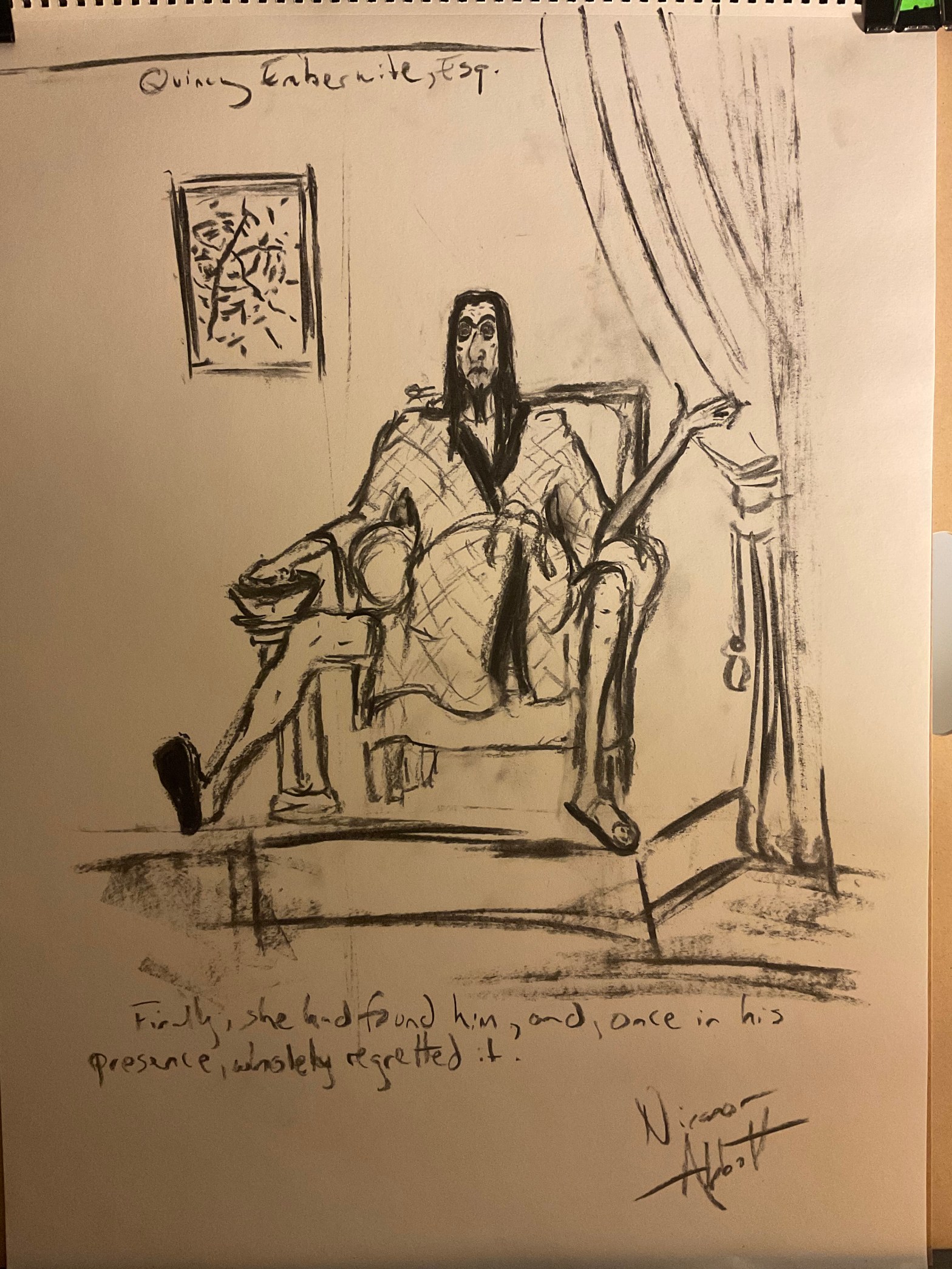
Character Sketch: Quincy Emberwite, Esq

The painted maidens escorted Alex, Jaycee, and Mina into a dim chamber. The drapes had been drawn; vertical slits of light revealed that it was day. In the dim, something moved. A juicy popping sound followed.

“Light,” whispered a low and gossamer voice.

One of the maidens turned up the sconces, revealing a greasy spider of a man. He slouched in his chair, limbs akimbo, his distended belly wrapped in a satin plaid smoking jacket, the knot tied atop his swollen gut like the bow of a present. Stringy black hair, long and lank, hung from a pasty skull. protuberant eyes lolled around. Alex wasn’t sure if Emberwite could even see. He reached out with a pale and spindly hand, plucked a cherry from a bowl beside his chair and ate it. The fruit burst in his mouth. He leaned over and spit out the pit. It bounced and rolled across the dusty floor. A third maiden emerged from behind a heavy curtain, picked it up, and put it in her pocket.

“Well, now.” He simpered and stroked his forked goatee. “The great Alexandra Hawthorne, I presume?”

“Alex.”

He shook his head, wide eyes searched her, then her friends.

“Alexandra, I think. You sought me out. That you found me…” he chuckled, “is by my will, not yours.”

Alex nodded. His voice seemed unnaturally high. Girlish. The door of her memory palace came to the fore. She could escape quickly and easily. Jaycee and Mina? Not so.

Emberwite bounced his tatty black slipper. Alex hoped he would fling it off his foot and forcibly break character to retrieve it.

“So, what brings you to me? My good looks?” He flicked his hair and posed. Someone had punched the mirror behind him, the web of cracks spreading across the glass.

Now he draped his leg over the arm of the chair, the robe shifted, but revealed nothing. “Desire? A job?” He motioned to the painted maiden standing silently nearby. “I could create an opening for you. You’d look so much better in porcelain.”

Jaycee made a retching sound. Mina whimpered. Alex kept her expression neutral.

“I seek the Man in the Golden Coat,” she said evenly.

Emberwite tsked. “So knowledge then. Boooriiing.”

The Box (Sick of Moving Variant)

AN: Hello readers: Sorry it’s been a while. The theme of the last three pieces–moving, is the tipoff. This is my last “moving” story for a while. I should be back to my regular writing schedule as of this week.

*****

“Sam!”

Toby eyed the box. Nondescript. Unlabeled, unmarred by packing tape or Sharpie. It wasn’t his. He was pretty certain it wasn’t his husband’s either.

“What?” Sam’s shout came from downstairs. He had been ensconced in the kitchen, unpacking ‘the most vital room in any house, according to Hart family ancestral tradition, thank you very much.’ That ancestral tradition Sam so espoused also meant that socks were folded, not knotted or rolled into an elastic-destroying ball, the windows were washed as part of the weekly cleaning, hyacinths were planted by the front door, and the Christmas tree went up on November twenty-sixth and came down on January seventh, hell or high water.

All this amused Toby, who left the socks in a pile on the bed, killed flowers by looking at them, and hadn’t celebrated his birthday since he was a kid. Christmas? What was Christmas? Well, it hadn’t been much before Sam.

His husband appeared in the doorway.

“Toby, love, we can’t have hot cocoa and snuggle by the fire until I find the hot cocoa. And I can’t find the hot cocoa if I’m standing up here worried because you called for me once then ignored all three of my replies.”

“Is that box yours?” Toby pointed.

“No. I don’t remember packing anything like that at all.” He picked it up. It was neither large nor heavy, about the size of a liquor box, but wasn’t exactly light either. It felt solid, more like a block than a container. He lifted the flap to see its contents.

“Wait!” Toby grabbed Sam’s arm.

“For what?”

“I just…” Toby took the box from him and set it on the bed. “I don’t think we should open it.”

“It’s hardly closed, honey.” Sam moved the flap as if it were a mouth and spoke in a high-pitched voice. “Open me, Toby! Open me!” 

“What if it’s something dangerous?”

Sam laughed. “The sellers probably left it. You think Old Lady Anderson left her portable meth lab behind?”

“Stop.”

Sam pulled Toby in close.

“Crack cocaine?” He said in that same playful tone.

“You’re mean,” Toby chuckled.

“Collection of severed fingers?” Sam whispered. “The murder weapon?” Now he sounded like a bad English butler. “She killed her husband in the bedroom with the mysterious cardboard box? Very good, sir. I’ll notify the guests.”

Still laughing, Toby pulled away. “Fine!” He flipped the flaps open and peered inside.

Sam looked over his shoulder.

“What the…”

“I know,” Toby whispered. Golden light emanated from within. He flipped it shut. The two exchanged glances. Toby leaned in and kissed his husband.

“Hide it,” Sam’s voice had gone hoarse. “We’ve got to protect it. We can’t let it be found.“

“Hide it… hide…” Toby glanced around the room. “Got it.”

The box ended up in the back of the closet, under a stack of spare pillows and comforters. Later that evening, as they watched the fire crackle, the couple discussed what to do with the sunroom, whether or not a sectional would work in the old house, and the success of a clean and organized kitchen. The box never entered the conversation; in truth, both men had forgotten about it completely.

*****

Sam found the box as he cleaned out the guest room closet.

“Toby?” He called out, then stopped. Sat on the bed. Cried again. Toby was everywhere in their house. Sam found it both comforting and stifling. Toby hadn’t believed in much, but after the diagnosis, warned Sam that if he didn’t move on, there would be a haunting until he did.

The box was unmarked, vaguely familiar. Sam flipped the lid up, peered inside, and smiled. 

“Oh,” he said as a gust of wind blew snow into his face. He smelled peppermint. “There you are.” The light inside twinkled. A familiar face beamed up at him. A rainbow scarf flapped as he pulled his hat lower. The figure motioned for Sam to join him.

Sam considered it.

The figure waved him in.

“I’d love to, honey. Really. But you also told me to live.”

The Toby-in-the-box encouraged him to enter.

“I wish I could. But it’s not time, is it?”

Toby-in-the-box offered a familiar look of frustration, then shrugged and turned. Beyond him, seated on a bench, was Old Lady Anderson, clutching her husband’s hand.  Sam cut off the jingle of sleigh bells when he closed the flaps.

“Keep it hidden,” Sam whispered. He put the box back in the closet, then pulled out everything else to pack or sell. 

*****

”Mom!” Kendra called. “Is this yours?”

She opened the flaps on the box that sat in the middle of her room. Inside, the silver and golden glitter and the twinkle of new fallen snow gave her a much needed sense of peace. There was an ice rink full of skaters, laughing racing and yelling and twirling and spinning. A couple held hands, one in a rainbow scarf. As she watched, he held tightly to the arm of his husband. Carolers sang on the bridge, and she smelled the pine.

Of course they are, she thought. How could they not be husbands.

“Is what mine?” her mother appeared in the doorway. Kendra closed the flaps quickly.

“Nothing,” Kendra said. “I didn’t recognize a box at first, but now I do. Sorry.”

Candace surveyed the room. The headboard and desk were scratched and chipped, a precious gift from their congregation. Kendra’s personal belongings filled three boxes taken from the shabby wine and spirits shop down from the charred ruin that had been home.

Whatever was in the box, Kendra would tell her in time. She hugged her daughter.

“You okay?”

Kendra nodded.

“We’ll replace what we can in time. It’s just gonna be tight for a while.” 

Candace felt the wetness of tears against her chest.

“I need to show you,” Kendra said, pulling away and picking the box off the desk.

“You sure?” 

She nodded, and showed her mother the secret.

“You gotta keep it safe,” Candace said, “but that doesn’t mean you shouldn’t look. Not if it gives you peace.”

So Kendra put the box in her closet, and added it to her calendar as a Tuesday night weekly event, so she would always remember to look. The old couple, the husbands, and a thousand other people lived in that box, and when she finally left home, she took it with her.

The Box: Fairy Tale Version

Forget April; October is shaping up to be the cruelest month. I want to play with the contrasts between short story and fairy tale, and I want to try and create more modern fairy tales. Today is a bit of play–a first draft attempt at one. Pretty sure I don’t like it, but hey, if others do, that works. Next week will be the short story version.

*****

Once upon a time there was a box. It was plain and new, and held something important. It waited alone in the upper room of a house on a long sloping street in a bustling city until men arrived and began to fill the room. 

“Oh joy,” the box thought. The men brought more boxes. A bookcase. A box spring. A mattress. And paintings. A desk and a chair.

“There,” said a pungent fellow who stacked the box with the other boxes. “All done.” Then he and the other men trooped away. The door slid shut with a click!

The next day, a couple came in and began to arrange the room. One laid a hand on the box.

“What’s this?” he asked.

The other looked over. “Dunno.” Then came the jiggle of metal and plastic and 

“Ow!” the box wanted to cry, but without a mouth that wasn’t likely to be. 

“What is that?” said the first man.

“I…wow.” said the second.

“Let’s just set this aside,” said the first, “we’ll deal with it later.” And into the closet the box went.

Time passed. Occasionally, one of the men would open the closet door, which creaked. Tip the box back. Lift a flap.

“Hm?” he would say, then put the box back.

More time passed. some days there were happy noises. Other days there were angry ones. The box heard it all, but trapped in the darkness, could never join in.

Until one day when the door was thrown open and everything emptied. The room had been filled with boxes, the bed stood up, the bookcase pulled down, and the desk chair set upside down on the desk. 

“What’s that” said the man, his voice sounded crackly. “Is that… do you remember…”

“I do,” said the second, “and I think we should leave it.”

“Really?” said the first. “I don’t know. Let’s think a little more.” Then along came some men who hauled everything else away.

“They’ve left me,” thought the box until late in the evening, when one of the men snuck the box downstairs, and set it by the heavy front door.

But the next day, when the box awoke, it was back in the bedroom.

“Did you bring this box up?” he called. 

A discussion followed.

The next night, the second man took the box downstairs, all the way out to the car.

But the next day, when the box awoke, it was back in the bedroom again.

An argument followed.

The third evening both men took the box out, each carrying one side.

Alas, the next day, when the box awoke, it was back in the bedroom.

The men stood in the doorway. One glared at the box. The other furrowed his ample brow and shrugged.

“I guess it stays,” the glaring one said. And they left.

The box remained alone until one day, some men arrived carrying boxes and bedsprings…

Roses

After the war, Victor bought a cottage on a postage stamp lot in the dying coal town of Pine Ridge. Through the spring of that year, he tried to keep to himself.

But there was Verna Cringe and a homemade cream cake.

“What brings you to our neighborhood?” She sighed. 

“Oh, the fresh air.” He thanked her for the cake. 

“Your roses are beautiful.” She stopped to sniff one of the yellow roses from a bush he had planted by the walk.

“That’s an English rose.” He stopped short of offering her a bouquet; he suspected she would mistake a gesture of friendship for something more, or worse, that her husband the longtime City Councilman might take offense. “They’re ornamentals. A bit touchy, but I do alright.”

“Are you English then?”

“I’m from Lancaster,” he grinned, and after a beat added “Pennsylvania.”

She laughed and invited him to join the horticulture society. He politely declined, then planted more delicate yellow English roses along the border beds from sidewalk to front porch. 

The next week, Antonia Busco appeared at the door with a large flat of manicotti.

“We don’t see you around town much, Mr. Williams,” she said.

“I’m very private.” 

She handed him the container. “And you’re certainly not old enough for Verna’s circle. My husband hosts poker night every few weeks. Would you care to join? I’ll introduce you?”

Pink floribundas separated the yellow English, creating a soft yet vibrant contrast that would only grow more brilliant over time. Victor was pleased.

Carmine Busco appeared next. He did not bring food. Instead, he shuffled, fidgeting with his hands from pocket to hairy neck scratch to crossed arms and back. Victor just smiled.

“My wife sent me to invite you to poker night.”

“Did she now?”

“Do you play poker?”

Victor shook his head. Carmine sighed and his hands fell comfortably in his pockets.

“Oh-okay.” He turned to go.

“Mr. Busco,” Victor called. “Perhaps we can do each other a favor?”

Carmine resumed fidgeting.

“I have a bush of temperamental tea roses in the back. Yellow, tinged orange on the edges. Quite beautiful things. Why don’t I cut you some as a gift from you to your wife?”

His awkward guest perked up. “Yeah?”

“Yes. And in return, could you… suggest… to our neighbors that although I’m tremendously grateful for the kindness so far, I’ll engage the community when I’m ready to do so.”

Carmine considered the request. “Yeah. Yeah, I think I can do that.”

Victor’s new snowy shrub roses clustered beneath the windows like eavesdropping neighbors. Much to his pleasure, the real neighbors soon stopped using food to coax him out, though not until after they had entreated him to join the Elks Lodge (lasagna), the volunteer firefighters (ladies’ auxiliary homemade filling), the historical society (a terribly dry meatloaf), and the horticulture society again (seven layer dark chocolate cake with ganache and fudge, which tempted him much more sorely than the meatloaf did). 

Meanwhile, ground cover roses crowded around the shrub roses like children at their mothers’ skirts. Along the foundation of his clapboard dwelling, he had erected stiff white trellises, soon hidden by red, pink, and yellow climbers. They hung from the fences as well, obscuring his backyard from watchful eyes. 

“Ow!” Jennie Pringle pulled her hair free from a thorny rambling rose just as Victor opened his door.

“Be careful,” he said. “They like to grab.”

“I see. You haven’t given any thought to pruning them back? You can hardly see off the porch!”

Victor smiled thinly. His eyes narrowed. She held out a plastic grocery bag.

“This is home made deer jerky. We have a farm, so Mark can bag a deer anytime.”

Victor looped a finger through the handles.

“And what club or organization would you like me to join in return?”

Jennie’s mouth moved before she spoke. “No, no no. It’s not like that at all.”

“No?”

“No. Well, I do wonder if I could have a rose or two?”

Victor raised an eyebrow.

Jennie wrung her hands.

“It’s just that… well, I saw how happy Antonia and Carmine have been since he gave her those roses, and I found out from Genevieve who heard from Mathilda at the library who found out from Francie at the general store whose husband Billy manages the diner over near the bypass that Carmine got the roses from you. And it’s hard to be a farmer’s wife, you know? Mark comes in from the field, and he’s tired, and somedays I want to hit him with my rolling pin. But I thought…I thought a rose or two might bring us a little happiness?”

Victor sighed and gave her five of his tea roses. One for her, one for Mark, and one for each of their children.

Then he transformed the backyard into a fracas of bleeding red and buttery yellow, spiraling outward in scratchy greens: waxy or serrated leaves and prickly thorns.The central birdbath and a variety of feeders and houses attracted his favorite eastern bluebirds, orioles, and hummingbirds, though jays and squirrels quarreled over meals as well. 

By the fifth year, he no longer needed the mower. People waved when they saw him, but that was rare. By the tenth year, his roses had formed a wall of color and scent that delighted all who passed. But the food and the visits had ceased. Rose bushes burst through the cracks in his walk. The ramblers and ground covers laced the front of his house in white. The climbers had broken the trellises but now clung to the roof. In the backyard, seeds had sprouted. Only the hummingbirds ceased to visit; Victor could no longer fill their feeders.

“Well, perhaps it’s apropos that a little sweetness has gone,” he said, and trudged up the stairs.

They had promised each other, but Cal had failed. He didn’t survive the war. Victor had taken possession of the ashes, and now they had all been used up, the last to plant a pair of Damask roses, one at each entrance to the house, smack in the middle of the cracked walkways. They would bloom strong and red, with a glorious, powerful fragrance. The neighbors would love them.

“Old Ghosts” / Practice with Steering the Craft #14

With this posting, my summertime project to apply the lessons from Ursula LeGuin’s Steering the Craft draws to a close. Apropos, I think, as I am also turning toward a new academic year. The calendar is already being booked. Syllabi must be revised. Teaching materials must be retrieved; the digital files have accumulated several months of digital dust. Tropical Storm Henri will make landfall later today and pass near me within the next 24 hours. Signs say change is afoot. 

But before I get to LeGuin’s last assignment, I want to reflect on some of the lessons gained from this summer’s work. It strikes me that her advice is mostly about revision—re-seeing the story as you want the reader to receive it. Yes, there have been plenty of drafting moments, but those drafts purposefully forced me to reexamine how and why I generate text. Less tangent, more emphasis on the protagonist, and more keenly aware of the limits and freedoms that come with different perspectives.

Last spring, an editor colleague of mine read the first 50 pages of my most recent manuscript. Of my protagonist, she said, “Put a camera on his shoulder and a microphone in his head.” LeGuin has helped me understand how the camera and microphone better translate into words. And I’m certainly not done with her text. I’ll probably review it during early draft phase and again between drafting and revision, just so the lessons don’t fade.

To her assignment, then. LeGuin asks the writer to cut the manuscript by half. The exercise is titled “A  Terrible Thing to Do.” Terrible? Yes, but oh, so necessary. And in the case of “Old Ghosts”, by now you must know what I have known for weeks as well: the story has changed so drastically that the title no longer fits and large chunks of text will be going. 

But it’s also no longer about the same idea. I wrote the initial draft years ago while wondering what would happen if a ghost met another ghost, and if the time of their passing might affect what they can know and see and do. But that’s just an idea, with no easy perspective for the telling and no protagonist to connect with.

Then I discovered my characters—and more. I met Clayton Morrow and his wife and child, and several other neighbors to boot. I moved from literal ghosts to science fiction to that much more accessible and terrifying “What if?” we ask in our moments of regret. That I may be stopping off in the Twilight Zone is my own choosing, but it’s not about an idea. It’s about Clay, and the regrets dwelling in his head.

The original draft of “Old Ghosts” that appeared in my very first post in this sequence was 500 words. The draft from last week, incorporating both the sequence of story built around a single action, the room description, and the A/B character dialogue was 4,000 words. So today, for my last post, I’m going to assemble a 2,000 word draft from all those pieces. I won’t post the final version on this site right away, as I will be trying to get it published. But if that doesn’t work out, maybe I’ll post it down the road. If I can get it published, I’ll post the citation for you to go find it.

Next week, I’ll be back to posting other bits of fiction and poetry and other observations that tie LGBTQ writing to the supernatural, the haunted, and science fiction and fantasy. We’ll see if I’ve learned anything…

*****

“Ghosts”

Clay hiked home, tackle box and rod in one hand, five gallon bucket with a pair of large brook trout in the other. The Sunday and Wednesday hikes always looked the same: yard, orchard, woods, then stream in the morning; stream, woods, orchard, yard, in the evenings. His routine only changed when one of his hens stopped laying. Then he ate chicken instead of fish.

His nephew, Dwight, had the tractor in the lower field, tending the garden. Most days, Clay would be out in the sun with his nephew and the farm hands, though his niece-in-law, Annie, always fussed if he stayed in the heat too long.

“Where’s your hat?” She always asked. She didn’t even look up—just kept picking blueberries or snap peas, or filling bushel baskets with peaches.

Clay would doff and wave it before flopping it back on his head. She side-eyed it, treating him like one of her brood. Dwight and Annie’s children worked the farm as well.

“Alright Uncle Clay, but I’m watching you,” Annie always warned. “There’s a cooler of water on the truck. Make sure you use it.” She always parked her pickup near the job, and she always had water or tea or lemonade on hand.

She was at once a comfort and nuisance. “No need to look after me so close,” Clay told her. “Dwight’s getting the farm already.”

More side-eye, and sometimes crossed arms to boot. “It ain’t about that, Uncle Clay.”

No wonder Dwight loved her so.

Before climbing into the woods, he turned back to watch the afternoon sunlight play on the stream. There was his fishing log on the bank, where he camped out two days a week. Over there, the place he had taught Junior to skip stones, then to fish. Junior was never good at skipping stones. Or fishing. But they both loved the sunlight.

Something shushed into the tall grass behind him. Snake, probably, he thought, and turned toward the woods. A bullfrog croaked. Furry things scuttled off the trail, rustling the blanket of leaves. Chipmunks. Squirrels. Birds darted through the trees. A woodpecker hammered a poplar. High in the canopy or under the detritus, life lived just out of view.

Round the next turn, he would see the sugar maple, and the pile of rocks beside. When Junior was a boy, they had cleared the trail of the smaller, looser stones, piling them along the way. They hadn’t tapped the silver maples in years. Maybe Dwight would do it.

Best to pass it all quickly, Clay always thought. He hated rounding the corner. Hated that tree. Hated that pile of rocks. But someone was coming down the trail. Dwight and one of his boys? A couple of the hands? Annie’s boys, sent to check on him? Clay looked up. Rubbed his eyes.

Junior.

But that couldn’t be right.

Junior, still wearing that glossy black snakeskin print jacket and those flatlander, city-slicker silver-toed boots. Half-buzzed head and pierced ears. Clay winced.

“Pop?”

The boy was weighed down by his troubles. 

“Pop, I got to tell you something.”

Clay focused on the path. The trees provided shade, but the sunlight still broke through. His fishing gear suddenly weighed him down. He clutched it, though, as if it would keep him from doing anything rash. Anything unforgivable. He set his bucket of trout on the ground to keep from dropping it. 

“Pop?”

Clay sighed.

“I’m listening.”

“I… I’m gay.”

Well there it was. The rumors about his boy and Benjamin Grouse must’ve been true.

“You let Miss Grouse’s boy have you in the shed last fall?”

Silence. Junior studied the dirt, hands in his pockets.

“I asked you a question.” His grip on the gear tightened. This wasn’t an answer he needed; he didn’t even know why he asked. Grouse had let Clara know that their boys were confirmed bachelors, and wasn’t that dandy? Perhaps they’d open a flowershop on Main, by the diner?

“Yeah.” Junior’s eyes were wet.

“Were you in love?” He had meant the question to be genuine, but the anguish that overtook his son’s face suggested differently.

“Nevermind,” Clay said, working hard to be gentle. “Go on back up to the house and help your mama. I’ll be up in a couple hours.” He eyed the stones. It would be so easy to grab one of them…just side-arm it at him. But God would know. Clara would, too.

The world went hazy and tipped sideways. Clay dropped his gear, put his hands on his knees. If the heart attack came now, Mother Nature would be conducting the service.

He looked up. Junior stood in front of him.

“Pop, I got to tell you something.”

“You’re a queer.” 

But that couldn’t be right. That wasn’t what happened was it? He could no longer deny Miss Grouse’s observations and the gossip that conveniently happened within earshot. Clara had come home crying. He pried it out of her. Dirk Markley had given her hell in the grocery store. Said something about Junior squealing like hog in the barn, his own boy Tom caught with his pants down behind. Dirk had intentionally fired his rifle upward; Tom hadn’t been seen since.

“I… yeah.”

“You let that Ben Grouse mount you like a dog in his Aunt’s garage?”

Silence.

“You let Tom Markley do the same in his daddy’s barn?”

More silence.

Clay appraised his son. The boy hunched, hands in his jeans pockets. Shiny blazer on a slender frame. How had he not known?

He dropped his gear; the tackle box landed on a rock and rolled over. trout water splashed his hip. He tapped his watch.

“I’ll be home in an hour. By the time I get back, you and anything you want should be gone from here. Got it?”

“Pop—“

“Don’t ‘Pop’ me. I don’t have any kids.”

Pain raced up his arm, his vision went hazy. He thought the trees leaned in… too close! Too close! And the buzzing in his ears… he reached out to a trunk. Steadied himself. Sap stickied his hand.

“Dad, I’m gay.”

“Your mother sent you down here to tell me that.”

The young man’s footsteps stopped.

Clay turned, set his gear down gently, and studied his son. Hunched. Downcast. Downtrodden. The boy had gone through a bit of emotional hell recently, if the rumors about Ben Grouse were true.

“You get your heart broken?”

Junior looked up, eyes wet, pleading.

Clay didn’t want to touch his son. Affection never suited him well. He disliked high drama, something four years of watching Junior on high school theatre had proven. God knew the boy excelled at it. He reached up, took his son by the shoulder.

“I take it that’s a yes.”

“Miss Grouse pulled me aside last Sunday…”

Clay shook his head.

“I don’t need to hear it, Junior. I just need to know if you’re going to go out there and try to love someone else now.”

“What do you mean?”

“I had it easy all these years,” Clay said. “Your mother’s the only woman I ever loved, and she loved me in return. But even as I say that, well, you know probably better than me, that love isn’t easy.”

Junior looked confused.

Clayton pressed onward. “I’m not good at this. I just want to know you’re not giving up on love. You may not have found it this time, but there will be other… eels?”

Junior sniffled and laughed.

“That what you go for? Eels? Well, the sea got plenty of them, too, I expect.” He squeezed his son’s shoulder. “It’ll be alright.”

He staggered, dizziness overtook him as the world went hazy. This might be it, he thought, and wondered who would find him. His gear tumbled away and he bent over, hands on his knees, breaking out in a cold sweat.

“Pop, I need to tell you something.”

“Anything different from what Miss Grouse and half the town is already telling me?”

His son had stopped. Clay set down his gear. Put his hands in his pockets, mirroring his boy’s posture.

“I guess not.”

Clay watched the light play across the path. The trees couldn’t block it all out. Shade. Light. Each had their place.

“Well,” he said. “At least, now that you told me, I can talk back to folks. Your Ma and I have been waiting for you to tell us so we can defend you properly, however you live your life. You told her yet?”

This wasn’t real. Junior hadn’t told her. He never had the chance, as far as Clay knew. When he came to the hospital in mascara and lipstick like a red light hussy, Clay hadn’t yelled or anything. He just told his boy to go home and clean up properly before his dying Ma saw what he was trying to become.

But now Junior stood here on the trail. For all the boy’s neatness—dress shirts and blazers and polished shoes—he looked a state, and not fit for the woods or the stream. Not fit for a farm, or the country.

“She told me to come talk to you.”

“You gonna leave home now?” Clay already knew the answer. After Ben Grouse and his batty old aunt, and with Dirk Markley thundering around, Junior had gained an unfortunate reputation.

Junior nodded but refused to look his father in the eye.

Clay gave him an awkward hug, puzzling over the origin of Junior’s penchant for drama. Didn’t seem to be an inherited thing, but who knew?

“Well, I guess your Ma and I are gonna see the world a little bit. Or at least, see whatever corner of it you end up in.”

His vision clouded. He dropped his gear, put his hands on his knees, tried to slow his racing heart. 

he saw it again from outside himself. The fishing gear tumbled off. The water sloshed. He hesitated before grabbing a stone. The sugar maple lent its strength. I’m in Hell, he thought. I’ve died and gone to Hell. Preacher Holland would be pleased.

he hurried home, sweating. Not pausing when Annie waved from the orchard. She had planted Clara’s flowerbeds. Mums, begonias, pansies, snapdragons—he’d neglected them. The beds had grown patchy: wild in some places, barren in others. Yes, he would have to tend them better. Annie never said a word, but Clara would have chastised him for neglect.

“You are indeed losing it,” he announced. “Too much nostalgia. Not enough work.” He left the trout bucket on the porch, its contents still swimming in tight circles.

The house was always too quiet. He stood in the living room. The mantle clock ticked away the seconds. A porcelain dancer pirouetted beside a few pieces of carnival glass on little wooden stands. Clara’s crocheted doilies protected every surface. Her fresh bouquets routinely presented in the clear glass vase had been replaced once and for all by one of Annie’s artificial arrangements. The room lacked the smell of growing things, mostly, but the peace lily remained, still filling the stand by the window, bursting in lush green that drooped over the planter. A congregation of flowers: three white, each with a trim of brown, and a fourth, smaller, green one, stood tall amongst foliage, turned sunward. The drapes were open as always; the sheer curtains, yellowed, remained closed. A set of long-retired coasters sat neatly in a rack beneath an end table lamp. The pillows, the afghans, all handmade and handed down, remained in their proper places, stacked, leaning, folded, covering. Still. Unused. A thin layer of dust covered everything. 

He pictured the stream in the hollow. Light played on the water today. A heron had swooped in, then swept away, gliding over the water. Can of peaches, beets, beans, and tomatoes lined the cellar pantry. Clara loved canning. The trout splashed on the porch. He mourned them, the old days, teaching Junior to skip stones. The three of them inviting the town to pick their own crops. Junior, Dwight, and some of the other kids carrying bushel baskets to the cars. Clara interfering with Preacher Holland so that Clay could take take of the real customers.

“Maybe it was a heart attack,” he mumbled. “Maybe I’m going.” The dancer on the mantle mourned at him with painted black eyes. That night he placed a call to New York. In the darkness of the hollow, the stream burbled along.

*****

2,086 words.

*****

Le Guin, Ursula  K.. Steering the Craft: A Twenty-First-Century Guide to Sailing the Sea of Story (pp. 124). HMH Books. Kindle Edition.