A Visit to October Country

Well. If you read my last post, you’ll know that I’m now shopping a novel manuscript that I thought I had completed two years ago, but then got enough similar feedback that I decided to re-teach myself the fundamentals and hire an editor so that I could revise it properly.

Now that the shopping–and praying, hoping, begging, and negotiating with any of several greater and lesser deities–is underway, I am turning my attention to my next projects. Yes, plural. I can’t remember if it was something I read of Neil Gaiman’s, or something he said at his talk in Boston earlier this year, but I have this sense that he keeps two projects on the fire at any time. So here are are mine:

First, know that I have three other manuscripts in various states of outline and draft. One is a bit of an unconventional superhero story. The second is a supernatural horror and adventure tale. Both are interesting, and I’ll get around to them yet, but my priority novel project is a science fiction novel on a far away planet in the distant future. There is a global environmental disaster, a certain penchant for tradition, and a crashed battleship engaged in a war unrelated to the planetary inhabitants. There are three sisters, a brother, and whole lot of squabbling. And there’s a city, and a nunnery, and a cave in the mountains. And a great deal of mis- and non-communication. We’ll see how they combine together.

But while I’m working on that, I’ll also be working on a collection of short stories. See, it goes like this:

As I was searching for agents, one of them expressed a desire on her website to find the next Ray Bradbury’s October Country–a collection of macabre short stories that illustrate both Bradbury’s fantastic prose and, unfortunately, a 1950s mindset that doesn’t fare well in light of a modern understanding of human diversity. Human condition? Yes. Human diversity? No.

Now, this is not my first experience with October Country. Several years ago, I was actually in a stage production based on some of his more accessible tales, and on opening night he called us from his home in Los Angeles to wish us well and to break a leg.

So here I am, reading this agent’s website, reminiscing on the past, and thinking about my own pile of short story efforts that could use some crafting and rethinking. And I thought, well, why not? So I purchased a copy of the book and have been alternating between reading stories and crafting my own tales built from little kernels of idea stuck between the teeth of his prose. It’s really a joy to me, because I love his prose, and he, along with Ursula LeGuin and Neil Gaiman, command the style of prose I would most like to emulate.

So here, to celebrate my embarkation on my next writing journey, is the opening to his collection, a piece that we used to open our own play.

October Country

. . . that country where it is always turning late in the year. That country where the hills are fog and the rivers are mist; where noons go quickly, dusks and twilights linger, and mid-nights stay. That country composed in the main of cellars, sub-cellars, coal-bins, closets, attics, and pantries faced away from the sun. That country whose people are autumn people, thinking only autumn thoughts. Whose people passing at night on the empty walks sound like rain. . . .”

Before I slip off to the Dreaming this evening, I did think I would answer a question you might have on your mind: what will Nic do if the agent doesn’t accept his collection? Well, easily enough–I’ll shop it elsewhere. And yes, I’m trying to land the individual pieces in literary journals as I write them.

Day 1: Intramuros & Binondo

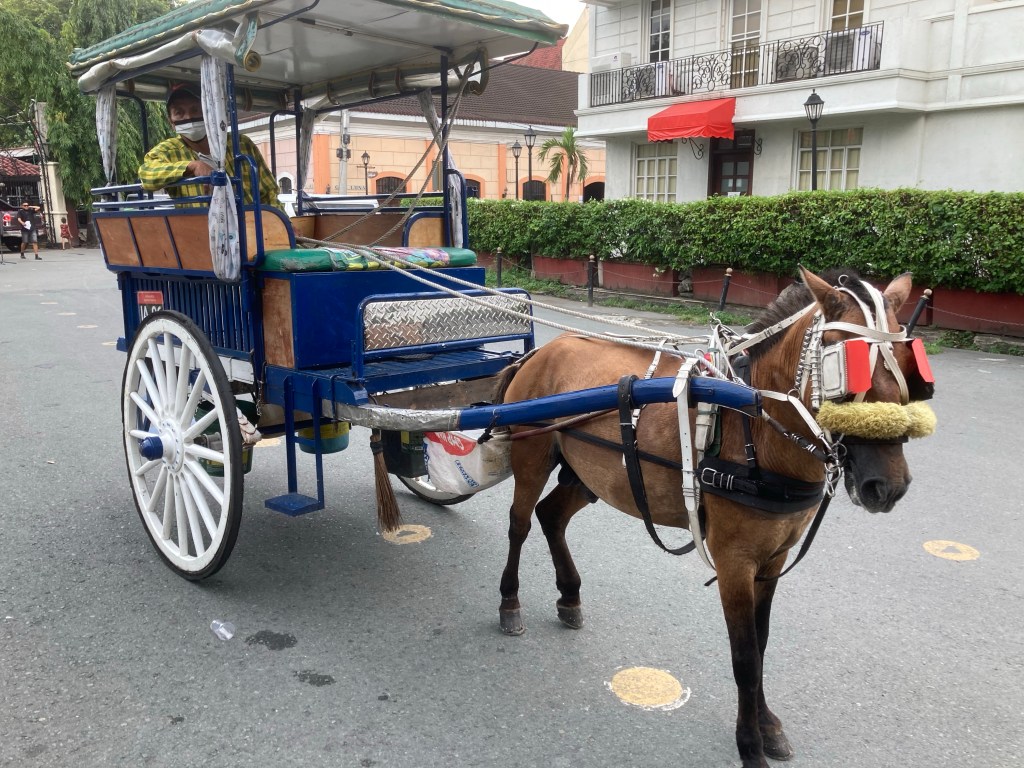
I am in awe of how Filipinos navigate traffic. It’s not just the drivers in their delivery trucks and vans and the passenger cars. But it’s also the jeepneys, motorcycle and scooter drivers, bicyclists, bike taxis, and pedestrians, many of whom push or pull carts and trolleys overladen with goods on delivery. And it’s also the kalesas—horse drawn, two wheeled carts that can fit about six people, plus the driver.

Luis navigates the Kalesa through Intramuros, while Rambo is the “small but tough” engine of the operation.

My sense of traffic is that anything smaller than a car just slides in between the rows of anything car-sized or larger, then everybody jockeys for position toward the next intersection where traffic merges in the exact same fashion—scooters and bicycles zooming inches away from delivery trucks and automobiles. Everybody stopping nearly against reach others’ bumpers (literally inches, again) to ensure a place in the pecking order once traffic resumes. It’s not for the faint of heart.

But I’m a little ahead of myself. Intramuros means “within the walls”. In this case, it’s the old city of Manila, a district of colleges and universities and several barangays (think of them as districts or villages, or perhaps more appropriately, barrios) housed within the fortress walls that also contains Fort Santiago. Because it was built as the seat of power by the Spaniards, it contains a number of historical sites, including the former home of the Governors General, San Agustin Church and the Manila Cathedral, as well as the Fort, which presents portions of the narrative detailing the imprisonment and 1896 execution of Dr. Jose Rizal, a Philippine national hero whose writing and political activity encouraging Spanish reform in part led to the creation of the Philippines as an independent nation. Our tour guide suggested Rizal was to the Philippines what Gandhi was to India. As part of the Commonplace Book theme of this blog, I’ve included an excerpt from Rizal’s Farewell, written before his execution. The full text may be found here, in its original Spanish as well as English and Tagalog.

Farewell, my adored Land, region of the sun caressed,
Pearl of the Orient Sea, our Eden lost,
With gladness I give you my life, sad and repressed;
And were it more brilliant, more fresh and at its best,
I would still give it to you for your welfare at most.

After the tour of Fort Santiago and the kalesa ride, we crossed the Binondo-Intramuros Bridge, dropping into the the oldest Chinatown in the world (well, outside of China. Our destination was the Ying Ying Teahouse which serves wonderful family style meals—chicken and pork “cold cuts”, lechon, a small mountain of fried rice, pancit and vegetables, and bowls of calamansi, which we learned how to squeeze and mix with water: our own calamansi juice drink, far less sweet than what can be purchased in premade bottles, though each are tasty in their own way.

Outside the store a white-haired and wrinkled man, hunched under the burden of a large pack, blew a sort of non-tune on a harmonica. It seemed to be a mix of his regular breathing with a mild effort at pentatonic notes, but I could be sure. He held out his hand for change, which we gave. Then, as he asked from a group emerging from the store, one of the customers handed him their bag of leftovers. And this, we were told, is part of the Filipino culture of giving. It doesn’t matter how much or how little you have; if you can give a little, you give. It recalled for me something Nanay always said: “If I can help, I will help. If you need, I will give little bit.”

Now, Nanay was, in her own neighborhood in Olongapo, a person who gave to the children if they stopped by her door. She helped the neighbors. She did what she could. This was what she always told us. Knowing this spirit of giving is a cultural value offers more insight into another principle Nanay operated with—utaang na loob—a type of indebtedness. For me, as a writer, watching the spirit with which this culture offers help, says thank you, and attends to the old children’s prayer Mom taught us:

ato aming kaunting kanin
ato ato kaunting sabaw
siya nawa

Literally, every day a little rice, every day a little soup. It will be done.

I see in this day the complications my mother’s spirit of giving created when she married a poor man who didn’t have the wealth to give. I can see Nanay bringing the same spirit of giving to bear a shield. already on the first day, I am learning how complex my mother and grandmother were. Not that I didn’t know, but simply that I didn’t understand.

When we closed our day at Binondo Church (Minor Basilica of Saint Lorenzo Ruiz and Our Lady of the Most Holy Rosary Parish), I recalled my mother once again. Inside, we found a range of depictions of Christ, from child to martyr, “Mama Mary”, a Black Nazarene, and a wood and wax body Christ under glass, akin to the incorruptible saints on display in churches across Europe. In fact, until I did further research into the Good Friday ritual “Santo Entierro”, I thought the body under glass had once been a living breathing person. To the Catholic faithful of the Philippines, of course, it was the body of Christ, which the take through the streets on Good Friday to mourn. Near each of these depictions, statues, glass encased effigies usually stood two other items: votive racks of various sizes with any number of lit candles, and a donation box. Instantly I stood in my mother’s Florida sewing room again, at the single bookshelf she had crowded with statuettes and photos of Christ, The Virgin Mary, Saint Philomena, and the Buddha in his various poses. Her rosary lay there near her incense sticks and cones. Inspiring messages and prayers to be repeated had been taped to the front face where she could read them quickly and regularly.

When we stopped at a street altar in a little alleyway behind the church, we saw the merger of these two faiths as people took three incense sticks, lit them, said prayers, and planted them in a copper bowl of deep sand before a shining cross adorned in garland and flanked by both live and dried plants. Signage indicated what to do, what to say, and how many times to repeat, depending on the strength needed. And I saw my mother again, in her sewing room, seated on a cushion, the candles lit and the incense burning, praying for the cancer to go away.

“Vogonic” Definition

Adjective. To advocate for and adhere to the weight of bureaucracy. See description below.

“Here is what to do if you want to get a lift from a Vogon: forget it. They are one of the most unpleasant races in the Galaxy. Not actually evil, but bad-tempered, bureaucratic, officious and callous. They wouldn’t even lift a finger to save their own grandmothers from the Ravenous Bugblatter Beast of Traal without orders – signed in triplicate, sent in, sent back, queried, lost, found, subjected to public inquiry, lost again, and finally buried in soft peat for three months and recycled as firelighters. The best way to get a drink out of a Vogon is to stick your finger down his throat, and the best way to irritate him is to feed his grandmother to the Ravenous Bugblatter Beast of Traal. On no account should you allow a Vogon to read poetry at you.” (Adams, Hitchhiker’s Guide to the Galaxy)

As I tried out this word in both adjectival and adverbial forms, one of my staff members jokingly punned “Vogonic Plague.”

Now I know what has gone wrong in the American workplace, including several of mine.

A Flip in Dialogue Changes a Character

So I was a fan of Alice Oseman’s Heartstopper before it became a Netflix show and a cultural phenomenon. Like many other LGBTQ people, this is one of those stories I wish I had when I was a kid, along with Saenz’s Aristotle and Dante books and the Young Avengers. Since the Netflix release, I have re-read the comic and watched the show a few times, and I noticed a particularly jarring moment that keeps jumping out at me. Note that if you have seen the show but not read the comic, there will be spoilers here.

The scene takes place the morning after Harry Greene’s birthday party, when Charlie and Nick are interrupted by Charlie’s mom, Jane Spring. The dialogue in the comic and the graphic novels is as follows:

Jane: Nick I didn’t know you were coming over?

Nick: Um, Er, Yes.

Charlie: He’s just picking up a jumper he left here last week.

Jane: You could have at least changed out of your PJs, Charlie. Don’t forget we’re going to Grandma’s later.

She leaves them in the foyer.

In the Netflix adaptation, Oseman has flipped Jane’s last two lines of dialogue and altered the verb tense:

Charlie: He’s just picking up a jumper he left here last week

Charlie’s Mom: Right. Um, well don’t forget we’re going to Grandma’s this morning, Charlie. You could at least change out of your pajamas.

In the comic description, the change out of the PJs suggests a set of norms for how to appear when a friend comes to call, announced or otherwise. But in the program, Jane seems to temporarily put up with Nick’s presence, reminding Charlie that there are other priorities and he should be prepared for them. She knows something is up, but chooses to gloss over it for the time being.

This change in dialogue and the tone in which the actress (Georgina Rich) delivers them suggests a higher level of antagonism toward Charlie and Nick than appears initially in the comics. Of course Charlie and Jane do come into conflict later (and I can empathize, recalling all the conflicts I had with my mom on the road to acceptance and mutual respect). But this flip keeps chewing on my sensibilities as a reader and writer. I suspect it’s Oseman laying a firmer foundation for the dramatic tension to come in seasons 2 and 3 (and which follow in the comic). She has done this in other parts of the TV script as well, where the medium requires a greater build than what she provided in the original comics.

I am eager to see if my concerns about Jane Spring being a greater antagonist toward Charlie will be played out in the show, and I am amused by how just this little flip in dialogue has changed the way I perceive her, from overprotective parent in the comics to borderline disdainful of her son on TV.

Fanboying…and Writer’s Block

Last night my husband and I took a brisk walk to the Orange Line, rode down to Chinatown, and had a delightful meal at Pho Pasteur. Boston is far more accessible now than it was when we lived at the end of a commuter line. I love train rides, but thankfully the time is shorter and options greater now that we only have to use the T. We don’t have to leave the car parked in a public lot, departure deadlines are more flexible—we don’t have to take the last train out an hour before we’d like, and there’s no more sitting in North Station terminal, shooing stunningly brave pigeons from snatching at leftovers.

Neither of us can tell whose birthday present it was—I thought they were his, he insists they were mine. But seeing that we’re almost halfway between the two, it’s not really a thing that matters. What matters is that he managed to find two tickets to A Conversation with Neil Gaiman at the Colonial Theatre on Emerson College campus, right across from the Central Burying Ground on Boston Common, which I found amusing, as I love The Graveyard Book. Well, I love most of his work, anyway.

The line for his books transcended what either of us thought reasonable—primarily because we’ve just had to downsize and still aren’t where we’re likely to end up staying. Why add when you know there’s more subtraction coming? So we muddled though the crowd, out of the lush red, gold-trimmed foyer and found our seats in the balcony. Dancers and musicians looked down on us: painted faces on the ceilings and walls, golden musicians awaited the proceedings above the boxes. Like many old theatres, the balcony seats were designed for the smaller people of another age, so we crowded in—a row of six couples, all strangers with less rom than eggs in a carton, perched in potentially vertiginous space. All well and good. Neil Gaiman was going to speak. Tom Waits, Nina Simone, and Johnny Cash serenaded us over the speakers in the run-up.

Gaiman came to the podium in all black—no surprises—and opened with an unpublished poem about Batman dedicated to Neal Adams, who had passed earlier in the day. He read “Shoggoth’s Old Peculiar”, “Click Clack the Rattlebag”, and closed with a poem for the Syrian refugees. He may have read one or two more pieces—I was fanboying, absorbing the moment, wherever the storyteller wanted to take me.

In between selections he answered from a stack of questions, humorously lamenting that the audience had had time to think about them, but he had not. Of particular interest to me was a question about writer’s block, which he strategically reframed as a bad writing day, which first we can own and second we can fix. The full answer was lengthy and beautiful, and I found that Hy Bender’s The Sandman Companion ends with nearly identical advice, so I’m going to close—and make my point—by sharing it here:

“I just sit down and write, regardless of how bad the stuff I’m producing is. I can do that because I know I’ll wake up the next day, look at what I’ve done, and say, ‘Yes, that is indeed not very good; But it’s mainly because this sentence here is entirely superfluous, the paragraph following it is clunky, and the scene in the middle should be moved to the top.’ In other words, when my writing facilities are on the blink for a little while, I can still rely on the editor part of my head to read what I’ve done objectively—that is, as if someone else wrote it—and fix the problems” (Bender, 262).

And now you know why I work with an editor, and why I am not suffering a block.

Follow the Camera

My editor friend and I have been talking about camera angles for some time. Several month ago, she told me to put a microphone in Nic’s (my protagonist) head and a camera on his shoulder. Sometimes it’s easy; other times, I miss the boat entirely because I get lost trying to capture the place and forget to capture the place in the context of action.

So in our conversation this weekend, we discussed the selections from my prior post (“Where Dialogue and Action Meet”), she gave me an alternate reading of the Tehanu passage by following the camera and asking “what do we see?” and “why do we see it?” Then she shared this excerpt from Chapter 35 of Dickens’s Great Expectations:

And now the range of marshes lay clear before us, with the sails of the ships on the river growing out of it; and we went into the churchyard, close to the graves of my unknown parents, Philip Pirrip, late of this parish, and Also Georgiana, Wife of the Above. And there, my sister was laid quietly in the earth, while the larks sang high above it, and the light wind strewed it with beautiful shadows of clouds and trees.

It’s a stunning passage with a clear motion for the eye, presenting the procession to the graveyard exactly as it unfolds, symbolism seamlessly woven into the scene. It’s really a beautiful thing, what Dickens has done here. My colleague’s analysis/instruction as it relates to the beauty of this scene as a means of thinking about the narrative camera was brilliant, resonating in a way that makes me wish I could have sat in her classes when we were teaching years ago. The passage is here where I can come back to it, a reminder to me now that when I think of the camera on Nic’s shoulder (or the narrator’s or anyone else’s shoulder who appears in my writing ever again), I really want to be breathing toward this scene.

And I suppose when I get a few other books in the pile read, I’ll be revisiting Great Expectations for the first time since high school, I think. Not that I’m upset by this–there’s much to discover now that I simply didn’t have the motivation to see then.

Where Dialogue and Action Meet

My current project is a first person limited narrative in which the protagonist, Nic, reflects extensively on the past and studies family artifacts—photos, documents, and the like. Sometimes he makes things up, building fiction on the narratives he learned as a child. One of the challenges constantly presenting itself is the integration of context and action into the dialogue. There are times when my vision is so clear I forget that my reader doesn’t see what I do. Et voilà, as Poirot would say. Text that does not connect. Insert David Suchet mustache-wriggle here.

So my editor suggested I look at a few sample texts. I chose two for this activity. Because I’m reading LeGuin’s EarthSea cycle so that I can have a conversation about it with one of my staff members, I pulled my first example from the early pages of book four, Tehanu, “Chapter 12: Winter”:

She sat down at the fireside with a weary sigh, and did nothing at all for a while.

A rap at the door: Clearbrook and Ged—no, Hawk she must call him—Hawk standing on the doorstep. Old Clearbrook was full of talk and importance, Ged dark and quiet and bulky in his grimy sheepskin coat. “Come in,” she said. “Have some tea. What’s the news?”

“Tried to get away, down to Valmouth, but the men from Kahedanan, the bailies, come down and ’twas in Cherry’s outhouse they found ’em,” Clearbrook announced, waving his fist.

“He escaped?” Horror caught at her.

“The other two,” Ged said. “Not him.”

“See, they found the body up in the old shambles on Round Hill, all beat to pieces like, up in the old shambles there, by Kahedanan, so ten, twelve of ’em ’pointed theirselves bailies then and there and come after them. And there was a search all through the villages last night, and this morning before ’twas hardly light they found ’em hiding out in Cherry’s outhouse. Half-froze they was.”

“He’s dead, then?” she asked, bewildered.

Ged had shucked off the heavy coat and was now sitting on the cane-bottom chair by the door to undo his leather gaiters. “He’s alive,” he said in his quiet voice. “Ivy has him. I took him in this morning on the muck-cart. There were people out on the road before daylight, hunting for all three of them. They’d killed a woman, up in the hills.”

“What woman?” Tenar whispered.

Her eyes were on Ged’s. He nodded slightly. (Kindle edition 213-4)

Tenar—the “she” of the scene—has survived an attack by a local gang the night before, and as a consequence has lied to a child she has taken in (I won’t spoil the story by revealing more; this is enough). The sentence—placement by the fireside, a description not of doing, but of not doing—it’s the barest little sentence so packed with weight, and it sets up the way she responds and reacts in the conversation that follows. She offers tea—culturally understood as a calming beverage and an act of care. A bracing cup of tea can help you through anything, right? But look at the emotions: horror that the man might have escaped, yet bewildered at his death, and upon discovering a murder had taken place, she drops to a whisper—in part to protect the child, in part possibly to absorb the news herself.

Equally important is the way action marks time and creates emphasis points in the dialogue. Ged doesn’t sit down right away. He appears in the doorway in his bulky coat, which comes off behind the scenes, while Clearbrook describes the scenes. We come back to Ged, who is a silent, methodical type, as he he has shucked the coat and is removing the protective leggings. He’s taking off his armor. Is he weary? Probably, as Ged has been equally stressed for some time. It’s his act of removing armor that teaches the reader where he is in the scene. And this is what I need more practice at—concise action to set mood and tempo.

Also of interest to me is how we know the dialogue belongs to Clearbrook. LeGuin describes him as full of talk, but in the second long passage of narration, the language does not fit a quiet man who has settled into removing his armor. The author never has to tell us it’s Clearbrook. She has foregrounded it enough with her description and the actions of her other characters—the ones who aren’t saying much.

Switching gears for a moment, when I began writing this work years ago, I had kept Tim O’Brien’s The Things They Carried in mind. My work isn’t the war story O’Brien writes, but it is a war story of sorts. And the way O’Brien deals in truth, and what constitutes it, and what we reveal and when, strikes chords with me. My protagonist Nic must contend with ideas of the truth as he redefines family and self. So here’s a segment of O’Brien’s work, the lion’s share of a chapter titled “Friends.” Two grunts—Jensen and Strunk—have gone from mortal enemies to—within the framework of war—friends, having resolved one night that if either should become “totally fucked up”, the other would put him out of his misery:

There was nothing much anybody could do except wait for the dustoff. After we’d secured an LZ, Dave Jensen went over and kneeled at Strunk’s side. The stump had stopped twitching now. For a time there was some question as to whether Strunk was still alive, but then he opened his eyes and looked up at Dave Jensen. “Oh, Jesus,” he said, and moaned, and tried to slide away and said, “Jesus, man, don’t kill me.”

“Relax,” Jensen said.

Lee Strunk seemed groggy and confused. He lay still for a second and then motioned toward his leg. “Really, it’s not so bad. Not terrible. Hey, really—they can sew it back on—really.”

“Right, I’ll bet they can.”

“You think?”

“Sure I do.”

Strunk frowned at the sky. He passed out again, then woke up and said, “Don’t kill me.”

“I won’t,” Jensen said.

“I’m serious.

“Sure.”

“But you got to promise. Swear it to me—swear you won’t kill me.”

Jensen nodded and said, “I swear,” and then a little later we carried Strunk to the dustoff chopper. Jensen reached out and touched the good leg. “Go on now,” he said. Later we heard that Strunk died somewhere over Chu Lai, which seemed to relieve Dave Jensen of an enormous weight. (Kindle edition pages 67-8).

O’Brien appealed to me when I was younger not because of the content, but because of the sparseness, the bite-sized chunks of experience that reminded me in some ways of my father’s own dinner-table narratives from his days in the Navy—which thankfully he sanitized so that his children could hear them.

As I consider this text now, I am grateful to not cling to this kind of storytelling voice the way I might have when I was younger. How much context is necessary in a person’s mortal wounding? This is Vietnam, and if it’s a jungle (we don’t know), only the language of human artifacts—weapons, aircraft, towns—distinguish it from any other jungle in which any other war was fought. If this was a jungle. We don’t know, and I’m not sure we need to. The actions are intimate. The passing out, the begging not to be killed, the touch of the leg. Staring at the stump. Death waiting on the flight out. It seems to me that O’Brien is working at once to make death mundane and to make each man’s lose intimate and numbing. Certainly it works, but I’m sure that what makes it work is exactly why it won’t work for the style of story I am currently writing.

References

LeGuin, U.K. (1990). Tehanu (Kindle Edition). New York: Atheneum.

O’Brien, T. (1990). The things they carried (Kindle Edition). New York: Houghton Mifflin.

Variations on Education

Every now and again, I think about Ambrose Bierce, who died somewhere in Mexico in January 1914, though sources disagree on exactly where and no one seems to have found the body. “An Occurrence at Owl Creek Bridge” helped me find a starting point for my love of literature and “The Devil’s Dictionary” reinforced my belief in play as a valid approach to language (I was once punished for calling one of the playground attendants a funny name–I’ll tell you sometime if you remind me). In this commonplace post, rather than quote from either, I just want to play with variations of a single word, and see how far I can abuse it. Please note that this post differs from the actual Devil’s Dictionary, which offers cynical definitions to real words.

Education (noun) is defined, officially and according to Oxford Languages and Google, as “the process of receiving or giving systematic instruction, especially at a school or university.” It is further defined as “an enlightening experience.”

Edumacation (noun) (vars. Edumacaytion, Edumacayshun, etc.)

Any variant pronunciation or spelling expressing cynicism, sarcasm, or mockery of the processes of receiving or giving systematic instruction. Often spoken or written between the 25th and 49th parallels in the Western hemisphere, including schools and universities. Exposure to such phrasing is an enlightening experience. Exaggeration of accent/ludicrousness of spelling is directly proportional to level of cynicism, sarcasm, or mockery.

Edumamacation (noun)

The process of receiving or giving systematic instruction in the art and science of motherhood. Basic lessons include traditional skills such as Sleep Deprivation Perseverance; Strategic Leftovers; and Combined Weight-Training Yoga. Advanced courses include Deception Detection; Ancestral Stories: The Coercive Moral Tale; and Rhetoric, Argument, and Logical Fallacy. Collectively an enlightening experience.

Edamamecation (noun)

The process of receiving or giving systematic instruction in legumes. Such instruction achieves enlightening experience through one of two means: beanstalk climbing or flatulence.

Edamcation (noun)

The process of receiving or giving systematic instruction in cheeses. Often confused with Edamamecation because of flatulence. Enlightening experience generally associated with wine or whine. Charcuterie selections and accompaniments optional.

Edudecation (noun)

The process of receiving or giving systematic ranch-based instruction on rural living. Enlightening experience often accompanied by saddlesores, backache, and significant financial expenditure. Fun for the whole family not guaranteed. Fun at the expense of family more likely.

A Wizard of Earthsea—from the Afterword

At first I was tempted to apologize for the number of times I have written about Ursula K. LeGuin. You may think “he’s obsessed!” Or “it’s a sickness!”

Perhaps you’re right.

My “to read” stack is deep; it includes Toole and Saramago, Corey and Saenz, Kingsolver and Russell and Munro and Gaiman. And that’s just the fiction. So why LeGuin? Well, that’s the job—the purpose—of these posts, isn’t it?

In the Afterword to A Wizard of Earthsea she writes “War as a moral metaphor is limited, limiting, and dangerous. By reducing the choices of action to “a war against” whatever-it-is, you divide the world into Me or Us (good) and Them or It (bad) and reduce the ethical complexity and moral richness of our life to Yes/No, On/Off. This is puerile, misleading, and degrading. In stories, it evades any solution but violence and offers the reader mere infantile reassurance. All too often the heroes of such fantasies behave exactly as the villains do, acting with mindless violence, but the hero is on the “right” side and therefore will win. Right makes might. Or does might make right?”

As a writer, I am finding many of my fundamental answers with her. The manuscript I am currently writing includes many wars; my editor suggested I change the title because of my frequent use of the word. The manuscript waiting in the wings takes place during a single war. I want war to be a context in these books, but not the obsession. In at least one of them, and I think likely in both, the binaries of right/wrong, on/off, yes/no must necessarily collapse. Like Ged, the characters cannot learn or grow without doing away with, or at least severely questioning, dichotomies.

It doesn’t hurt that one of my current employees has been pestering me to finish the book so we can discuss it. He is very excited. Now I am excited as well.

Fundamental to my discipline is the principle that writing is a mode of thinking, not just the demonstration of thought. When Neil Gaiman admitted in 2014 that as a young writer, he could not copy LeGuin, I wonder if the challenge at the time was that he couldn’t think like her? And therefore if the above is true, and my goal is to think like her, I’d better be soaking up everything she wrote.

Of course, this isn’t to say I have no problems with A Wizard. It’s more narrative than I prefer, and I generally dislike moments when the author warns that the story at hand is not the same as another story you might rather have, or will possibly get later. Gaiman does this in Stardust, as I recall, and the convention is definitely used in the film adaptation. It’s just not a thing I like; throw me into the deep end, please, and trust me to swim. No doubt my editor will remind me of these words later—come to think of it, they may be her words from a conversation we shared two weeks ago.

So is he obsessed? Is it a sickness? Sure. Why not. When it is time for me to finish The Sparrow and A Confederacy of Dunces, then I will. But right now we live with a daily reminder that false dilemmas and a tendency to violence-first are alive and well in the minds of everyone from autocrats to academy award winners. For the sake of my writing, I needed something different. So here I am, getting ready to start The Tombs of Atuan … but if the sea changes, as it does, I’m sure it will also spend time in the stack.

Conversations on Writing: Fiction

“There is so much less reading in schools, and very little teaching of grammar. For a writer this is kind of like being thrown into a carpenter’s shop without ever having learned the names of the tools or handled them consciously. What do you do with a Phillips screwdriver? What is a Phillips screwdriver? We’re not equipping people to write; we’re just saying ‘You too can write!’ Or ‘anybody can write, just sit down and do it!’ But to make anything, you’ve got to have the tools to make it.”

The further I go down the writing path, the easier it is to rest easy with the difficulty of the craft. I’m back with Ursula LeGuin, this time in her Conversations on Writing with David Naimon. An interview—her last—that was released posthumously. At times in this text, we know she is at the end of her career. She tells us. She has nothing left to lose, if she ever did. But it’s implied so much more in moments like the passage above.

I have taught writing for years now. That’s more about my personal life and current career than I ever thought I would reveal in this space. And I was raised in the school of “You Too Can Write!” I assigned the classical and contemporary essays, subjects of rhetorical analysis, and early on depended on the knowledge that I had studied grammar in several years of junior high and a year of high school, so therefore my students must have studied it, too. Of course, the misconceptions fell away quickly, and I incorporated at least some grammar into my teaching.

But it’s never enough. We need the metalanguage of grammar specifically and language more broadly, the perpetual refreshing when we read, not just to examine ideas, but to examine the construction of ideas. Yes, they are the tools we need in the shop, or at our own writing desks. They are the tools that help us learn not only to build, but also to see. I’ll admit a certain horror when I find that a student cannot identify a noun (person, place, thing, or idea), or the verb that the noun is either doing or having done to it. Yes, you too can write, but it’s merely throwing down the words and hoping without any sense of clear meaning or construction.

In my own work in progress, I am spending a lot more time listening to my editor, who is helping me see those passages that are narrating context, or world building, or telling what I either fail to show or show later. The process of cutting and emending is not a fast one. We don’t run with scissors, in life or on the page. So slowly, word by word, line by line, I discover my own language, my choices, and add by subtraction. At the same time, adding by addition is preferable, and the best way is not just to read good words, but to know the tools the author used to write those good words. Yes, you, too can write. But first, you must read.