Day 8: Olongapo City

This was the day I had waited years for. For the first time, we would see for ourselves the place where my mother and father met, the place where our grandmother—Nanay—had lived for perhaps 30 years.

Our second cousin—Gigi—greeted us in the parking lot of a strip mall on the edge of town. First we get a massage, she insisted, so we had massages and jasmine tea in the flickering candlelight and low-lit lamps of a second floor suite. The incense was sweet, the literature on homeopathic remedies and eastern medicine piled high on the coffee and end tables, on the register counter.

We toured the city. The bars and clubs of Rizal and Magsaysay Drives were long gone, especially after the Filipinos voted to take back Subic Bay Naval base from the Americans. It’s now an industrial and tourist zone—the military buildings of Old Cabalan have been converted to hotels and casinos, not all of which survived the global Pandemic of 2020. We stayed on Waterfront Rd., in the presidential suite of the hotel. When Gigi wants something …

Gigi was Nanay’s favorite. She was a young girl when Nanay was in her prime. They went to restaurants and movies together, and Nanay really gave her everything. Well, Gigi grew up right there in Olongapo. She told us stories: Nanay would ask if she wanted to see a movie. “Yes,” Gigi would say. Then Nanay would finish her solitaire game and away they would go. “Or when her tenants would fight with their neighbors or friends, Nanay would threaten to throw a pot of boiling water on them if they didn’t stop.”

When Nanay came to us she was highly private, trapped in a white man’s world dominated by my father, and only escaped it when the older man who hired her as his housekeeper proposed. We were ancillary to Nanay. Only after our parents divorced did we start to learn anything about her, and then it was limited.

The Subic Bay waterfront monuments are dedicated to soldiers who had been POWs, slaughtered by friendly Allied troops who sank Japanese military vessels regardless, and often without knowing, who was actually on board. There is the worker’s monument, and the monument honoring the twelve senators who voted out the Americans. A mile down the road was the dock where ships like the USS America, my father’s carrier, would dock. From there, he would get a jeepney at the Spanish Gate, and from there to Mom’s Club or the Whiskey A-Go-Go. Mom’s Club—the place where my mother was a cashier and my father decided he would like to go short time with her—is long gone.

We took Gordon Ave. around the perimeter of the city, through East Bajac Bajac. I wondered where pinatubo was.

“You’re on it,” Gigi said. “It’s a long slope from the volcano to the sea.”

Nanay’s house was a string of three apartments where her female tenants lived with a sari-sari at the end. She lived in a shack behind them. The whole place is gone, and a restaurant stands where Nanay grew vegetables and herbs and fruit to sell in her sari-sari. Lost to history is the room where my mother fed my father “the old fish heads and rice” soup, as he called it years later.

Even White Rock Beach—where they used to walk together, before my father ignored the U.S. Navy and then the local magistrate, both of whom warned him against marriage— was no longer accessible to the public. Every last vestige of Nanay’s, mom’s, dad’s places were lost to us.

Except the Spanish Gate, where a young man who thought he had all the answers boarded the jeepney that changed his life in October, 1968.

The Spanish Gate, Olongapo City, Philippines

Day 6: Honda Bay

Mom hated the lakes and rivers that we loved as children.

“They’re shitty,” she insisted. “That’s a dirty, muddy river. Don’t go in there.”

Once while camping, she evaluated the lake. “It’s freezing! And you can’t see a thing if a fish swim up and bite your pecker. The damn thing is a shitty green.” To this day, I remain uncertain if the green was the water or her predicted outcome for a bitten penis.

All this from the woman who taught us that the tidal canal separating Subic Bay Naval Station from Olongapo City was colloquially known as the Shit River. We simply never understood her vehement disgust and refusal to step into the waters of our home state, especially when we didn’t have anything that sounded as horrific as the Shit River.

Once she described the beaches of her childhood and teenaged years, perhaps hoping we would understand. “We have a white sand, and the water is clear. You can see to the bottom, and all the fish, and the lobster that will bite your toe. Our beaches are clean, and the water is warm.”

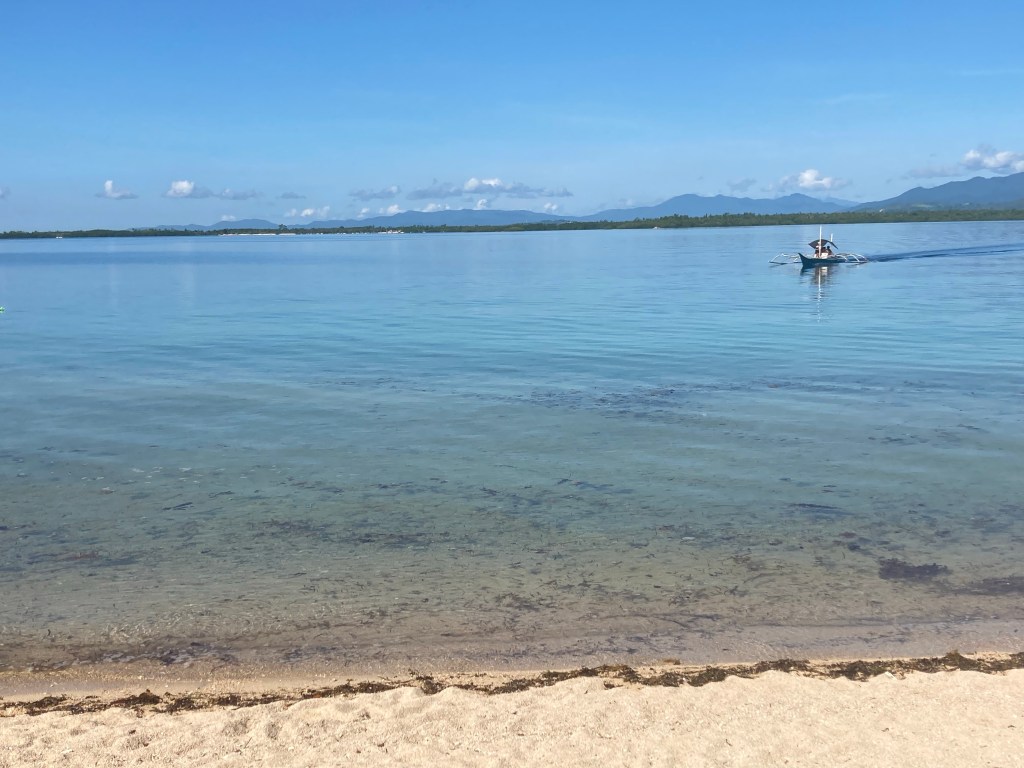
It was one thing for mom to say it, and another to see it in pictures. But for someone who has never experienced the soft white sand and endless blue sky and sea and the warm clear water of the Visayas, or Palawan, not even a picture does it justice. (Note that I call it white because she did. I have been on the white coral sand of the Florida Keys; it is hard, scratchy, unforgiving, and not a blessed thing like the sand of Honda Bay, Palawan). So here is a photograph from the trip, and I share it knowing that no matter how beautiful it may look to you, it was ten times more beautiful when I stood there.

The clear water around Starfish Island, Honda Bay, Puerto Princesa, Palawan, Philippines

I can only guess that my mother or grandmother visited Palawan. Mom was raised in Quezon City and spent her time between Manila and Olongapo. I know she visited a couple beaches in central and southern Luzon. Nanay crossed the islands on her own at twelve years old, from an island near Surigao del Norte to Manila to Olongapo. No doubt she grew up seeing this kind of scene. But for those of us who knew them, fought with them, loved them, mourned them, and now remember them, this was as close as we will ever get to knowing what Mom so clearly treasured.

We spent the day island hopping on the Trishia Mae, a banca large enough to hold not only our party of nine but another party of four and three crew members: Capt. Roy, Jody, and John Lee. First they took us to Starfish Island, where we swam around the net-protected area and tried snorkeling a little, though none of us in our group were so brave as to venture out past the drop off.

While we swam and searched for starfish among the rocks and coral remnants, our guide, Jake, prepared a picnic lunch: Sisig, shrimp, cucumber, bitter melon and shrimp paste, whole tilapia, and fresh pineapple. I did not know how much I loved pineapple, but I think this was the day when I became certain of two things: first, I love pineapple; second, until I went to the PI, I had never eaten a properly ripened pineapple. No candy is as sweet.

From Starfish Island, we traveled to Luli Island, where I found myself feeding bread to a school of black fish with hints of vertical stripes. Again, we stayed among the rocky patches where the coral had died—the thriving reef areas were not accessible to those of us on the boat tours, which is a good thing, given how delicate a reef ecosystem is and how quickly people have destroyed them through careless interaction.

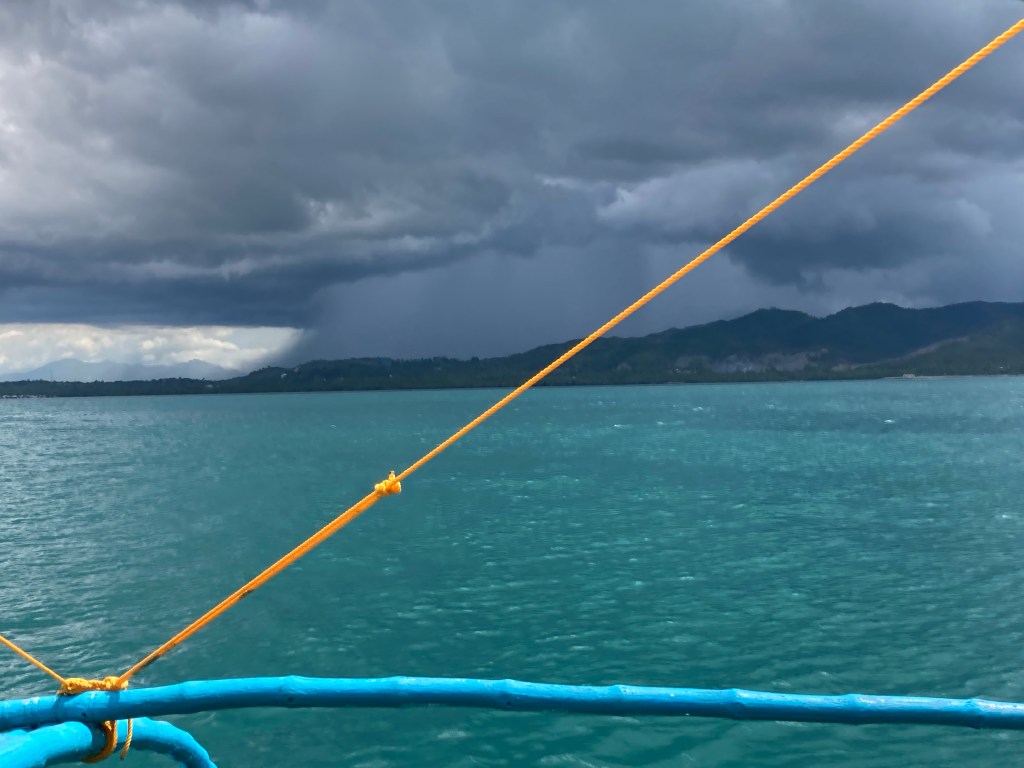
By the time we reached Cowrie Island, I opted to remain in the shade of a thatched pavilion, one of many beneath a grove of palms. I had worked myself into the worst case of sunburn I’d had since childhood, but it was well worth it. Back on Palawan, dark clouds had rolled over the mountains.

A storm crosses Palawan

By the time I took this photo, we were already on the Trishia Mae headed back to port. Nearly all the bancas loaded and left together in an effort to beat the weather—a flotilla of blue and white, confident boatmen, sure in their lives on the sea, returning skittish tourists to the city.

I won’t ever fully understand my mother or grandmother. When I was young, I didn’t listen. Neither of them could explain what it was like to live immersed in this tropical world. But I laughed as I reflected on the fact that none of my appendages had been bitten that day. I finally think I understood them a little bit more. Why Mom wouldn’t go in the water in the states. Why Nanay, even as her health deteriorated, still dreamed of going home to the PI. I can’t regret not sharing with them; they were both dead and gone long before I had the means and incentive to make the trip. But with our vacation nearing its end, we had one more stop to make, to a place where I hoped I might discover the most about who my people were: Olongapo City. The place Mom and Nanay had called home.

Day 5: The Subterranean River

We landed at Puerto Princesa Airport, Palawan, on a blue day in late June. In truth, all of Palawan is deep azul y verde. Crayola had the Philippines in mind when they developed their blues and greens. Cirrus clouds feathered the deepest, almost space blue. Cumulus white cotton formed a bed upon which the lighter tones rested. Gulls and herons glided in that space between blue-of-sky and green-of-jungle, of beech and palm, ficus and mangrove. Birds of paradise unfolded everywhere, it seemed. Rainforest green and its trim of tan sand gave way again to blue-green sea. Sulu Sea. Western Sea. Places where sky and earth gave way to water.

We set out the next day from the New Casamila Hotel, a dozen people in a white van bouncing and jostling through Puerta Princesa and into the mountain rainforests. Skirting Honda Bay to the east and Ulugan Bay to the west. We followed a concrete slab road, little sari sari stores here, farms over there. A carabao grazing under a palm. Limestone formations revealed the oceans’s affect on the vertical mountain cliffs.

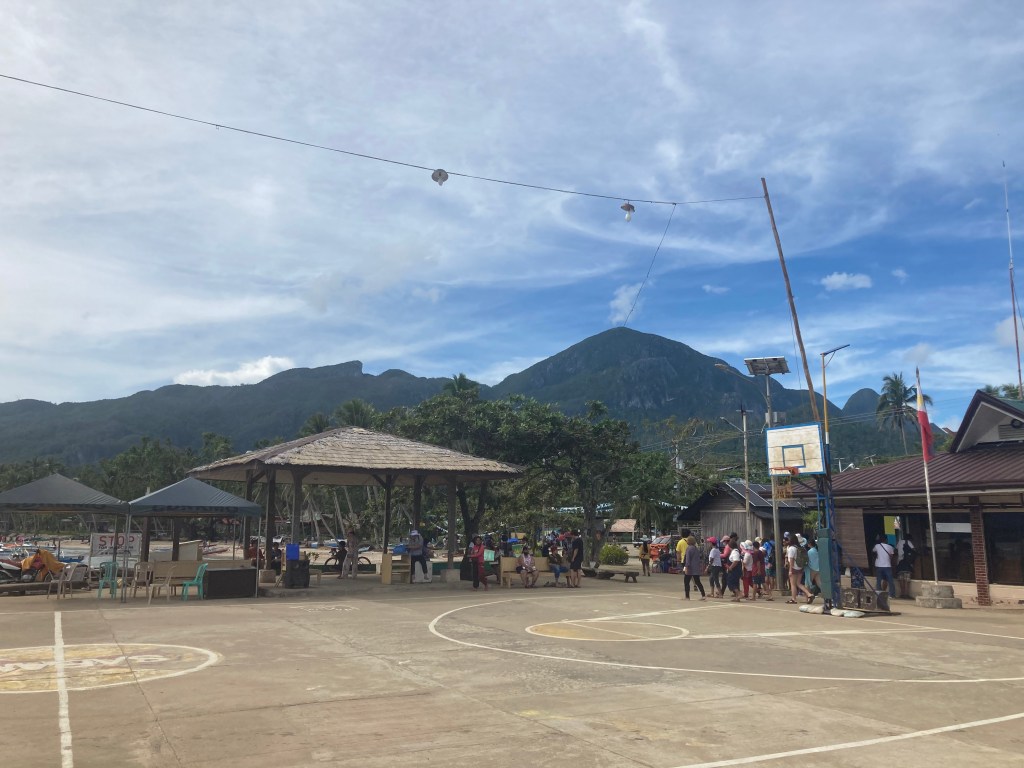
Cabayugan is a little village on Saint Paul Bay. Mostly dirt roads and crowds, though there was a resort off to the left. Not our speed. We waited on a concrete expanse, flat on top and sloping into the Bay. A beach house of sorts good at one end, where we were encouraged to take care of business.

“Once you’re on the boat, you’ll have to hold it. There’s no place to go until you get back,” we were warned. A basketball court had been painted between the beach house and the bay. Teenagers shot hoops and talked smack about each other’s skills. We didn’t know the words; we knew the tone. Vendors waved their bracelets and necklaces, floppy hats and t-shirts at us from the moment we stepped out of the van.

“Five dollar! Ten dollar!” They said pressing them into our hands.

“Hindi! Walang peso!” We were taught to reply.

All of us seemed to have exchanged shoes—the locals turned English-speaking capitalists; the westerners borrowing limited Tagalog to avoid an unnecessary sale. There would be time for gifts after the visit.

Awaiting the banca in Cabayugan

We were ushered down a ramp and on to a little platform, from which they loaded us into small banca boats—motorized fishing boats stabilized by bamboo outriggers attached to both sides. We bounced across the bay to the rhythm of the waves, arriving soon at a wide sandy beach secluded behind a limestone cliff. The beach and the river entrance are on opposing sides of a small peninsula, so up the beach and through a little jungle of palms we trod, receiving helmets and life jackets from pavilions at either end of the wood plank and beach sand trail.

The Subterranean RIver is a UNESCO World Heritage Site. We paired up by twos, heaviest toward the center, and another guide paddled our boat into the cave. The acidic smell of bat guano was immediate; I remembered the grain silos and dairy barns I had visited or walked past in my youth. Soon we operated with only the headlamp from the guide, a monotone man with a dry sense of humor who described every formation—color and shape— in terms of his culture. The market place’s color suggested fruits and vegetables—reds and yellows and greens. In the cathedral, shrouded women prayed to the face of a bearded man beneath a high ceiling. Mushrooms. Carabao. Bats, both figurative and real. The swallows that darted around the entrance quickly ceded space to the swooping rodents.

“The light colors are from water through the mountain. The dark colors are from the bats,” he said.

Some time later, in the middle of a dripping cavern with a ceiling several stories high, he asked if we wanted to see what the trip was like in the dark.

“Sure,” my nephew said.

“Close your eyes,” the guide deadpanned, then switched off his light. We sat in the boat in the darkness beneath the mountain for a minute or two, feeling the cool of the earth and the drip of water and the squeak flap of bats. I could not help but feel a certain momentousness upon emerging from the darkness. Was it a birth? An expulsion from the earth? The knowledge that we had gone into a place extraordinary in the rhythm of our lives? Indeed, the whole trip had been extraordinary. I wonder what my mother, and what Nanay would have thought?

They were not from Palawan. Mom was born in Manila. Nanay in Surigao del Norte. But this land was their land. Mom had complained about the lakes and rivers in our home state, describing them as muddy and gross. Now we knew why. And Nanay? She had crossed these blue-green waters alone when she was little more than a girl. Surely she had watched the fish beside her boat, just as I was doing now? Did she travel by banca, or was there a larger boat to transport her from her home?

Day 3: Villa Escudero Plantation and Resort

Nanay was a farmer’s daughter from Dapa, an island off the coast of Mindanao, in the Surigao del Norte region. She moved to Manila and then Olongapo City, both across the Visayas, over 700 kilometers from her home. I hardly expected to find any hints about her life at a hydroelectric plant-turned-sugarcane plantation-turned coconut plantation. But at Villa Escudero, I was in for a surprise.

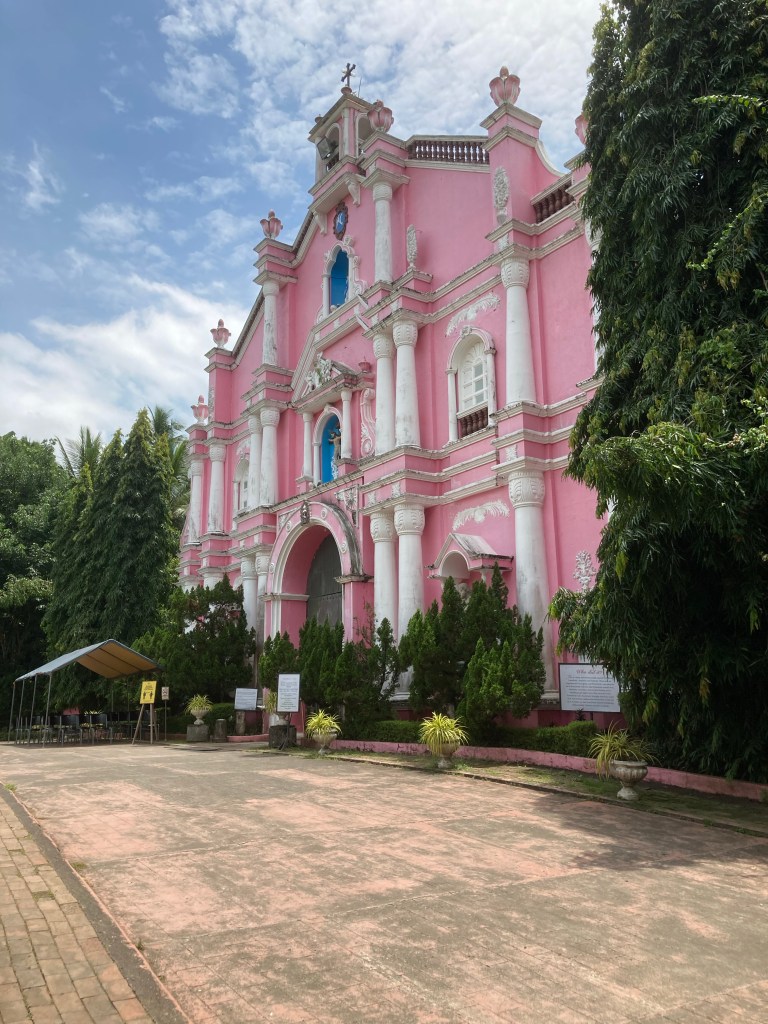
Our guide brought us there because we wanted a sense of the diverse cultural heritage and history of the Philippines. Of course this can be done in many ways. Books are one way, though they don’t give the reader lived experience. Slowly touring the countryside over many visits is an expensive and authentic way to get at the culture, but it would be slow, and there is lots of room for error in language and meaning. Because Filipinos are a people whose hallmark identity has been deep and friendly hospitality, it came as no surprise that our guide chose this plantation resort with a waterfall buffet as a place to get a sense of the agricultural history while spoiling us a bit. But we did not expect the “pink cathedral,” the former plantation church turned private museum, home of art, historical and political artifacts, and scientific specimens from across the Philippines.

The Private Museum at Villa Escudero

The main floor of the museum is dedicated to the Escuderos’s extensive collection of Christ figures, many life-sized, and the majority carved in the Islands. Most look distinctly Spanish, with sharp features and narrow faces. An adjacent aisle holds the family collection of animal specimens—everything from spiders and crabs to birds, leopards, and snakes. Most of the collection dates back to the late 19th and early 20th centuries; I couldn’t help thinking of Don Placido and his son Don Arsenio as game hunters in the model of Teddy Roosevelt. They were all contemporaries, at any rate. But in the next wing, the museum displayed the cultural trappings and artifacts of the major indigenous people of the nation.

“I am Ilocano,” our guide explained, “and here you can see the kinds of things that we have at home, even today.” The mannequin woman on display stood outside her hut overlooking vast rice paddies. On the ground beside her sat a figure of a man carved from dark wood, the size of a nine or ten year old. His knees were pulled up to his chin, and his arms wrapped around his legs.

“This is the representation of our ancestors,” our guide said. “To help ward off evil.”

At the next display she stopped.

“Did you say your Nanay was from Surigao?”

I nodded. “Surigao del Norte.”

“Well, this would have been her people!” She was very excited. “Unlike the Ilocanos, who worried about the next world, the Surigaonons are showier. They like to display what they have.” The mannequin was dressed in more colorful attire than any of the others, in this case wide stripes. A sunka board (similar to mancala) nestled in an ornately carved stand nearby. I reviewed the photos of Nanay—she always wore colorful clothes, at times mismatched or clashing, and was proud of her accomplishments.

“I may be old woman, But I have de money. I am not estupid,” she would remind us every visit. her old sunka board now sits in my living room.

I looked to my sister, who shared a knowing look. we both saw Nanay there behind the glass. her style, her trappings, the traces of her customs were suddenly revealed to us. Well, the corner of the page was pulled back a bit, and we could tell there was a richness there we could never fully know. But a little more of who Nanay was had been revealed.

Day 2: A Short Ride in a Fast Machine

My apologies to the composer John Adams …

Barangay San Antonio los Baños Laguna. Early in a monsoon season that has lacked rain.

If Philippine farmers get one crop of rice a year, they are happy. Two would be a miracle. But how can they plant when the monsoons will wash the crop away? It could come at any time. Still, some farmers take their chances.

Rice is harvested by hand. Here, it is dried and milled by hand, weeks stretching into months for each process. Each grain left behind is a loss of income, just as each grain left on a plate can never be recovered, our guide explains.

“That’s why we never leave it behind. You can never get it back, in this life or the next.”

The Philippines population has grown so quickly—by nine million people from 2016 to 2022, that in the past several years the country has gone from being a major rice exporter to a major importer. Enter the IRRI—the International Rice Research Institute—based in the PI since 1960. Today, it continues research and development on matters of sustainability, nutrition, and food security. It works to create healthier types of rice, engage people in the process to reduce poverty and strengthen nutrition. They are headquartered here in Los Baños, and we are about to take a two kilometer rail ride from the road skirting Laguna de Bay to just short of the gate. This is not like Amtrak or the Great Western. It’s a symbol of Philippine industriousness and a can-do, make-do approach to life. As riders, we will contribute financially to the community in a much smaller but no less important way.

The hot springs area we travel through is not all tourism. There are farmers, like my great-great grandfather Isidro, planting paddies and harvesting rice. Store fronts—some modern, some little more than shacks—bear the names of women, mostly: Clarice’s Sari Sari (everything), Ester Food House, Rose’s Fruit Stand, JenJoyce Sari Sari, Daniela Buko (young coconut) Pie. Janet, Josephia, Lanie, Nancy … they all have sari sari crowded along the roadways. But the men have some, too. Jonathan Auto Supply. Jhari’s Food House. Benji Poultry Supply. Alston’s Store.

Our guide tells us that under the Americans and Japanese, roads and stores had numbered names. 11th Street. Store 32. That sort of thing. But after the war, shop owners named their stores after women. Sometimes the women (or men) were known proprietors, but just as often, a woman’s name was used because it evoked gossip and conversation— an invitation to chat, to hear the news and local happenings.

Today, we jog and jockey among the bike taxis and jeepneys as usual. A single beep beep warns a scooter to one side, or chases a dog from the road. Or wants a pedestrian not to wander to far into the road, for at times there is little shoulder and no sidewalk. The road is the only place to travel whether by engine or on foot. We stop at a place where the railroad crosses, turn alongside the track, and park in a basketball half-court, depriving the children their place to shoot hoops—but only for a little while.

First we receive a breakfast of warm tofu and fruit with syrup, served in a plastic Dixie cup the likes of which we might find in our bathroom cabinet. It is sweet, silky smooth, and warms our insides as it goes. While we are breakfasting, the men prepare our cars. Jobert and Dante are two of them. They are mechanics and maintenance crew who have affixed the bearings of long dead cars onto wooden platforms, and on to each platform they have added a wooden bench. Each car can hold up to seven people. In our group, we only ride two per car. This means we will pay for more cars, but we also tend toward the plus sizes.

Then the two men per cart change metaphorical hats, from builders to conductors and engineers—and engines. Jobert and Dante push my niece and I the two kilometers, past the shacks and sari saris of the people who live along the track, past dogs and cats. We nearly hit a trio of pigeons. Some people eye us suspiciously. Others wave. The children watch by the rail side, just careful enough to avoid the cart as it rumbles past.

Riding from the Laguna Road to IRRI

There are other men stationed along the way, their carts on the track, awaiting anyone who needs a quick ride up to the highway or down to the IRRI neighborhood. as we approach, they remove their carts, replacing them after we pass. A couple road crossings present challenges: scooters and bicycles dart across the rail. A truck passes in front of us. Once it was the reverse; everyone stopped for the train. There’s a trestle crossing a ravine. Someone’s lola (grandmother) waits to cross, plastic grocery bag in each hand, face expressionless, until we have passed.

We stop at the fence beside IRRI property, a place where the elbow in the road goes one way to town and the other along the adjoining rice paddies. We disembark, and the men turn our carts around. Our guide asks the men if they like the work.

“I am happy,” Jobert says. “I get to provide for my family.” After we return, we know he will check the cart, oil it to keep the bearings working, and wait for another person to transport. At ten pesos per trip, they need to make at least ten trips a day. By taking us, they have made the day’s wages in one go.

“Next time, you come,” our guide says, “they may not be there anymore.” The rails are being reclaimed and rebuilt, and the state is relocating families who live in land slated for renewal into public housing with electricity and water. It’s an improvement, but for men who have built their livelihood, it is also a challenge, trying to determine where the next job might be. For now though, we have learned a little more about the people and their ingenuity.

Our van has moved to a recently emptied parking spot. Three boys shoot hoops; one sports a worn #23 LeBron James Lakers jersey. His friends tease him when his shot goes under the net.

Day 2: Pagsanjan

This is my mother’s country: a symmetry of canyons, the first bedecked in Tagalog, Chinese, and English signage amidst a tangle of cables; the second sedimentary rock in striated layers, purple and white streaks cutting toward the river below, a lush and wild arrangement of tropical life draped, bushy, twitching with birds and dragonflies in black, neon blue, and yellow. A baby monkey crouches on a rock, watchful, then leaps into the green river and swims away. My mother grew up in Quezon City and lived in Manila. Her mother—we called her Nanay because she didn’t like Lola—grew up in a farming village of rice paddies and coconut palms, then moved to Manila, then to Olongapo. No doubt her island was just as green when she left it.

Gilbert and Ben meet us in a dugout canoe at the Casa del Rio dock, a concrete and stone ledge two dozen steps below a cliff side resort. The backyard pavilion, close and green and overlooking the river gorge, feels naturally grown from a grove of kamagong and palm. They wave to us from their boats, two of the six boatmen, two boatmen per canoe. We are nine tourists, and they load us three per boat, for balance, to ferry us upstream through the rapids to the Pagsanjan (the j has a y sound) Falls. This was Nanay’s country. The boatmen keep count—of weight, of balance, of distance and rapids, of rocks and steps and strokes of the paddle and a thousand other calculations. And this was Nanay counting: strawberries from the patch, strokes of a broom on the walk or buckets of grass snipped from the patch in front of the porch, the vinegar and soy, the pieces of meat and chicken. The dollars she kept in her white envelopes.

Casa del Rio, looking up river toward the gorge, the rapids, and beyond, Pagsanjan Falls.

They paddle swiftly against the current. A man in a plaid shirt arrives in a canoe fitted with a small motor. Gilbert, a sinewy young man with a silky black ponytail, grabs a rope from the back and attaches it to the front of our canoe. After all three canoes are linked, the boatman motors us up toward the first rapids. We cut through the Lillies and swarms of dragonflies. He pulls us through the a punishing stream of engine fumes. The motor sound echoes off walls resembling pebbly dinosaur skin, it rattles inside little alcoves and niches in the rock. A yellow butterfly flits across vines against black rock.

The rapids are low; the water shallow. Gilbert and Ben jump out of the boat. Barefoot, Gilbert deftly pushes us off the rocks with his feet as he pulls us upward. Sometimes there are pipes embedded in the rock across the water, creating a set of risers that make it easier to slide us upward. Gilbert dances across them. Had I tried it, I would have but cut and bruised and twisted and sore. Ben pushes from behind, from the side, and once, her and Gilbert both pulled us from the front of the boat. When he climbs back in, sometimes he grunts or exclaims, as if in pain. He’s got a belly, though I can’t see how.

In the pools between rapids, Gilbert sinks in neck deep, cooling quickly. Behind me, Ben scoops out excess water with a sandal. We bought them drinks from an old woman who paddled out on the river to sell them: bottled water and coke. She does this a lot. We are to pay her after, 350 pesos per boat. At one point, they ask how much I weigh. I give them the number in pounds. They ask for it in kilograms. Metric conversion is not one of their calculations; I am going up the river either way. I give Ben my unopened water. It’s the least I can do.

When we reach the falls, the men take a break while another group put us on a thick bamboo raft and float us right under the falls and into the cave beyond. We swim a while, take photos. The water is warmer here. The spray is sharp, pounding and great on the back and shoulders. Hot springs are popular in this part of southern Luzon, and we benefit. Relaxed, rejuvenated, and thoroughly saturated, we load up and the boatmen take us back. The trip is faster, and they need to disembark less frequently. The call ahead, Tagalog syllables to let others know we are coming down the rapids. A call back from another boatman at the bottom would bring us to a temporary halt. We pass now familiar sites: A tower of some kind leftover from the Americans or Japanese. White cows grazing on both banks. A few huts with only two or three walls to keep out the rain. Down the river we race, and soon there are children swimming beside us. Houses on the cliffs in Japanese or Spanish styles. A white statue of the Virgin Mary tall as the neighboring trees, gazes down serenely as we pass below her. This is my mother’s country: when I see the Virgin Mary at home, I think nothing of it. When I see the Virgin Mary here, I think of her prayer altar, second shelf from the bottom of her sewing room bookcase, bedecked in Catholic and Buddhist imagery, Mary prominent among them not by size but by frequency.

Gilbert and Ben work one day a month. There are a thousand boatmen in need of work, but no tourists. The trip takes about two and a half hours. It is grueling and it is dangerous, especially for the feet and legs. The pay is low. A good tip makes all the difference when you must provide for a family on one day of work a month. Back in the Casa del Rio, the staff of young women and a couple women who know better than to get old serve us homemade chicken BBQ, lumpia, stewed vegetables, rice, mushroom soup, and a tapioca with bananas and jackfruit. We drink buko water straight from the coconut.

Coconut water, straight from the fruit.

The people of the resort are friendly, generous, kind, and in a state of perpetual smiles, but they, too, operate under a harsh climate. No tourists. They ask us to return and invite us to stay in their poolside cottages. One could hardly say no to their hospitality, and that seems to be the way of things here. This is my mother’s country. This is Nanay’s land. It is as beautiful as they said it would be. It is sometimes as painful as their lives suggested.

Day 1: Intramuros & Binondo

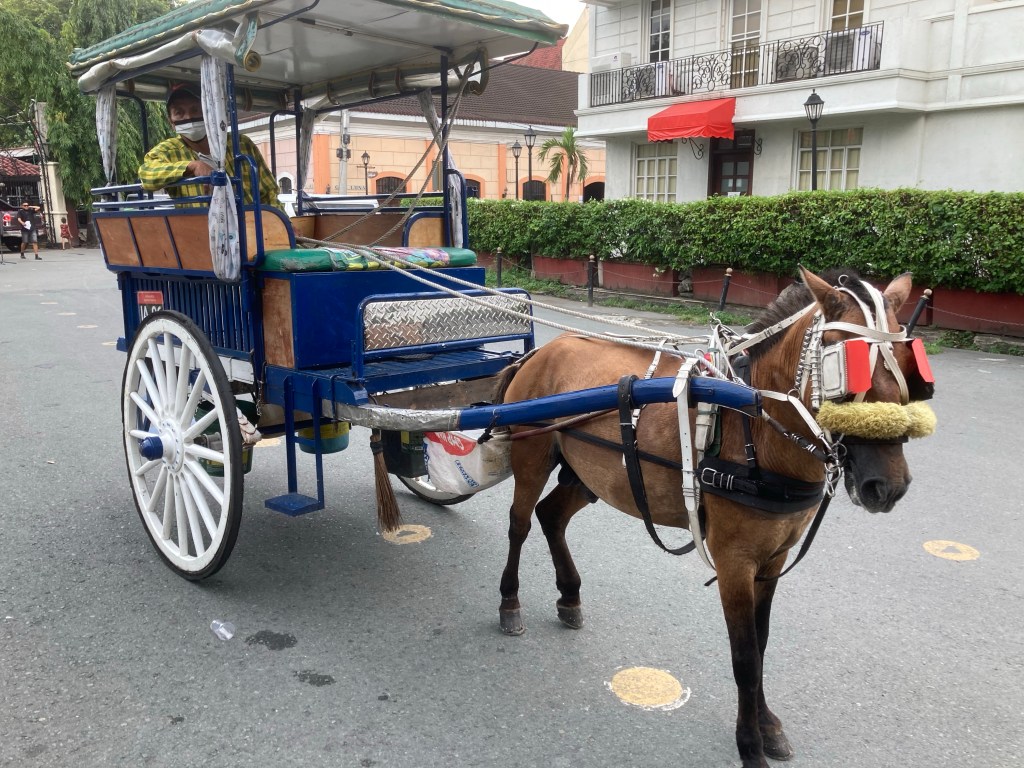
I am in awe of how Filipinos navigate traffic. It’s not just the drivers in their delivery trucks and vans and the passenger cars. But it’s also the jeepneys, motorcycle and scooter drivers, bicyclists, bike taxis, and pedestrians, many of whom push or pull carts and trolleys overladen with goods on delivery. And it’s also the kalesas—horse drawn, two wheeled carts that can fit about six people, plus the driver.

Luis navigates the Kalesa through Intramuros, while Rambo is the “small but tough” engine of the operation.

My sense of traffic is that anything smaller than a car just slides in between the rows of anything car-sized or larger, then everybody jockeys for position toward the next intersection where traffic merges in the exact same fashion—scooters and bicycles zooming inches away from delivery trucks and automobiles. Everybody stopping nearly against reach others’ bumpers (literally inches, again) to ensure a place in the pecking order once traffic resumes. It’s not for the faint of heart.

But I’m a little ahead of myself. Intramuros means “within the walls”. In this case, it’s the old city of Manila, a district of colleges and universities and several barangays (think of them as districts or villages, or perhaps more appropriately, barrios) housed within the fortress walls that also contains Fort Santiago. Because it was built as the seat of power by the Spaniards, it contains a number of historical sites, including the former home of the Governors General, San Agustin Church and the Manila Cathedral, as well as the Fort, which presents portions of the narrative detailing the imprisonment and 1896 execution of Dr. Jose Rizal, a Philippine national hero whose writing and political activity encouraging Spanish reform in part led to the creation of the Philippines as an independent nation. Our tour guide suggested Rizal was to the Philippines what Gandhi was to India. As part of the Commonplace Book theme of this blog, I’ve included an excerpt from Rizal’s Farewell, written before his execution. The full text may be found here, in its original Spanish as well as English and Tagalog.

Farewell, my adored Land, region of the sun caressed,
Pearl of the Orient Sea, our Eden lost,
With gladness I give you my life, sad and repressed;
And were it more brilliant, more fresh and at its best,
I would still give it to you for your welfare at most.

After the tour of Fort Santiago and the kalesa ride, we crossed the Binondo-Intramuros Bridge, dropping into the the oldest Chinatown in the world (well, outside of China. Our destination was the Ying Ying Teahouse which serves wonderful family style meals—chicken and pork “cold cuts”, lechon, a small mountain of fried rice, pancit and vegetables, and bowls of calamansi, which we learned how to squeeze and mix with water: our own calamansi juice drink, far less sweet than what can be purchased in premade bottles, though each are tasty in their own way.

Outside the store a white-haired and wrinkled man, hunched under the burden of a large pack, blew a sort of non-tune on a harmonica. It seemed to be a mix of his regular breathing with a mild effort at pentatonic notes, but I could be sure. He held out his hand for change, which we gave. Then, as he asked from a group emerging from the store, one of the customers handed him their bag of leftovers. And this, we were told, is part of the Filipino culture of giving. It doesn’t matter how much or how little you have; if you can give a little, you give. It recalled for me something Nanay always said: “If I can help, I will help. If you need, I will give little bit.”

Now, Nanay was, in her own neighborhood in Olongapo, a person who gave to the children if they stopped by her door. She helped the neighbors. She did what she could. This was what she always told us. Knowing this spirit of giving is a cultural value offers more insight into another principle Nanay operated with—utaang na loob—a type of indebtedness. For me, as a writer, watching the spirit with which this culture offers help, says thank you, and attends to the old children’s prayer Mom taught us:

ato aming kaunting kanin
ato ato kaunting sabaw
siya nawa

Literally, every day a little rice, every day a little soup. It will be done.

I see in this day the complications my mother’s spirit of giving created when she married a poor man who didn’t have the wealth to give. I can see Nanay bringing the same spirit of giving to bear a shield. already on the first day, I am learning how complex my mother and grandmother were. Not that I didn’t know, but simply that I didn’t understand.

When we closed our day at Binondo Church (Minor Basilica of Saint Lorenzo Ruiz and Our Lady of the Most Holy Rosary Parish), I recalled my mother once again. Inside, we found a range of depictions of Christ, from child to martyr, “Mama Mary”, a Black Nazarene, and a wood and wax body Christ under glass, akin to the incorruptible saints on display in churches across Europe. In fact, until I did further research into the Good Friday ritual “Santo Entierro”, I thought the body under glass had once been a living breathing person. To the Catholic faithful of the Philippines, of course, it was the body of Christ, which the take through the streets on Good Friday to mourn. Near each of these depictions, statues, glass encased effigies usually stood two other items: votive racks of various sizes with any number of lit candles, and a donation box. Instantly I stood in my mother’s Florida sewing room again, at the single bookshelf she had crowded with statuettes and photos of Christ, The Virgin Mary, Saint Philomena, and the Buddha in his various poses. Her rosary lay there near her incense sticks and cones. Inspiring messages and prayers to be repeated had been taped to the front face where she could read them quickly and regularly.

When we stopped at a street altar in a little alleyway behind the church, we saw the merger of these two faiths as people took three incense sticks, lit them, said prayers, and planted them in a copper bowl of deep sand before a shining cross adorned in garland and flanked by both live and dried plants. Signage indicated what to do, what to say, and how many times to repeat, depending on the strength needed. And I saw my mother again, in her sewing room, seated on a cushion, the candles lit and the incense burning, praying for the cancer to go away.

First Impressions—My First Visit to the Philippines

Taking a detour from my usual work because I’m on vacation/on assignment doing research for my book… in the Philippines!

I’ve made a few discoveries:

—JAL Airlines may be the friendliest airline I’ve ever flown, and that includes some very good experiences on Virgin Atlantic and JetBlue. I have found that all flight attendants are courteous and friendly, but the JAL folks seem to have down to an art, right up to making you feel good about waiting to disembark after a 13 hour flight.

—And the JAL food isn’t bad either. Yes, the choices are limited, because, well, it’s airline food, but it still works the entire palate, and that goes a long way toward satisfying hunger in a real sense—quality and diversity over quantity.

—The friendliness and hospitality of Filipinos is legendary (to some of us), and it really is true, from Roy, the attendant at Ninoy Aquino International who tended to a family member with mobility issues, to MJ and Jam, our tour guides, the hotel staff, along with the grandmother, the young woman from central Luzon, and the business woman on a return trip, all of whom I chatted with on the flight in, friendliness abounds here. This is the land of my mother and grandmother, and I feel welcome already.

Traffic: I’ve navigated Chicago, NYC, Atlanta, and Philadelphia, among other cities in the US (well, most of the ones east of the Mississippi, anyway), but look down from my hotel room onto a large intersection with five lanes in each direction, I do feel a little unnerved watching the driving.

Of course, the one challenge I have here is one that no one can control: it’s hot. I’m am already well-practiced in the art of sweating, but I think I will be challenged in new and exciting and even more moist ways this coming week.

Well, doing a bit of sightseeing in the old city, and maybe taking in a Museum. We’ll see what today brings.