
Meditation: Social Media, Writing, and the Pursuit of Authorship

Hi all:

I know it has been a while, and my apologies for that. I used the holiday season for some much needed rest and recuperation, and to unplug from social media a bit. But now in the past few days I have checked my Facebook (*gag*), Twitter (*more gagging*), and Tumblr (*smdh* If you’re gonna spambot me with scantily clad people, could you at least make them Scott Evans, John Barrowman, or (sweet mother of god) Jonathan Groff ???). Thus, it’s time to start recommitting. The holidays are over.

I have a manuscript I’m shopping and two works-in-progress I wish to make significant progress on this year: A short story horror collection inspired by Ray Bradbury’s October Country and a Sci-Fi Wartime Refugee novel inspired by Bela Bartok’s Romanian Folk Dances. There’s creation to do in all its aspects of work and play. but before I get to that, I’d like to take a meditational-historical-intellectual detour. Maybe to vent. Or purge. or something. Bear with me. This is first draft ground.

Decades ago, I studied technology as a tool for teaching writing. I read 1990s texts about the digital age: Negroponte’s Being Digital, Clifford Stoll’s Silicon Snake Oil, Janet Murray’s Hamlet on the Holodeck, and others. Twenty-five plus years later, I find myself at an interesting crossroads: while my engagement on social media is proliferating once again, I find myself more averse to it than ever before.

I have or have had accounts on Facebook, MySpace, Twitter, Tumblr, Second Life, Mastodon, and spent a brief period of time engaged in Object-Oriented Multi-User Domain design and construction. I have avoided Instagram and TikTok only because I work in the written medium for the most part, and what visual offerings I have are static, amateur, and not really worth displaying. Should I ever follow my dream of storytelling and poetry reading in video form, I may reconsider those social media options.

I remember sitting in a meeting, maybe ten or so years ago, where a young man in his too-cool grad student phase (I should know; I went through it myself) all but labelled me a luddite for not indiscriminately adopting every possible use of Twitter in my classroom. Of course, it didn’t help his cause that I greeted his assertion of its significance in the digital age with skepticism. He did, of course, suggest that I might be left behind by my resistance to full-throated endorsement and adoption. I suggested in turn that I was never a very fast adopter, could be clumsy and tended to watch my feet, but that although slow, I got where I needed to be in good time nonetheless. I haven’t changed.

My only reason for engaging social media at all is that I like telling stories, and I hope to publish my works. Therefore, I need web and social media presence. I’ve tried it before, and flamed out spectacularly. I find that devoting time to writing on social media detracts from writing the actual stories and manuscripts that I want to publish through a publishing house. I am trying to break that habit with this blog, which I link to social media platform accounts under my pen name. I question the value of such an effort, but every time my manuscript goes out or I read an agent blog or review Duotrope or QueryTracker, I am forced to concede that this is a necessary evil. Which is silly. Technology is neither good nor evil; it just is. Good and evil are in the implementation of technology–anything, really–in relation to personal and civic values. Still, a desert island looks really good these days.

The disinformation and misinformation age is upon us. Well, it has always been upon us, but the tools are really expanded and the people less inclined to critical thinking and textual analysis right now. Digital attacks, photoshopping, bubble communities, and the like have moved me from patient adopter to “only if I absolutely must” status. Yet if I am determined and desperate enough, I can publish my work without the industry–via online platforms, self-publishing routes, or simply by posting here. They are not my first choice, because I still aspire to the cachet and support that comes with the traditional process. To me, agents and editors form a valuable part of the publishing chain. That’s a statement many people would be inclined to disagree with, and a belief that may not stop me from self-publishing larger works in the future. But I’d like to reflect on the value of the traditional process a little further.

In The Rise of Writing, Deb Brandt suggests that we may have moved from a culture of readers to a culture of writers. In her interviews with a wide range of people (99, I think) across a variety of professions and stages of life, she discovers that although they generally don’t call themselves writers, they nearly all use writing. For years I heard it from my students: they weren’t writers, but they used writing all the time. My experience has suggested that people call themselves writers depending on the kind of writing they do. “Functional” writing–classwork, grocery lists, letters to grandma-don’t make you a writer. But engaging in the creative process and generating fiction or poetry or “creative” writing? That makes you a writer. because so many people don’t value their own creative capabilities as writers, they rule themselves out from the identity. I think people should take more inspiration from Brenda Ueland. But perhaps I am speaking too soon?

When I focus on a culture of readers, I think of a society in which many people read and fewer people publish–maybe they always wrote, but Aunt Gardenia’s rhyming couplets claiming that her colorful English garden was the divine product of a toga-wearing white guy on a cloud probably wouldn’t have made most of the cuts. The discernment about what was quality enough for civic consumption and what was not was made by agents, editors, publishers, and the like, and their range of influences depended on their location and finances. More money = bigger press in a major city with big reach. Less money? Tiny press. Specialized. Maybe even radical.

This is the way things were.

Now, we are in a more tragic and hopeful culture of writing in which everyone writes but no one reads with discernment. Everybody has a mommy blog or a garden blog or a Facebook page of fictionalized stories of nationalism and religious fervor and incessant tweeting anti-conservative, anti-liberal, your dog is a bastard, my T Rex ate your zombie family crap. There are gobs of “writing” out there, but now, instead of crazy Uncle Earl penning off-color stories on a yellowed legal tablet that he only recites after too much moonshine, Earl can put that stuff on the web for mass consumption. Every crazy thought, every unscrutinized idea can be published in one capacity or another, with varying levels of crafting, care, attention to detail, wordsmithing, etc. Some of it’s good. Most of it isn’t.

Like that Nihilist pablum your angsty younger brother has been writing in the basement? It’s now available to his angsty angstmates all over the country, who link in with other angsty people of varying ages, though mostly of one gender and race in the U.S. Et voilá! Crap, hateful ideologies and radicalism available for mass consumption. While some of us get radicalized, the rest of us gobble down Aunt Gardenia’s poetry or Uncle Earl’s stories so we can sing her praises or titter behind his back at Christmas or over tea. Tragic.

This is not to say hopeless. I did say the situation was tragic and hopeful, didn’t I? Sites like Webtoons and AO3 provide fertile ground for writers and artists to develop their skills and tell the stories they don’t see anywhere else. And unlike the social media goblins who create bubbles of sycophantic followers who read without question, these platforms have a process of discernment–monitors, reviewers, editors–betas, they call them in the fanfic world–who try to ensure content and quality according to some standard. Don’t like the standard? Find a new platform. Agents, editors, and reviewers have persevered into the “culture of writing” phase of this digital age, and their discernment is key. Where artists and authors want quality, editors and reviewers have been recreated.

So what am I actually trying to say, and what does it mean for me as a writer trying to publish in a traditional manner? Here’s what I think I think:

  1. This “Culture of Writing” is recreating the traditional means of discerning publication quality to some degree, and it’s a good idea to submit to that process for your own benefit. Therefore–
  2. We should take the time to scrutinize ideas and posts, even if only first draft material like what you’ve just read. Feedback from a quality reader is important. Don’t just leave this to your mother (Mine loved me quite a lot, and loved what I wrote, even when it was trite, queasy, pimple-scratching stuff).
  3. I am opening posts up to comments from now on–I didn’t do that before. We’ll see how it goes.
  4. I hate being on social media, but if I want to publish, I need to have a presence here in some meaningful capacity.
  5. In order to increase the value here, I am considering writing a full length work specifically for this medium, so that I have a standing obligation to developing my writing in this space, even if that means I can’t turn around and publish it later through traditional means.

Okay. I think I’m done griping. Let’s see what happens next week. There’s a story about a mansion-turned old-folks-home in suburban Philadelphia that I’ve wanted to tell. A sinister figure lives among the residents. An odd, shuffling delivery man who spends more time listening to the song in his head than minding the present has arrived, and he has brought a small, strange package…
A Visit to October Country

Well. If you read my last post, you’ll know that I’m now shopping a novel manuscript that I thought I had completed two years ago, but then got enough similar feedback that I decided to re-teach myself the fundamentals and hire an editor so that I could revise it properly.

Now that the shopping–and praying, hoping, begging, and negotiating with any of several greater and lesser deities–is underway, I am turning my attention to my next projects. Yes, plural. I can’t remember if it was something I read of Neil Gaiman’s, or something he said at his talk in Boston earlier this year, but I have this sense that he keeps two projects on the fire at any time. So here are are mine:

First, know that I have three other manuscripts in various states of outline and draft. One is a bit of an unconventional superhero story. The second is a supernatural horror and adventure tale. Both are interesting, and I’ll get around to them yet, but my priority novel project is a science fiction novel on a far away planet in the distant future. There is a global environmental disaster, a certain penchant for tradition, and a crashed battleship engaged in a war unrelated to the planetary inhabitants. There are three sisters, a brother, and whole lot of squabbling. And there’s a city, and a nunnery, and a cave in the mountains. And a great deal of mis- and non-communication. We’ll see how they combine together.

But while I’m working on that, I’ll also be working on a collection of short stories. See, it goes like this:

As I was searching for agents, one of them expressed a desire on her website to find the next Ray Bradbury’s October Country–a collection of macabre short stories that illustrate both Bradbury’s fantastic prose and, unfortunately, a 1950s mindset that doesn’t fare well in light of a modern understanding of human diversity. Human condition? Yes. Human diversity? No.

Now, this is not my first experience with October Country. Several years ago, I was actually in a stage production based on some of his more accessible tales, and on opening night he called us from his home in Los Angeles to wish us well and to break a leg.

So here I am, reading this agent’s website, reminiscing on the past, and thinking about my own pile of short story efforts that could use some crafting and rethinking. And I thought, well, why not? So I purchased a copy of the book and have been alternating between reading stories and crafting my own tales built from little kernels of idea stuck between the teeth of his prose. It’s really a joy to me, because I love his prose, and he, along with Ursula LeGuin and Neil Gaiman, command the style of prose I would most like to emulate.

So here, to celebrate my embarkation on my next writing journey, is the opening to his collection, a piece that we used to open our own play.

October Country

. . . that country where it is always turning late in the year. That country where the hills are fog and the rivers are mist; where noons go quickly, dusks and twilights linger, and mid-nights stay. That country composed in the main of cellars, sub-cellars, coal-bins, closets, attics, and pantries faced away from the sun. That country whose people are autumn people, thinking only autumn thoughts. Whose people passing at night on the empty walks sound like rain. . . .”

Before I slip off to the Dreaming this evening, I did think I would answer a question you might have on your mind: what will Nic do if the agent doesn’t accept his collection? Well, easily enough–I’ll shop it elsewhere. And yes, I’m trying to land the individual pieces in literary journals as I write them.

Two Years Ago…

Two years ago this month, I shopped my manuscript to a handful of agents. By handful, I mean six. Two of them I had been in touch with via the Boston Writing Workshop. They both had the same response to my manuscript: “Loved the premise, but the writing isn’t what I’m looking for.”

I spent all of about fifteen minutes pondering what that meant and poring over my manuscript. Very quickly, it became apparent that I depending on some words more than others, that I wasn’t letting the reader immerse in the scenes, and that my turns of phrase were at times awkward.

It would have been easy to give up. I read Twitter often enough to know that others have felt the same way, and for lesser hurdles. But what drives me is the story, so I took steps to fix the issue.

First, I took a break from the book to study my writing more, and to study the writing of others. I used LeGuin’s Steering the Craft to work through my way with words. I’ll probably do it again this winter.

Second, I read—voraciously. For the first time in a while. I read all of the EarthSea Cycle. Radio Silence. The Temperature of Me and You. Divine Secrets of the Ya-Ya Sisterhood. Running with Scissors. The Stationery Shop. The entire 12 graphic novel set of Sandman. Parts of Lives of Girls and Women. Possessing the Secret of Joy. The Things They Carried. The stack of books by the bed is no smaller than it was before. I read like I was a thirsty man in the desert, desperately searching not just for story, but for words. Rebecca Wells’ reliance on scent. LeGuin’s exercise in warm colors. Munro’s description of a country road. I don’t know that we remember every word in a story. We remember the feelings words evoke, and that’s part of the challenge of writing: Did you get the precise words to capture the exact feeling?

The third thing I did was hire a former colleague as my editor. She did a no-holds-barred analysis of my manuscript, questioning anything that she either could not follow that did not ring true. She held up the mirror … no. She held up the magnifying glass, and made me look closely. In the process, she made me a better writer.

So why am I saying all this? No, I did not find an agent. Not yet. But I did begin shopping my manuscript again this weekend. I will shop it to more than a half dozen this time. There is no guarantee I will succeed, but there are always other options for sharing a story. And that’s where my allegiance lies: to telling a good story that people will want to read. In the meantime, I’m on to the next project, because … well, there’s always more to write, isn’t there?

Day 2: Pagsanjan

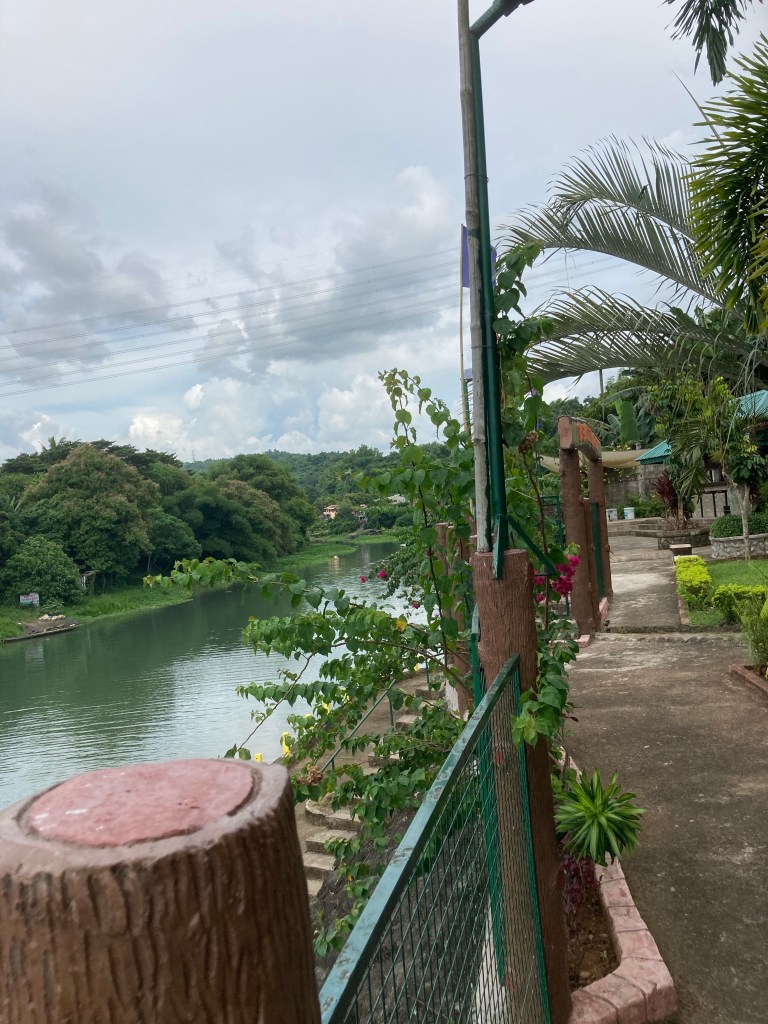
This is my mother’s country: a symmetry of canyons, the first bedecked in Tagalog, Chinese, and English signage amidst a tangle of cables; the second sedimentary rock in striated layers, purple and white streaks cutting toward the river below, a lush and wild arrangement of tropical life draped, bushy, twitching with birds and dragonflies in black, neon blue, and yellow. A baby monkey crouches on a rock, watchful, then leaps into the green river and swims away. My mother grew up in Quezon City and lived in Manila. Her mother—we called her Nanay because she didn’t like Lola—grew up in a farming village of rice paddies and coconut palms, then moved to Manila, then to Olongapo. No doubt her island was just as green when she left it.

Gilbert and Ben meet us in a dugout canoe at the Casa del Rio dock, a concrete and stone ledge two dozen steps below a cliff side resort. The backyard pavilion, close and green and overlooking the river gorge, feels naturally grown from a grove of kamagong and palm. They wave to us from their boats, two of the six boatmen, two boatmen per canoe. We are nine tourists, and they load us three per boat, for balance, to ferry us upstream through the rapids to the Pagsanjan (the j has a y sound) Falls. This was Nanay’s country. The boatmen keep count—of weight, of balance, of distance and rapids, of rocks and steps and strokes of the paddle and a thousand other calculations. And this was Nanay counting: strawberries from the patch, strokes of a broom on the walk or buckets of grass snipped from the patch in front of the porch, the vinegar and soy, the pieces of meat and chicken. The dollars she kept in her white envelopes.

Casa del Rio, looking up river toward the gorge, the rapids, and beyond, Pagsanjan Falls.

They paddle swiftly against the current. A man in a plaid shirt arrives in a canoe fitted with a small motor. Gilbert, a sinewy young man with a silky black ponytail, grabs a rope from the back and attaches it to the front of our canoe. After all three canoes are linked, the boatman motors us up toward the first rapids. We cut through the Lillies and swarms of dragonflies. He pulls us through the a punishing stream of engine fumes. The motor sound echoes off walls resembling pebbly dinosaur skin, it rattles inside little alcoves and niches in the rock. A yellow butterfly flits across vines against black rock.

The rapids are low; the water shallow. Gilbert and Ben jump out of the boat. Barefoot, Gilbert deftly pushes us off the rocks with his feet as he pulls us upward. Sometimes there are pipes embedded in the rock across the water, creating a set of risers that make it easier to slide us upward. Gilbert dances across them. Had I tried it, I would have but cut and bruised and twisted and sore. Ben pushes from behind, from the side, and once, her and Gilbert both pulled us from the front of the boat. When he climbs back in, sometimes he grunts or exclaims, as if in pain. He’s got a belly, though I can’t see how.

In the pools between rapids, Gilbert sinks in neck deep, cooling quickly. Behind me, Ben scoops out excess water with a sandal. We bought them drinks from an old woman who paddled out on the river to sell them: bottled water and coke. She does this a lot. We are to pay her after, 350 pesos per boat. At one point, they ask how much I weigh. I give them the number in pounds. They ask for it in kilograms. Metric conversion is not one of their calculations; I am going up the river either way. I give Ben my unopened water. It’s the least I can do.

When we reach the falls, the men take a break while another group put us on a thick bamboo raft and float us right under the falls and into the cave beyond. We swim a while, take photos. The water is warmer here. The spray is sharp, pounding and great on the back and shoulders. Hot springs are popular in this part of southern Luzon, and we benefit. Relaxed, rejuvenated, and thoroughly saturated, we load up and the boatmen take us back. The trip is faster, and they need to disembark less frequently. The call ahead, Tagalog syllables to let others know we are coming down the rapids. A call back from another boatman at the bottom would bring us to a temporary halt. We pass now familiar sites: A tower of some kind leftover from the Americans or Japanese. White cows grazing on both banks. A few huts with only two or three walls to keep out the rain. Down the river we race, and soon there are children swimming beside us. Houses on the cliffs in Japanese or Spanish styles. A white statue of the Virgin Mary tall as the neighboring trees, gazes down serenely as we pass below her. This is my mother’s country: when I see the Virgin Mary at home, I think nothing of it. When I see the Virgin Mary here, I think of her prayer altar, second shelf from the bottom of her sewing room bookcase, bedecked in Catholic and Buddhist imagery, Mary prominent among them not by size but by frequency.

Gilbert and Ben work one day a month. There are a thousand boatmen in need of work, but no tourists. The trip takes about two and a half hours. It is grueling and it is dangerous, especially for the feet and legs. The pay is low. A good tip makes all the difference when you must provide for a family on one day of work a month. Back in the Casa del Rio, the staff of young women and a couple women who know better than to get old serve us homemade chicken BBQ, lumpia, stewed vegetables, rice, mushroom soup, and a tapioca with bananas and jackfruit. We drink buko water straight from the coconut.

Coconut water, straight from the fruit.

The people of the resort are friendly, generous, kind, and in a state of perpetual smiles, but they, too, operate under a harsh climate. No tourists. They ask us to return and invite us to stay in their poolside cottages. One could hardly say no to their hospitality, and that seems to be the way of things here. This is my mother’s country. This is Nanay’s land. It is as beautiful as they said it would be. It is sometimes as painful as their lives suggested.

“Vogonic” Definition

Adjective. To advocate for and adhere to the weight of bureaucracy. See description below.

“Here is what to do if you want to get a lift from a Vogon: forget it. They are one of the most unpleasant races in the Galaxy. Not actually evil, but bad-tempered, bureaucratic, officious and callous. They wouldn’t even lift a finger to save their own grandmothers from the Ravenous Bugblatter Beast of Traal without orders – signed in triplicate, sent in, sent back, queried, lost, found, subjected to public inquiry, lost again, and finally buried in soft peat for three months and recycled as firelighters. The best way to get a drink out of a Vogon is to stick your finger down his throat, and the best way to irritate him is to feed his grandmother to the Ravenous Bugblatter Beast of Traal. On no account should you allow a Vogon to read poetry at you.” (Adams, Hitchhiker’s Guide to the Galaxy)

As I tried out this word in both adjectival and adverbial forms, one of my staff members jokingly punned “Vogonic Plague.”

Now I know what has gone wrong in the American workplace, including several of mine.

Fanboying…and Writer’s Block

Last night my husband and I took a brisk walk to the Orange Line, rode down to Chinatown, and had a delightful meal at Pho Pasteur. Boston is far more accessible now than it was when we lived at the end of a commuter line. I love train rides, but thankfully the time is shorter and options greater now that we only have to use the T. We don’t have to leave the car parked in a public lot, departure deadlines are more flexible—we don’t have to take the last train out an hour before we’d like, and there’s no more sitting in North Station terminal, shooing stunningly brave pigeons from snatching at leftovers.

Neither of us can tell whose birthday present it was—I thought they were his, he insists they were mine. But seeing that we’re almost halfway between the two, it’s not really a thing that matters. What matters is that he managed to find two tickets to A Conversation with Neil Gaiman at the Colonial Theatre on Emerson College campus, right across from the Central Burying Ground on Boston Common, which I found amusing, as I love The Graveyard Book. Well, I love most of his work, anyway.

The line for his books transcended what either of us thought reasonable—primarily because we’ve just had to downsize and still aren’t where we’re likely to end up staying. Why add when you know there’s more subtraction coming? So we muddled though the crowd, out of the lush red, gold-trimmed foyer and found our seats in the balcony. Dancers and musicians looked down on us: painted faces on the ceilings and walls, golden musicians awaited the proceedings above the boxes. Like many old theatres, the balcony seats were designed for the smaller people of another age, so we crowded in—a row of six couples, all strangers with less rom than eggs in a carton, perched in potentially vertiginous space. All well and good. Neil Gaiman was going to speak. Tom Waits, Nina Simone, and Johnny Cash serenaded us over the speakers in the run-up.

Gaiman came to the podium in all black—no surprises—and opened with an unpublished poem about Batman dedicated to Neal Adams, who had passed earlier in the day. He read “Shoggoth’s Old Peculiar”, “Click Clack the Rattlebag”, and closed with a poem for the Syrian refugees. He may have read one or two more pieces—I was fanboying, absorbing the moment, wherever the storyteller wanted to take me.

In between selections he answered from a stack of questions, humorously lamenting that the audience had had time to think about them, but he had not. Of particular interest to me was a question about writer’s block, which he strategically reframed as a bad writing day, which first we can own and second we can fix. The full answer was lengthy and beautiful, and I found that Hy Bender’s The Sandman Companion ends with nearly identical advice, so I’m going to close—and make my point—by sharing it here:

“I just sit down and write, regardless of how bad the stuff I’m producing is. I can do that because I know I’ll wake up the next day, look at what I’ve done, and say, ‘Yes, that is indeed not very good; But it’s mainly because this sentence here is entirely superfluous, the paragraph following it is clunky, and the scene in the middle should be moved to the top.’ In other words, when my writing facilities are on the blink for a little while, I can still rely on the editor part of my head to read what I’ve done objectively—that is, as if someone else wrote it—and fix the problems” (Bender, 262).

And now you know why I work with an editor, and why I am not suffering a block.

Follow the Camera

My editor friend and I have been talking about camera angles for some time. Several month ago, she told me to put a microphone in Nic’s (my protagonist) head and a camera on his shoulder. Sometimes it’s easy; other times, I miss the boat entirely because I get lost trying to capture the place and forget to capture the place in the context of action.

So in our conversation this weekend, we discussed the selections from my prior post (“Where Dialogue and Action Meet”), she gave me an alternate reading of the Tehanu passage by following the camera and asking “what do we see?” and “why do we see it?” Then she shared this excerpt from Chapter 35 of Dickens’s Great Expectations:

And now the range of marshes lay clear before us, with the sails of the ships on the river growing out of it; and we went into the churchyard, close to the graves of my unknown parents, Philip Pirrip, late of this parish, and Also Georgiana, Wife of the Above. And there, my sister was laid quietly in the earth, while the larks sang high above it, and the light wind strewed it with beautiful shadows of clouds and trees.

It’s a stunning passage with a clear motion for the eye, presenting the procession to the graveyard exactly as it unfolds, symbolism seamlessly woven into the scene. It’s really a beautiful thing, what Dickens has done here. My colleague’s analysis/instruction as it relates to the beauty of this scene as a means of thinking about the narrative camera was brilliant, resonating in a way that makes me wish I could have sat in her classes when we were teaching years ago. The passage is here where I can come back to it, a reminder to me now that when I think of the camera on Nic’s shoulder (or the narrator’s or anyone else’s shoulder who appears in my writing ever again), I really want to be breathing toward this scene.

And I suppose when I get a few other books in the pile read, I’ll be revisiting Great Expectations for the first time since high school, I think. Not that I’m upset by this–there’s much to discover now that I simply didn’t have the motivation to see then.

Where Dialogue and Action Meet

My current project is a first person limited narrative in which the protagonist, Nic, reflects extensively on the past and studies family artifacts—photos, documents, and the like. Sometimes he makes things up, building fiction on the narratives he learned as a child. One of the challenges constantly presenting itself is the integration of context and action into the dialogue. There are times when my vision is so clear I forget that my reader doesn’t see what I do. Et voilà, as Poirot would say. Text that does not connect. Insert David Suchet mustache-wriggle here.

So my editor suggested I look at a few sample texts. I chose two for this activity. Because I’m reading LeGuin’s EarthSea cycle so that I can have a conversation about it with one of my staff members, I pulled my first example from the early pages of book four, Tehanu, “Chapter 12: Winter”:

She sat down at the fireside with a weary sigh, and did nothing at all for a while.

A rap at the door: Clearbrook and Ged—no, Hawk she must call him—Hawk standing on the doorstep. Old Clearbrook was full of talk and importance, Ged dark and quiet and bulky in his grimy sheepskin coat. “Come in,” she said. “Have some tea. What’s the news?”

“Tried to get away, down to Valmouth, but the men from Kahedanan, the bailies, come down and ’twas in Cherry’s outhouse they found ’em,” Clearbrook announced, waving his fist.

“He escaped?” Horror caught at her.

“The other two,” Ged said. “Not him.”

“See, they found the body up in the old shambles on Round Hill, all beat to pieces like, up in the old shambles there, by Kahedanan, so ten, twelve of ’em ’pointed theirselves bailies then and there and come after them. And there was a search all through the villages last night, and this morning before ’twas hardly light they found ’em hiding out in Cherry’s outhouse. Half-froze they was.”

“He’s dead, then?” she asked, bewildered.

Ged had shucked off the heavy coat and was now sitting on the cane-bottom chair by the door to undo his leather gaiters. “He’s alive,” he said in his quiet voice. “Ivy has him. I took him in this morning on the muck-cart. There were people out on the road before daylight, hunting for all three of them. They’d killed a woman, up in the hills.”

“What woman?” Tenar whispered.

Her eyes were on Ged’s. He nodded slightly. (Kindle edition 213-4)

Tenar—the “she” of the scene—has survived an attack by a local gang the night before, and as a consequence has lied to a child she has taken in (I won’t spoil the story by revealing more; this is enough). The sentence—placement by the fireside, a description not of doing, but of not doing—it’s the barest little sentence so packed with weight, and it sets up the way she responds and reacts in the conversation that follows. She offers tea—culturally understood as a calming beverage and an act of care. A bracing cup of tea can help you through anything, right? But look at the emotions: horror that the man might have escaped, yet bewildered at his death, and upon discovering a murder had taken place, she drops to a whisper—in part to protect the child, in part possibly to absorb the news herself.

Equally important is the way action marks time and creates emphasis points in the dialogue. Ged doesn’t sit down right away. He appears in the doorway in his bulky coat, which comes off behind the scenes, while Clearbrook describes the scenes. We come back to Ged, who is a silent, methodical type, as he he has shucked the coat and is removing the protective leggings. He’s taking off his armor. Is he weary? Probably, as Ged has been equally stressed for some time. It’s his act of removing armor that teaches the reader where he is in the scene. And this is what I need more practice at—concise action to set mood and tempo.

Also of interest to me is how we know the dialogue belongs to Clearbrook. LeGuin describes him as full of talk, but in the second long passage of narration, the language does not fit a quiet man who has settled into removing his armor. The author never has to tell us it’s Clearbrook. She has foregrounded it enough with her description and the actions of her other characters—the ones who aren’t saying much.

Switching gears for a moment, when I began writing this work years ago, I had kept Tim O’Brien’s The Things They Carried in mind. My work isn’t the war story O’Brien writes, but it is a war story of sorts. And the way O’Brien deals in truth, and what constitutes it, and what we reveal and when, strikes chords with me. My protagonist Nic must contend with ideas of the truth as he redefines family and self. So here’s a segment of O’Brien’s work, the lion’s share of a chapter titled “Friends.” Two grunts—Jensen and Strunk—have gone from mortal enemies to—within the framework of war—friends, having resolved one night that if either should become “totally fucked up”, the other would put him out of his misery:

There was nothing much anybody could do except wait for the dustoff. After we’d secured an LZ, Dave Jensen went over and kneeled at Strunk’s side. The stump had stopped twitching now. For a time there was some question as to whether Strunk was still alive, but then he opened his eyes and looked up at Dave Jensen. “Oh, Jesus,” he said, and moaned, and tried to slide away and said, “Jesus, man, don’t kill me.”

“Relax,” Jensen said.

Lee Strunk seemed groggy and confused. He lay still for a second and then motioned toward his leg. “Really, it’s not so bad. Not terrible. Hey, really—they can sew it back on—really.”

“Right, I’ll bet they can.”

“You think?”

“Sure I do.”

Strunk frowned at the sky. He passed out again, then woke up and said, “Don’t kill me.”

“I won’t,” Jensen said.

“I’m serious.

“Sure.”

“But you got to promise. Swear it to me—swear you won’t kill me.”

Jensen nodded and said, “I swear,” and then a little later we carried Strunk to the dustoff chopper. Jensen reached out and touched the good leg. “Go on now,” he said. Later we heard that Strunk died somewhere over Chu Lai, which seemed to relieve Dave Jensen of an enormous weight. (Kindle edition pages 67-8).

O’Brien appealed to me when I was younger not because of the content, but because of the sparseness, the bite-sized chunks of experience that reminded me in some ways of my father’s own dinner-table narratives from his days in the Navy—which thankfully he sanitized so that his children could hear them.

As I consider this text now, I am grateful to not cling to this kind of storytelling voice the way I might have when I was younger. How much context is necessary in a person’s mortal wounding? This is Vietnam, and if it’s a jungle (we don’t know), only the language of human artifacts—weapons, aircraft, towns—distinguish it from any other jungle in which any other war was fought. If this was a jungle. We don’t know, and I’m not sure we need to. The actions are intimate. The passing out, the begging not to be killed, the touch of the leg. Staring at the stump. Death waiting on the flight out. It seems to me that O’Brien is working at once to make death mundane and to make each man’s lose intimate and numbing. Certainly it works, but I’m sure that what makes it work is exactly why it won’t work for the style of story I am currently writing.

References

LeGuin, U.K. (1990). Tehanu (Kindle Edition). New York: Atheneum.

O’Brien, T. (1990). The things they carried (Kindle Edition). New York: Houghton Mifflin.

Variations on Education

Every now and again, I think about Ambrose Bierce, who died somewhere in Mexico in January 1914, though sources disagree on exactly where and no one seems to have found the body. “An Occurrence at Owl Creek Bridge” helped me find a starting point for my love of literature and “The Devil’s Dictionary” reinforced my belief in play as a valid approach to language (I was once punished for calling one of the playground attendants a funny name–I’ll tell you sometime if you remind me). In this commonplace post, rather than quote from either, I just want to play with variations of a single word, and see how far I can abuse it. Please note that this post differs from the actual Devil’s Dictionary, which offers cynical definitions to real words.

Education (noun) is defined, officially and according to Oxford Languages and Google, as “the process of receiving or giving systematic instruction, especially at a school or university.” It is further defined as “an enlightening experience.”

Edumacation (noun) (vars. Edumacaytion, Edumacayshun, etc.)

Any variant pronunciation or spelling expressing cynicism, sarcasm, or mockery of the processes of receiving or giving systematic instruction. Often spoken or written between the 25th and 49th parallels in the Western hemisphere, including schools and universities. Exposure to such phrasing is an enlightening experience. Exaggeration of accent/ludicrousness of spelling is directly proportional to level of cynicism, sarcasm, or mockery.

Edumamacation (noun)

The process of receiving or giving systematic instruction in the art and science of motherhood. Basic lessons include traditional skills such as Sleep Deprivation Perseverance; Strategic Leftovers; and Combined Weight-Training Yoga. Advanced courses include Deception Detection; Ancestral Stories: The Coercive Moral Tale; and Rhetoric, Argument, and Logical Fallacy. Collectively an enlightening experience.

Edamamecation (noun)

The process of receiving or giving systematic instruction in legumes. Such instruction achieves enlightening experience through one of two means: beanstalk climbing or flatulence.

Edamcation (noun)

The process of receiving or giving systematic instruction in cheeses. Often confused with Edamamecation because of flatulence. Enlightening experience generally associated with wine or whine. Charcuterie selections and accompaniments optional.

Edudecation (noun)

The process of receiving or giving systematic ranch-based instruction on rural living. Enlightening experience often accompanied by saddlesores, backache, and significant financial expenditure. Fun for the whole family not guaranteed. Fun at the expense of family more likely.

Conversations on Writing: Fiction

“There is so much less reading in schools, and very little teaching of grammar. For a writer this is kind of like being thrown into a carpenter’s shop without ever having learned the names of the tools or handled them consciously. What do you do with a Phillips screwdriver? What is a Phillips screwdriver? We’re not equipping people to write; we’re just saying ‘You too can write!’ Or ‘anybody can write, just sit down and do it!’ But to make anything, you’ve got to have the tools to make it.”

The further I go down the writing path, the easier it is to rest easy with the difficulty of the craft. I’m back with Ursula LeGuin, this time in her Conversations on Writing with David Naimon. An interview—her last—that was released posthumously. At times in this text, we know she is at the end of her career. She tells us. She has nothing left to lose, if she ever did. But it’s implied so much more in moments like the passage above.

I have taught writing for years now. That’s more about my personal life and current career than I ever thought I would reveal in this space. And I was raised in the school of “You Too Can Write!” I assigned the classical and contemporary essays, subjects of rhetorical analysis, and early on depended on the knowledge that I had studied grammar in several years of junior high and a year of high school, so therefore my students must have studied it, too. Of course, the misconceptions fell away quickly, and I incorporated at least some grammar into my teaching.

But it’s never enough. We need the metalanguage of grammar specifically and language more broadly, the perpetual refreshing when we read, not just to examine ideas, but to examine the construction of ideas. Yes, they are the tools we need in the shop, or at our own writing desks. They are the tools that help us learn not only to build, but also to see. I’ll admit a certain horror when I find that a student cannot identify a noun (person, place, thing, or idea), or the verb that the noun is either doing or having done to it. Yes, you too can write, but it’s merely throwing down the words and hoping without any sense of clear meaning or construction.

In my own work in progress, I am spending a lot more time listening to my editor, who is helping me see those passages that are narrating context, or world building, or telling what I either fail to show or show later. The process of cutting and emending is not a fast one. We don’t run with scissors, in life or on the page. So slowly, word by word, line by line, I discover my own language, my choices, and add by subtraction. At the same time, adding by addition is preferable, and the best way is not just to read good words, but to know the tools the author used to write those good words. Yes, you, too can write. But first, you must read.