Mason Hall. Three.

The woman who came to retrieve Cara was neither as deferential as Penny nor as icy as Ms. Carrington. In fact, with her mass of black hair held back with a white bandanna and her faded sweatshirt and denims, Beatrice Thurmond looked too laid back, too chill to be a supervisor. She gave Cara a warm smile.

“You look like your Mom. And you got a touch of your Pappy in you.”

“You knew Pappy?”

She nodded as she ushered Cara through the double doors. “Your Mom and I grew up together. She didn’t say?”

“She said I had an opportunity that I shouldn’t waste.”

Bea laughed. “That’s your Gran speaking. Audrey was always torn between those two. Loved her Daddy, but feared her Mama more.”

“Sounds about right,” Cara said.

They passed through the great room, where Ms. Carrington dealt with a fussy-looking old man in a bathrobe. Mr. White waited at the foot of the stairs; he gave Cara a slight nod and a smile, which she returned.

When Bea opened the door to the administrative wing, she took note of the scene unfolding in the great room.

“Did you come in with Mr. White?” She asked.

“You know him, too?”

“He’s a regular,” Bea said as they walked.

“Ms. Carrington doesn’t seem to like him.”

“Mm hm. Which brings us to rule number one about working in Mason Hall. What Ms. Carrington says goes.” Bea opened a door and led Cara into a plush looking office with strong wood furniture. But something didn’t feel quite right.

A pair of leather wingbacks had been placed opposite the heavy desk. The two women sat there.

“It’s a real nice office.”

“Carrington does like to make sure she has the best.”

“Oh.” Cara surveyed the room again and realized what felt so wrong.  There wasn’t a single photograph or personal effect anywhere. No knick-knacks. Generic paintings of landscapes. Not even a plant or a vase of flowers.

“But it doesn’t feel very friendly.”

Bea pursed her lips. “Make sure you don’t say that in front of her.”

“Huh?”

“Be deferential. Better yet, in Ms. Carrington’s presence, a smile and nod do better than a word. Got that?” Bea was suddenly stern, all traces of friendliness gone.

“I feel like I’m about to be fired.” Cara stared at her pumps. “Which is strange because I haven’t even been hired.”

Bea sighed. “This isn’t how I wanted to bring you on board.”

“No?”

“Nothing about this is standard, Cara. I would have interviewed you on my own, in the staff room, the way I interviewed the other folks on Housekeeping. Carrington leaves well enough alone when it comes to us. Be seen and not heard. Report problems promptly. Can you do that?”

“Of course I can.”

“I know it. Audrey wouldn’t have raised a fool, I don’t think. Not with parents like hers.”

“So why are we meeting here?”

“At a guess, I would say it was because you walked in with Mr. White. So now I’m going to ask you to do something very important.”

Cara examined the leather chair arm and nodded. “Uh huh.”

“No matter what Mr. White said or did—“

“He didn’t say or do anything.”

“No matter what Mr. White said or did, he only said good morning and sheltered you from the rain. Got that?”

Bea had a look of determination that reminded Cara of her mother, or of Gran.

“Well that’s easy enough. That’s all he did.”

“Good.”

The conversation turned casual then, as if Bea had turned a switch from formal to casual. Even when Ms. Carrington arrived wearing that same slippery smile she gave Mr. White, Bea remained casual. Quiet, yet casual.

Mason Hall. Two.

Days like this made Cynthia want to scream. The pounding rain. The flooded inbox. A leak in the west wing. Supply delays. State inspectors. Staffing issues. Mrs. Grant’s vendetta against Mrs. Cornelius. Mr. Oliver camped out in the great room. A dozen other residents with twice as many needs and complaints. And God forbid …

She glanced out the window.  “Christ,” she said and picked up the phone. “White’s at the door, along with a girl. Hold them.”

The person on the other end spoke briefly.

“I don’t care. Just keep them there.”

Mr. Oliver, still in his pajamas and bathrobe, climbed from his usual leather chair and shuffled toward her as she strode across the room. He waved at her, mouth already moving.

“Ms. Carrington, I—“

She held up a red-taloned finger. “I’ll be with you in a minute,” she replied.

He backed off. “Oh, oh. Okay.”

Like the rest of the great room, the doors to the foyer were dark wood and brass. Heavy. She pushed one open and slipped inside, She pulled her blond hair behind her ear and adjusted her glasses as she approached the pair.

“Mr. White. Good to see you again.” She reached out her hand. 

He watched her hand as she approached, like it was something dangerous. Then took it quickly, stopping her short. “Ms. Carrington,” he said. 

“I assume you’re here to visit with Mr. Mason?”

“That’s correct. I left my umbrella in the rack, as usual.” 

“May I take your coat?” She motioned to the small, empty coat rack.

Mr. White still wore his rain-spattered topcoat. “I’ll keep that with me, thank you.”

She smiled thinly. “Then let me escort you upstairs.”

“I know the way.”

“Just the same,” she said. “It would be my pleasure.” Cara didn’t think Mr White was nearly as friendly with Ms. Carrington as he had been with her.

Carrington turned to the attendant behind the glass, a mousy woman who seemed to shrink even further away.

“Penny, I’m going to escort Mr. White to Mr. Mason’s quarters. Would you please have Bea come to escort Miss Baker to my office.”

Penny picked up the phone—Cara assumed she was dialing Bea, as Mr. White and Miss Carrington disappeared through the doors. 

Mason Hall. One.

“If you had only listened to Granny, you could be off to college, too,” Audrey chided as gently as she could. 

“If I wanted a degree in nursing or teaching or business, yeah.”

“Those are perfectly respectable careers.” Audrey pushed the pantsuit into her daughter’s hands.

Cara groused. “But they’re not me. I want to be on stage. I want to sing. Dance—”

“Sleep on a grate in Center City.”

“Mom!”

“I never said you couldn’t sing and dance and get on stage.”

“Granny did.”

“Mm-hm. Because she don’t want you sleeping on that grate. And neither do I. You need a fallback.”

“And scrubbing old people toilets in Mason Hall is a fallback?”

“Until you find something better. And maybe it’s enough. But I can’t have you melting into my sofa with no job, no career, no hope. So until you make a plan, Mason Hall it is.” 

Audrey had given her daughter a week after graduation to enjoy her newfound freedom, then snatched it away with a word from her sometimes-friend Beatrice. Cara’s classmates had gone to Temple or CCP, but her friends—what few she kept up with—had mostly entered a desperate post-pandemic workforce where jobs were plenty but living wages scarce. A few of them had already made the arrest columns in the Inquirer or the Daily News. One was already in his grave.

“You can’t do an interview dressed like a hobo,” Audrey insisted. 

“It’s ragamuffin,” Cara corrected acidly. “Check with Granny.” 

“Your grandmother just wants what’s best for you.”

She looked away so that her rolling eyeballs wouldn’t cause a fight. She was already treading on dangerous ground. “It’s just a part-time job. Housekeeping.”

“It’s still a job,” Audrey insisted. “At Mason Hall.”

“My jeans are fine for Mason Hall.” Some part of her had given up, willing to fulfill the ragamuffin description.

Audrey hauled her only child to the bedroom. “No. Beatrice says you could be a shoo-in for this. You leave nothing to chance.”

Now as she sat in the car, she found a new worry. “The torrential rain is going to dash Audrey Baker’s hopes,” Cara muttered. 

Sheets of water battered the windshield, smearing her view. The red bricks and black shutters of Mason Hall, a mansion-turned-assisted living facility, were geometric splotches of color masked behind white and bright green streaks of young summer birch trees. The scene ebbed and flowed with the downpour.

Cara could not have felt more out of place, dressed in her mother’s second-hand navy pantsuit and battered pumps the color of mud. Well, that might actually be mud, thought Cara, as she reached down and brushed at her leg. It was a dash from their row home across the puddles to the ’83 Chrysler Malibu Audrey had inherited from her late father and that Cara, in turn, had come to own. 

“Pappy’s car. Mama’s clothes. You really are a wreck.” She twisted around, searching the back seat for an umbrella. The jacket was tight where she wanted it loose; loose where she wanted it tight. No umbrella.

A shadow filled her driver’s side window. A rap on the glass. She turned to see the smiling face of an old man under an oversized red and white umbrella. She rolled the window down slightly.

“Can I help you?”

“Saw you pull in,” he said. “I’m guessing you’re short an umbrella?”

“Yeah.”

There was a twinkle in his eye. His hair was close cropped and gray. He smelled strongly of aftershave. His tie was wide and his topcoat old. He reminded her of pappy. “May I escort you inside?”

“Thank you,” she said and rolled up the window. He stepped back so she could exit, and together they braved the weather.

Watcher

I always click the button that locks the door until my Subaru beeps. It beeps twice, and sometimes, if the mood is just right, I keep hitting the button as I sing “Tainted Love”, the timing and rhythm perfect, as if we are singing together. And that’s what I’m doing as I cross the desolate wet parking lot toward the shabby four-story hotel.

This rust belt town is grim, on its knees, leather work gloves resting on a scratched yellow hardhat, exhausted and panting, trying to get to its feet. The hotel–part of a low budget chain–has seen better days. There are desperately-needed renovations going on inside, and a dumpster the size of a big-rig trailer and several construction vehicles are parked at the darkened end of the lot. Not all the lamps work, and why bother? The interstate with its high halogens sits right there on the other side of a steel and concrete barricade. That’s enough.

My clients asked where I was staying. When I told them, they shuddered. “That’s kind of a halfway house,” they said. “The addicts and homeless often end up there.” I did not offer that once, in another life, I had helped run a little house church, and the men from the halfway house next door had been regular attendees. The men laughingly called me pastor, and I laughed along, because I might be the worst candidate to shepherd any flock anywhere. Ever. People with problems are not the problem; systems that exacerbate problems are.

The car beeps along merrily when I notice him–the shadow of a hooded figure, a man in a rain poncho of some kind–looking down at me, hands pressed against the glass of a third floor guest room window. No discernible features. only darkness where his expressions should live.

The song dies on my lips. In my hesitation, the imagination my steelworker father so often condemned as overactive revs into high gear. Scream. Psycho. The Shining.

I take three more steps and pause between two puddles, my eyes never leaving that darkness where his face must be.

He doesn’t move.

I began calculations, eyeing the structure. Distance to the lobby. Distance to my room adjacent to the second floor stairs. Time it takes to climb those stairs with my briefcase, wearing my slick-soled dress shoes. Distance from his room to the same stairs. Probability that he would correctly guess I had parked closer to the side where my room was located so that I could see it from my window.

I keep watching, my neck craning until I enter the building, until he disappears from sight. The lobby is tiny, brightly lit, and the young woman at the counter has headphones on. She nods as I pass. Once I round the corner, I scurry down the hall to the stairwell closest to my room. On the second floor landing, I hear the fire door open on three. I slip into the hall, run my card key through the slider on my door, and breathe a sigh of relief when it is closed, bolted, and chained. Just my imagination. Yeah.

A shower and a change of clothes later, I settle at the desk to complete the day’s paperwork. That’s when I hear the fire door, followed by a whistle. It’s the tune I had been singing not an hour earlier. The whistler stands just outside my door. I see the shadow of their feet through the crack. There is no peephole. I switch off the light. The whistler leaves the way he came.

I spend the next several hours watching my car through a little opening in the drapes. My room is dark. No one can see me. Just me in the chair and the car and the mostly empty, half-darkened, puddle-ravaged lot. My accursed overactive imagination and the lamps of the interstate. The scattered showers that come and go. An occasional car or truck headed up the mountain, away from the town. A figure–a man in a ball cap and hoodie–walked by my Subaru earlier, during one of the lulls in the rain. Paused in front of it but didn’t touch it. Was he the same person I saw in that window? I don’t know–probably not–but the longer I sit, the more uneasy I get, the more I wonder if I’m somehow part of the problem. No. It’s just my imagination. It must be.

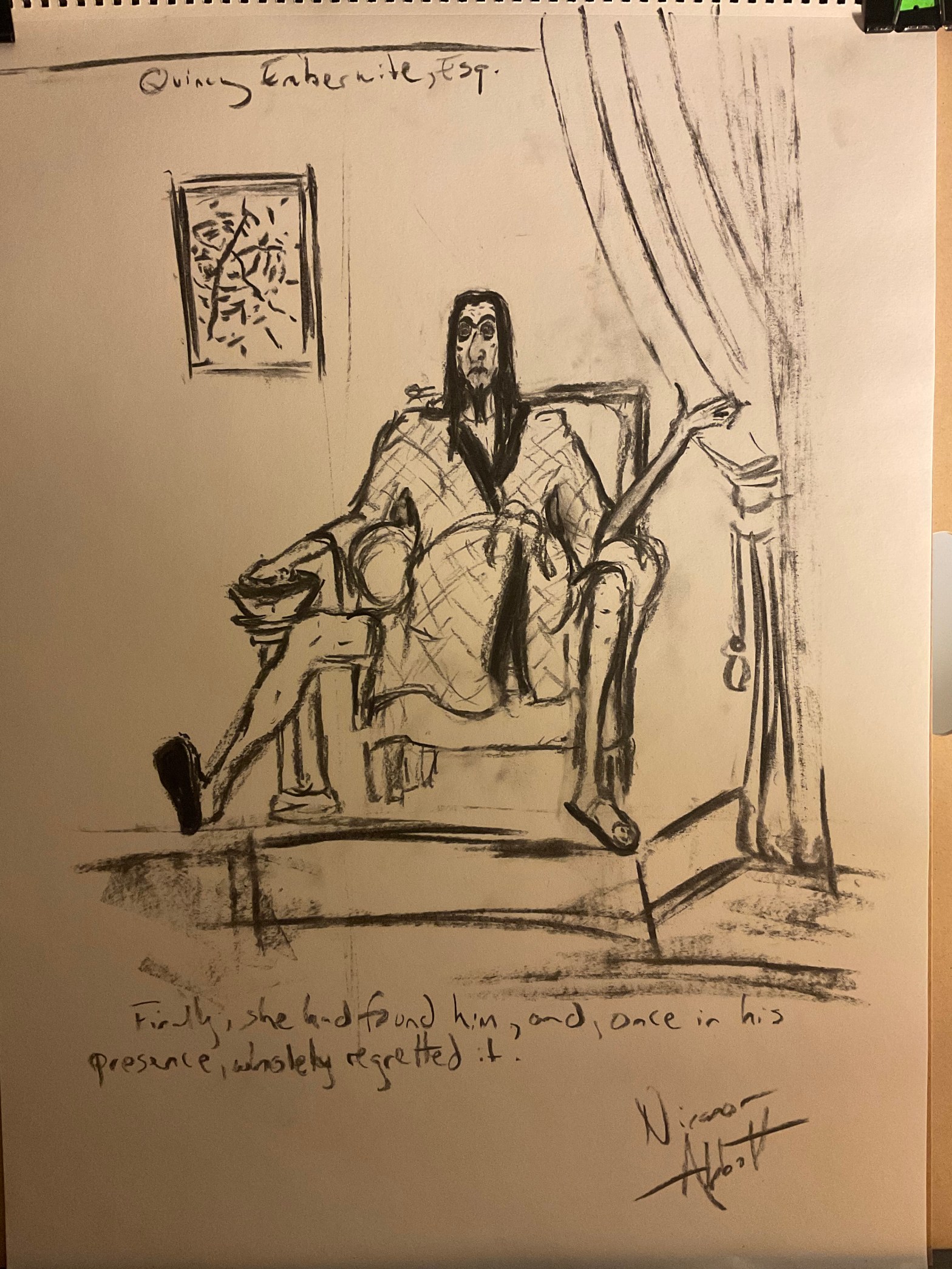
Character Sketch: Quincy Emberwite, Esq

The painted maidens escorted Alex, Jaycee, and Mina into a dim chamber. The drapes had been drawn; vertical slits of light revealed that it was day. In the dim, something moved. A juicy popping sound followed.

“Light,” whispered a low and gossamer voice.

One of the maidens turned up the sconces, revealing a greasy spider of a man. He slouched in his chair, limbs akimbo, his distended belly wrapped in a satin plaid smoking jacket, the knot tied atop his swollen gut like the bow of a present. Stringy black hair, long and lank, hung from a pasty skull. protuberant eyes lolled around. Alex wasn’t sure if Emberwite could even see. He reached out with a pale and spindly hand, plucked a cherry from a bowl beside his chair and ate it. The fruit burst in his mouth. He leaned over and spit out the pit. It bounced and rolled across the dusty floor. A third maiden emerged from behind a heavy curtain, picked it up, and put it in her pocket.

“Well, now.” He simpered and stroked his forked goatee. “The great Alexandra Hawthorne, I presume?”

“Alex.”

He shook his head, wide eyes searched her, then her friends.

“Alexandra, I think. You sought me out. That you found me…” he chuckled, “is by my will, not yours.”

Alex nodded. His voice seemed unnaturally high. Girlish. The door of her memory palace came to the fore. She could escape quickly and easily. Jaycee and Mina? Not so.

Emberwite bounced his tatty black slipper. Alex hoped he would fling it off his foot and forcibly break character to retrieve it.

“So, what brings you to me? My good looks?” He flicked his hair and posed. Someone had punched the mirror behind him, the web of cracks spreading across the glass.

Now he draped his leg over the arm of the chair, the robe shifted, but revealed nothing. “Desire? A job?” He motioned to the painted maiden standing silently nearby. “I could create an opening for you. You’d look so much better in porcelain.”

Jaycee made a retching sound. Mina whimpered. Alex kept her expression neutral.

“I seek the Man in the Golden Coat,” she said evenly.

Emberwite tsked. “So knowledge then. Boooriiing.”

Delivery

I’ve had this idea in my head for a while, based in part on a news article I read some years ago. It’s a draft of a piece that I would like to put into a collection of northern gothic tales.

*****

As addresses went, Fourteen Seventy-Two Warren Valley Road did not match its appearance. At least not to Brewster. He pictured a boxy two-story on a manicured cul-de-sac. A split level in an aging neighborhood. A fifties rancher under a stand of old maples.

The first crack in his expectations came when he found the numbers peeling from a battered mailbox standing sentinel at the head of a dirt drive. By the time he finished bouncing and jostling his way up the rutty road to a low slung cottage, he had dismissed all preconceptions about his delivery and its recipient, a Miss Delia Grunderson.

Brewster parked the van on the edge of a field that had once been a yard. He adjusted the pin on his vest: “Here’s a bouquet to brighten your day!” it read, and retrieved the flowers from the back. He paused at the passenger side mirror. He checked his nostrils and teeth for anything that could ruin his impression, adjusted his cap to an angle he deemed more jaunty, and started toward the porch. 

A Buick, its yellow faded with age, sat in the freestanding shed, an AM radio gospel preacher shouted the message of the Lord from the shadows at the back of the garage.

“Anybody home?” Brewster called. Only the preacher replied, demanding his flock repent.

The porch ran the length of the cottage. He rang the doorbell. Silence. He opened the wood screen door and knocked, letting the door slam shut.

“In a moment!” came an elderly voice.

Brewster held up the delivery: three dozen red roses in a white ceramic vase, the neck of the tase trimmed with bright red ribbon.

The door creaked open.

“Delivery for Miss Delia Grunderson!” Brewster cheered.

A wrinkled old woman answered the door. She was tiny, with white hair like cotton candy coiffed in a thin Edwardian pompadour. She blinked, uncertain, with vibrant green eyes.

“Oh! For me? Do come in!” She motioned with a claw-like hand—it looked stiff in the knuckles—for Brewster to follow into the front room. He placed the flowers on a faded lace doily that covered the coffee table, as if she had expected them. “I was just pouring tea. Would you like some?”

“I’ve got a few more deliveries,” Brewster began, but the sudden droop in her countenance, the sag of her smile and the wetness of those eyes made him reconsider. “Maybe just a minute or two,” he said, and settled on the ancient sofa. Its damask cushions had little give and the creak it unleashed made him fear for its delicate wooden legs.

“Oh, good. Now wait while I get the tea. Do you like shortbread?”

“Yes, Miss Grunderson.”

“Such a nice young man.” She swept out, quicker than he expected for someone so old.

The furniture came from a bygone age. There was no television, but an old Zenith console radio stood in the corner. Velvet paisley drapes. The doilies, the polished dark woods and the claw-footed chaise the hardware on the double doors that separated him from an adjoining room—they seemed like refugees from an aristocrat’s house museum, an exhibit on wealthy life a century prior. Odd decor for a house in woods, Brewster thought, except the roses unsettled it even further. Every surface—the end tables, the buffet on the far wall, the mantle—had been decorated in dried roses, some still in their white ceramic vases, others clustered in bunches on the mantle. The room may have been frozen in time; but the roses revealed its passage.

“Here it is!” she said, pushing a little server cart laden with thin china pieces and a platter of shortbread. “Home made. And the mint comes from the garden.”

Brewster stood to help but she shooed him away and parked the cart between the sofa and the chair by the radio.

Miss Grunderson nibbled the bread, slurped her tea, and cooed throughout. Brewster started, then accepted these actions to be products of age. 

“May I ask who all the flowers are from?” He set his cup and saucer on the tray.

“Who the—? Oh, yes, they’re from my admirer.” Grunderson hid her mouth behind her cup.

“He must be a wonderful admirer.”

“He is,” she replied. Her tea finished, she fingered her brooch: a rose with red glass petals and silver leaves.

“What’s his name?”

She froze, her index finger still against a petal. He followed her eyes. She was looking out the window toward the garage.

“William,” she finally said. “William Warren.”

“As in the road?” Brewster asked.

“The road is named for him,” she said, then turned on the radio. Gospel hymns crackled from the speakers.

“Really? Oh, speaking of which—there’s a radio on in the garage. Did you leave it on, by chance? Shall I turn it off for you?”

“No!” she jerked as if some invisible thorn had stabbed her finger. “You’re a lovely boy. Please don’t. That’s my husband.”

“I thought you said you had an admirer?”

“My husband. He’s my admirer. But he’s very busy.” She trembled a little. “Well, you’ve been a blessing, Mr.?

“Brewster. Eddie Brewster. But you’re right, Miss Grunderson. I should be going now.”

“Yes, you should.” They stood at once.

“More deliveries—“

“Make their day with a bouquet,” she said, and her smile returned. She reached up, motioning for him to lean down. She pinched his cheek.

“Thank you,” she said, and closed the door swiftly behind him. He heard the lock click and a bolt follow.

Scratching his head beneath his cap, Brewster wandered around to the garage.

“Mr. Warren? William?” He wondered about Miss Grunderson’s behavior. “Sir?”

He stepped into the cool of the garage. The preacher had given way to a stirring rendition of “A Mighty Fortress Is Our God.” Mr. Warren sat in a chair by his workbench, eyes closed, listening to the radio. 

“Mr. Warren, I just wanted to say how nice it is—“ Brewster’s voice trailed off as he finally saw William Warren properly. A car coming up the drive scattered dirt and gravel.

“Oh my—“ Brewster backed away, turned, and saw a police officer emerge from his patrol car.

“Officer! Officer! There’s a corpse in the garage!” Brewster grabbed a hold of the officer’s arm. 

“Easy now, son. You new in town?”

Brewster nodded. 

“You planning to stay?”

He looked at the officer’s name badge. It read Grunderson.

Horror and realization filled Brewster’s face.

“What is this?” he whispered. Another car had pulled up behind his van, effectively blocking him in. The gentleman who appeared wore a black suit and a grave expression.

“Just answer the question, Mr. Brewster. Are you planning to stay?”

“I… I.. what happens if I don’t?”

The officer unlocked his service pistol from its holster. Brewster paled.

“Well, you and I’ll have to go for a walk before you can leave. But you look like a smart boy, so I suspect you’re staying.”

Brewster nodded.

“How come you’re up here? Doesn’t the florist make this delivery herself?”

“She… she had to step out. The order came in with a rush on it. The assistant just put it together and sent me to deliver it.”

“Well, you’ve got to admit, Chief,” said the grave looking man, “Callie can really keep a secret if her assistant didn’t even know.”

“Yeah, and that’s why she called me in a panic when she couldn’t get Brewster here on the phone. So what’s it gonna be, Brewster?”

The screen door clatter drew all three of their attention. Miss Grunderson stood in the doorway.

“I like him, Chief. Can we keep him?”

“Go back inside, Delia.” The grave-looking man went to lead her back in.

The Chief sighed. “People give me a headache. You know that, Brewster?”

“What is all this?” Brewster whispered.

“This is what happens when you grow old alone. Delia’s husband died. Then her sister-in-law died. Then Jones—who own the only funeral home in the area—caught my great aunt in the cemetery with a shovel. more times than you can imagine. So are you staying or going?” He hadn’t taken his hand off his revolver.

“I really like him,” Miss Delia told Jones. “He’s a lovely young man.”

“She likes you, Brewster. It’d be a lot easier on everyone if you just stayed.”

“Can I talk with her?”

Chief Grunderson led Brewster back up the steps.

“You can stay for tea, can’t you?” she asked him. “I have homemade shortbread.”

“Why isn’t she in a hospital?” Brewster asked.

“That’s a long and complicated story,” the Chief said. “Officially it boils down to money and family. She has a lot of one and none left of the other.”

“Aren’t you her family?”

The Chief shook his head. “No more than anybody else. She had two family members: her husband, who we keep in the garage. And her sister-in-law, who occupies the back bedroom.”

Jones huffed. “Make a choice already, Brewster. If you’re gonna be a problem, we can just stuff you and set you up in her parlor. She’d love the company.”

Brewster recoiled. “You’d do that?”

Miss Grunderson smiled and gave the deliveryman a little wave. “I love company. You can visit any time.” She held out her arms as if to embrace the world.

“Yes,” Jones said. “This town would do anything to keep her happy.”

“She must have been important.”

The Chief nodded.

“Then I’ll stay,” Brewster sighed.

Chief Grunderson locked his pistol back in the holster.

“Good choice,” said Jones.

“Wonderful,” added Miss Grunderson. “I’ll pick more mint! And maybe some lemon balm!”

“We’ll need to keep an eye on you,” the Chief said as they returned to their cars. “Don’t go skipping town any time soon. Callie will be watching as well.”

Brewster only half heard the chief. His mind was on something else. “When she dies, will they all be buried?”

The Chief hung his head before looking Brewster in the eye. “Brewster, when she dies, I will personally bear witness to all three cremations.”

Brewster chuckled. The Chief didn’t.

“Thing is, kid, Callie sent me here to rescue you. Don’t get any funny ideas about coming back up here on your own. We hope Delia will go naturally, and soon, but truth is, no one knows when or even if that will be. And you don’t want to experience Delia Grunderson grieving or angry. None of us do ever again.”

“Is that the unofficial reason?”

Chief tapped the hood of his car.

“Just get back to the shop,” he said. “And focus on delivering those flowers. It’s good to make people smile.”

History

Author’s Note: A friend asked me to write a story about industrial buildings-turned-condos… one that paid attention to people and history. This was the result.

“See what I found!”

The words consistently made Ellen Dreyfus jumpy. Junior suffered the same curiosity as his father. Jim senior had channelled that curiosity into engineering, a job in the city, and a brand-new high-end condo in a converted industrial building by the train station. The future of his four year old spawn, however, had yet to be written. He could be bringing a magnetic letter from the refrigerator door, a grasshopper, or a bit of moldy pasta from under the stove—again.

“What’s that, baby?” She squinted at the thing in his hand as she hugged baby Ashley to her bosom. Junior seemed to be holding a piece of hotdog. Or a caterpillar. Or—

A finger.

Ellen knocked it from his hand with a shout. It bounced off the hardwood floor with a light thud and landed on the area rug. Both children erupted into tears.

“Baby, I’m so sorry.” She cradled her children, one in each arm as she stared at the digit. It was wrinkled, ash-grey, and the nail had been split down the middle. Despite her observations, she counted Junior’s much smaller fingers. He took off his socks while she checked Ashley’s hands and feet. Then she counted Junior’s toes. Against all rational thought, she inspected her own hands and feet, worried about leprosy or diabetes or some other illness that could cause digits to drop off—none of which she suffered from.

“You sit here, ok? Don’t move.” Junior nodded, still wiping tears, as Ellen tossed Ashley’s spit-up towel over the dismembered part. Then she called Jim, questioning Junior as she thumbed her cell.

“What’s going on, babe?”

“There’s a finger on the floor.”

“Say again?”

“Junior found a finger under the dining room table. Is… is it yours?”

“No.” She guessed—correctly—that Jim was checking his hands as well.

“It’s none of ours. I check their hands and feet—”

“Why’d you check their feet if it was a finger?”

His penchant for analysis grated at her, never more so than now. “I—just come home, alright? I don’t know. Maybe it was a toe. Do you have all your toes? We have all of ours and I’m not looking at it again—”

“Call 9-1-1, babe. I’m on my way.”

After calling the police, Ellen and her children hunkered on the sofa. Junior and Ashley watched Mickey Mouse Clubhouse. Ellen held her children close and watched the towel, half expecting the thing underneath to start moving.

While Jim Dreyfus raced home, Gloria Hatchett, first floor resident of one of the accessible-friendly units, puzzled over a bowl of wet cat food. The electric can opener always brought the cats running, but today, they didn’t answer. Missy would have been first, inky blackness dropping from the kitchen window to press against her legs. Alexander would prance in, light on his orange tabby toes from his late namesake’s easy chair. Mr. Pickles would slink in from whatever furniture he had chosen to hide under that day. And Queen Anne would come last, skittish as always, ducking in from the guest room, the warm dent and long hairs in the center of the bed evidence of her royal place.

Gloria set the bowl on the floor. 

Nothing. 

Missy wasn’t in her windowsill.

She crossed the living room. No Alexander. No Mr. Pickles.

Queen Anne was not on the bed, but Mr. Pickles’s gray tail swished back and forth, the rest of his body hidden by the bedskirt. 

Gloria attempted to extract him, but he fought, the telltale sound of ripping carpet indicating that he had dug in.

“Spoiled, all of you.” 

A growl from underneath, almost as if in reply. 

“So spoiled.” She retrieved the broom from the cupboard and slowly dropped to her knees. The crackling made her grimace.

“The nerve of you. All of you. Especially you, Alexander.” She swept the broom underneath and flushed them out. Queen Anne jumped out first, with Mr. Pickles close behind. Her broom met with unexpected resistance.

“Really, Missy?” She swept again. Missy popped out and raced away, a streak of black.

Gloria tried again She stuck the broom under, gave it a firm sweep, and a severed hand bounced out at her, flesh torn away in morsel-sized tatters. She screamed. Dropped her broom. Screamed some more. Alexander jumped up on to the bed and watched her, blinking and licking his chops.

The scene repeated throughout the building. Gary Breen had bounced a red rubber ball down the hall, and instead of returning with it, his schnauzer returned with a desiccated set of three fingers—pinky, ring, and middle—joined by a bit of sinew and tendon. Dana Lowry concussed herself in the shower when she pulled back the curtain and rolled her ankle on a partial hand and forearm left on the bathmat. Jim Dreyfus returned home to find their building cordoned off, blue lights flashing, paramedics and mental health counselors treating the residents.

“What is it?” he asked a young officer who shrugged and urged him away. Ellen’s mom had picked up her daughter and grandchildren. Jim was there just to get answers.

Across the street, an old-timer took in the spectacle from his seat on a low wall. He wore a blue suit too long in the sleeves and leaned on his cane. When Jim waved, he waved the cane back.

“Sit down.” The rumpled man rapped his cane on the concrete wall.

“Nobody seems to know what’s going on.” Jim huffed and sagged.

“Lemme guess. They finding parts?”

“How’d you know that?” Jim asked.

“Oh, it’s history.” The old-timer tapped his cane on the ground. “Used to be they brought the cattle down by rail.” He pointed to the station. “Run ‘em right down the road to the slaughterhouse. Gone now.” He motioned to the condo parking lot. “And they’d get processed right there.” He pointed at the building. “Ain’t been in there in a long time.”

“So what are you telling me?” Jim asked.

The old-timer watched police officers come and go through the front doors. “Tellin’ you there’s a good reason we have unions.” He pulled back his sleeve to reveal a naked stump where his wrist had been.

“I don’t believe in unions.” Jim abruptly stood up. “Sorry about your hand.” He had no time for politics, and he wanted answers, not stories.

“If you see it in there, tell ‘em I’d like it back.” The old-timer chuckled. “Been tryin’ for years.”

Jim paled and hurried away. He pressed the matter with the police, who offered him little time and no answers. He pointed out the old-timer, but no one would listen. After every rejection he turned back, as if expecting the old man to disappear. He never did though. He just smiled and waved with his cane until the last of the emergency services departed, leaving yellow tape across the doorway to warn anyone against entering.

But when Jim tried to speak to the old-timer again, all he got in response were shrugs.

“Come on, man,” Jim pressed.

“What do I know?” The old-timer finally stood up, creaking and cracking, and adjusted his suit coat. “You made it big enough to live there. Do your homework, man. Read The Jungle or somethin’. Attend to your history.”

As he strolled away, the old-timer felt it happen. Body never forgets a missing limb. At the medical examiner’s office, the bag containing all those severed parts had gone flat, the contents vanished.

A Feather for Thoughts

Author’s Note: One of my readers got me thinking about keeping voices distinctive. This is an old draft I revised to try and play with voice.

“Well this is a fine how-do-you-do.” Cerna picked her jagged teeth with a talon and glared into the crib.

“How-Do-I-Do what?” asked Tenga. She preened her red feathers constantly and kept a nail kit in a baggie in her purse, along with a little vial of tea tree oil. She loved the smell.

Midge joined them, preventing Cerna from having to answer. 

“All set.” Her yellow slitted eyes twinkled. “The fire is lit and the bodies will—what’s that?”

Like the others, she peered into the crib, where a toddler whacked a stuffed dog with a rattle. He laughed gleefully at the sound of a hundred little beads.

“Cerna. Check the contract.” Midge cringed when the cherub squealed and reached for her. “I distinctly remember only reading two names on the list.”

A snap of fingers and the contract appeared in Cerna’s clawed hand. Tenga and Midge stood on tiptoes to look over her shoulders. Cerna mumbled, grumbled, then mumbled some more.

“Well?” Midge grew impatient, pursing her lips and scratching her scaly arms. “C’mon, Cerna. I’m starting to peel.”

“Sorry girls. We’re only supposed to take Trevor and Lydia. It doesn’t say anything about a baby.” Cerna rubbed the single great horn that sprang from the left side of her head and picked her teeth some more. A line of drool landed on her muumuu.

“Well I doubt it’s named Baby, anyway.” Tenga pointed to the wall where the child’s newly-deceased parents had hung some block letters. “See? It’s named Trevor. Well, maybe it’s named Trevor? Or maybe Daddy wanted Baby to learn his name first? Maybe Mommy and Daddy were in some kind of compet—”

“Shut up,” Cerna said.

“So what do we do?” Midge reached down for the child. Cerna slapped her hand.

“Don’t touch it! There could be a spell on it!”

“There’s no magic here!” Midge flicked her forked tongue. “The parents didn’t have any, that’s for sure.”

Cerna sniffed the air as well, searching.

“And it’s just a baby,” Tenga pouted.

“Who is part of a bureaucratic oversight,” Cerna growled. The heat was intensifying; smoke drifted into the bedroom.

“We could just eat it?” Midge licked her lips and tasted the air again.

“We can’t!” Tenga cautioned. “Remember the promise at the Council of Reeds? There’s a moratorium on eating children.”

“Promises were made to be broken.” Midge scratched more flakes from her arms.

“Not one made before the Council.” Tenga shook her head, certain of immediate consequences. “I want no part of it. It’s Baby Trevor, not Baby Tartare.”

“Well how will they ever know?” Midge flapped her arms and a cloud of dandruff puffed around her.

“How will they not is the better question,” Cerna said. “No, we’ll simply do away with the child like we did with the parents.” She swiped at the child with her spit-covered claws. Her arm bounced off an invisible barrier.

“Ow!” She grabbed her smoking hand and turned away in anguish.

“Well, that’s new.” Tenga cocked her head, curious.

“Maybe we can smother him?” Midge suggested and pushed the child down with a pillow. But Baby Trevor just giggled, even as the wall started to blacken and the smoke thickened.

“Oh, move over.” To everyone’s surprise, Tenga swept the child up in her arms. Cerna and Midge followed her to the living room.

“How did you do that?” Cerna asked.

“With my arms.”

“No, no, no. How come you picked him up when we couldn’t?”

Tenga rocked the baby against her feather-covered bosom. He held firmly to one of her claws. “Why… I don’t know. I just wanted to get him out of that room. I mean hellfire and smoke don’t bother us, but Baby Trevor might choke—”

“You want to adopt this child, don’t you?” Cerna said, and began rubbing her side-horn in earnest.

“Oh, don’t be mad, Cerna. It could be fun! We could raise him as our own. I mean it’s always done in threes, and there’s precedent, I’m sure. The fairies did it with Aurora—”

“But they were all crazy.” Midge sampled the air again. “He would taste good with garlic. I’m sure.”

“Not everything is edible, Midge.” Cerna pulled her away from the child by the back of her neck. “And Tenga, the Fey never have enough to do. That’s why they’re always in other peoples’ business.”

“How about the Fates? Didn’t they—”

“All powerful,” Midge hissed.

“And too busy for mortals,” Cerna laughed. “They’re worse than us. They don’t even see humans as human—just woven bits of thread.”

Midge reached for the child. “Well, I’m getting hungry, and I still say we eat him. Damn the Council.” But the glint in Tenga’s raptor eyes held her at bay. 

“Oh, fine then,” Midge conceded. “You two figure it out. I’ll see if they have some snacks or something.” She stalked into the kitchen, clanking dishes and opening cabinets in her search.

A wail of sirens drew close.

“There’s gotta be some way we can keep him, Cerna. Please?” Tenga rocked the toddler, her feathers ruffling.

“I’m sorry, Tenga, but we can’t. None of us are prepared for parenthood; it’s not in our nature. I mean, Midge ate her last brood!”

“I know, it’s just… you know the saying ‘the one that gets away is your undoing?’”

“Uh huh.” 

Midge returned with a platter bearing cups of tea and a plate of animal crackers. Tenga sat Baby Trevor on the sofa and snuggled him against her side, petting him with the back of a feathered hand.

“Well, what if this one gets away and becomes our undoing? At least if he’s in our care, we can raise him not to attack us.”

The sirens were right outside. Red, blue, and white lights lit the front yard and shone around the edges of the drapes.

Cerna sniffed her tea. “It, Tenga. Not He. It. Have you considered that if we try to raise it, we might be inviting our doom as well?”

“Sip your tea, Cerna,” Midge said. “It’s chamomile. Your favorite.”

Hammering rattled the front door. Men shouted on the other side.

“There’s not much time now.” Midge purposefully looked away from Tenga. “We can’t kill it and you won’t eat it. You’re going to have to give it up now—let it die in the fire. But I am not going to find out from the Fey how to raise a human child. I have a life, and a fabulous social circle, and a child will just cramp my style.”

Cerna rolled her eyes. “You eat your dates and expel the bones, Midge. That’s not a social circle; it’s a buffet.” 

“If we take him, he’ll know where we are. He might hate us, and we’ll be as regretful as one of Midge’s dates.”

Midge looked affronted. Cerna just picked her teeth. Tenga scooped the baby back into her arms. She plucked a zebra cracker from the plate and tried to feed him; he pushed it away and yawned.

“But if we give him to the people outside, they’ll raise him and love him and care for him.”

“Maybe,” Cerna said. “The saying is true for the humans, too.”

Tenga smiled down at the child’s pink face. “But maybe there’s a way for Baby Trevor to know that we’re not letting him get away.” She leaned close and whispered something in his ear. He reached up and plucked a feather from her cheek.

A pair of firefighters burst through the door. Midge snapped her fingers and the back end of the house burst into a white fireball, forcing them back.

“That’ll hold them for a little longer.” She studied her talons. “C’mon, Tenga. I got a date tonight.”

“Poor thing,” Cerna said. Midge bared her fangs and hissed.

“Oh, please. You really think I’m scared?”

The firefighters returned. Tenga laid the boy down on the sofa. He cried out, and the men saw him. They quickly rescued him from the inferno.

Cerna patted Tenga’s feathery arm. “You did the right thing.”

Tenga ate the zebra cookie Baby Trevor had rejected. “You know,” she said. “I prefer Girl Scout cookies. Like the ones from that assignment in Muncie… and the one in Tucson… and the—”

“Yes, yes,” Cerna said. “We could relive it all again, but I still have to get this paperwork filed, and Midge has to go eat her date. Are you going to be okay?”

Tenga nodded. “I’m going to have a spa day, I think. Clavis is so talented with his tentacles…”

In the ambulance, the EMTs examined the little boy.

“What’s he got there?” one of them asked. “Looks like a feather.”

Whence the Horrors

Author’s Note: A little different tune today. A bit of fiction about a particularly scary personal rabbit hole.

April had been a month-long deluge. We used twice the socks; the puddles and rivulets of runoff begged to be jumped in and over, especially after long days in stuffy classrooms with no lunchtime recess. Mom hung our wet pants over the shower curtain rod; they dripped on to a frayed towel spread on the floor beneath. Our sneakers practically lived in the dryer.

Between the school library and the public library, I had gained access to a Halloween-colored collection of books on the horror film classics: The Wolfman, Dracula, Frankenstein. The school library also owned a book on horror films wherein I first met Count Orlock and Erik Claudin. The public lIbrary’s series from Time-Life Books—The Enchanted World—completed my tour of the terrible fantastic; I was set for a month of pleasure reading.

“What have you got there?” Dad asked.

I showed him the book Wizards and Witches. He frowned at it, as if blaming the book for arriving in my hands.

“That’s garbage,” he said, and walked away.

After that, he didn’t ask what I was reading, opting to lace his question with judgment.

“Still reading garbage?”

Of course, the Playgirl he found under my mattress six years later was far worse to him than anything I had brought home before. As I reflect on it, my only regret is that I didn’t start reading comic books sooner, since those were banned in our house as well.

I rolled my eyes and held up whatever I was reading so he could read the cover.

“Yep. Garbage,” he invariable decreed.

That night I awoke to the light of the full moon shining through my window. The clouds had parted, the patter of rain ending just in time for me to notice the silence. No chirping of crickets or cries of spring peepers. No whirrs or croaks, no skittering of rodents over detritus. Not even the rustle of leaves. We lived on the edge of the woods. Silence was wrong.

“Hey Justin?” I asked. I could see the hulk of my older brother in bed beneath the far window. Overweight and a heavy sleeper, he snored badly. But now I heard nothing.

“Justin, I know you’re awake. Answer me!”

I slid out of bed and crossed the creaky old floor. He didn’t stir. I pulled on his shoulder. He rolled back, eyes glassy, lips blue.

Heart pounding, I ran from the room. The attic door was next to our bedroom, and I heard the clomp of heavy boots descending the creaking stairs. I smelled formaldehyde and ozone. The groaning started before I reached my parents’ bedroom.

“Mom! Dad!”

I pounded on their door, grabbed the knob, and flung it open.

They were dead, too, wrapped in thick webs. Something skittered under the bed. I turned. Something with yellow-eyes snarled from the darkness of the bathroom.

I raced past my sisters’ room, sure of the horror I would find if I opened their door. Instead I bounded downstairs, and struggled with the kitchen door, sparing a glance just as Orlock in his rat-toothed glory crept from around the corner that led to the cellar.

The door was locked. Something grabbed me from behind. I awoke.

It happened again the next night, after which I was too afraid to go to sleep. I pictured them waiting, horrors taking shape in the cellar, in the attic, under the bed, their clomps and growls and snarls held at bay just for me. The stink of them—wet wolf and the rusty smell of blood—came to me in my waking hours.

My father decreed that I had too active an imagination, and confiscated my books. I didn’t want to tell him that he shouldn’t take my Mad Scientist book because Fredric March might be the most handsome Dr. Jekyll I’d ever seen and I really wanted look at him some more. 

The third night, I made it outside and across the yard. But Margaret Hamilton’s Wicked Witch caught me in the driveway. I skidded across the stone and gravel, tumbling to all fours as her green claws dug into my shoulder and scratched wet grooves down my back. My limbs gave out. A cackle filled the damp, foggy night.

My palms and knees hurt the next few days.

I made it across the street a few nights later. Nearly hit by a car. The witch caught me running up the road, screaming for help. I didn’t know if the car was real. I felt the whoosh of wind and the blare of a horn. It smelled like fire as it passed, contrary to the icy wind that followed in its wake. But I didn’t dare turn. There was no time to look back.

The first time I reached the neighbors, I actually paused to reconsider. These were not nice neighbors: the windbag, the milquetoast, and their spawn. But I pounded on the door anyway. Screamed for them. Something with claws yanked me off the porch and dragged me across the yard.

Finally, one night they answered. A quartet of shambling corpses. Emaciated cheeks and the stink of rotting flesh. Lolling eyes and broken grasping fingers. Not even the unsafe places were safe. I was alone. They swiped at me; I fought back. Tried to pull me inside. I ripped free of their clutches, tearing my t-shirt, and ran up the road, barefoot, crying, alone…

And then I awoke.

The next evening, Justin called me a faggot at the dinner table.

“Well, you should be more of a man, Brian,” my father said. Mom just stared at her salad. Jane leered at me, complicit in her silence. Little Alice chewed her cud, blissfully ignorant. And suddenly I knew what those horrors had been trying to say.

I determined to face my fears this time—not to run—sure that I was alone. Anything I did in my life, I would do for myself. Love and support did not exist; help wasn’t coming. No one would care for me like me.

The nightmare didn’t return.

I’m older now, and there are days, really bad days, when I think I could dream it again. I am no longer the lonely boy in the house on the edge of the woods. But I can sit in the park, or at a restaurant, or drive home on a perfectly blue day, birds chirping in the trees, and feel a hand, clammy against my neck, or glance in the rearview mirror to see a pair of glowing eyes staring back. Or hear the unnatural creaking under my bed as my husband snores gently beside me.

No, the nightmare hasn’t come back.

And it’s my job to keep it that way.

The First Room in the Palace

Author’s Note: Alex has been in my head for a long time. Their story will take place when they are older, but whenever I see them these days, I see Eliot Page playing an adult Alex, which makes me very happy.

“You’re a woman now,” Tessa declared proudly as she sat down.

Alex nearly spat out her cereal. “Jesus, Mom.”

“Well, it’s true.” Tessa’s spoon tinked against her mug. Constant Comment. One sugar.

“Do we have to talk about it at breakfast?” Alex blushed and disappeared behind the cereal box again.

Bradley never looked up from his tablet. “Did you really think you wouldn’t?” he asked his daughter.

“You’re laughing at me, Daddy!” She flicked a Lucky Charm at him. It stuck to his polo.

“Only smiling,” he conceded, dropping the cereal on his napkin.

Tessa paid no attention to her husband.

“So after breakfast, I thought we would light the candles in the meditation room, set the rosemary incense burning—”

“And I’ll struggle with The Art of Memory again while you sit on the cellar floor and talk with The Circle. That book is hard to read, Mom.”

“But you’re getting it.”

“Yeah—one page a day. And its got hundreds of pages…”

“Thank heavens I was able to help you pronounce some of those Greek, Italian, and Latin words!” 

“My friends don’t have to learn Greek and Italian! Sarah’s parents don’t make her do it!”

“Well, Sarah’s not like you, is she?”

Alex appeared downcast. “I don’t know anyone like me.”

Tessa touched her daughter’s cheek. “That’s a good thing though, right?”

“Sometimes,” Alex conceded, though she still sulked a little.

Tessa tried again. “So when we get to the meditation room—“

“I’ll practice foreign languages—” Alex groused.

“Listen to your mother,” Bradley said before sipping his Earl Grey. Lemon, not milk. No sugar.

Alex rolled her eyes sarcastically. “Oh yes, mother of mine?” She smiled adoringly. “What will happen when we get to the cellar?”

“Meditation Room. And nevermind.” Tessa fake pouted.

“What?” Alex pressed, suddenly curious, grabbing the sleeve of her mother’s green sweatsuit jacket.

“No, no… It’s not worth discussing.” She sipped her tea and looked away theatrically, holding a hand aloft to block the sunlight as she examined the overhead light fixture. “Bradley, I think we should dust the chandeliers today.”

“Sounds good,” he replied. “Afterward, the two of you should see if Marblehead Little Theatre needs a pair of drama queens.”

Alex stuck her tongue out at her father, then resumed begging. “Tell me, Mom. Pleeeease?”

“I thought you didn’t want to talk about it?” Tessa asked.

“I don’t want to talk about… woman stuff. Especially in front of Dad.”

“I don’t want you to talk about it in front of Dad, either,” Bradley deadpanned.

“But you’re willing to listen?” Tessa grinned conspiratorially.

“Yes!”

Her mother made a show of cupping a hand to her ear. “I don’t think they heard you in Boston.”

“I’ll get louder,” Alex threatened with a Cheshire Cat grin.

Tessa shook her head. “Please don’t. I just thought for your eleventh birthday, I would help you create the first room in your memory palace?”

Alex nearly knocked over her juice. 

“No way!” 

Earlier attempts had failed, but whenever she asked for help, her parents exchanged cryptic glances and said, ‘when you’re ready.’ Alex had gotten heartily sick of only visiting limited places in her parents’ palaces, and not being able to build her own.

“So does this mean I’m ready?” She shook with excitement.

“Well, you are a woman now. It’s time.”

“Really?”

“Mm-hm.”

“Dad, are you coming, too?” 

Bradley smiled but shook his head. “Your Mom has had ants-in-the-pants over this ever since you were born. This is for the two of you. Besides, it’s a woman… thing.”

After breakfast, Alex followed her mother down the cellar steps and into the cold, low-ceilinged meditation room beneath their red brick home on Salem Commons.

Tessa lit the candles and incense as Alex waited to enter the pentagram painted on the floor.

“Thus far you have been held at bay, Alexandra,” Tessa said as she handed her daughter a cushion. “But today you will find your power. Today you enter the star.” She directed her daughter to sit in the nearest triangular arm. Cellar windows at her back cast trapezoids of light on each side.

“You sound a little like grandmother did.”

Her mother smiled and shushed her with a finger.

“You know what to do. Open your chakras and meet me on my front porch.”

Alex nodded, closed her eyes, and disappeared. The speed with which she did so pleased Tessa quite a bit.

On its exterior, Tessa Hawthorne’s memory palace looked like a farmhouse in a Kansas field. Alex walked up the narrow path through the high grass. On the right, a large blue egg sat beneath an apple tree. On the left, a burnt cross flaked away in the wind. Her mother emerged from the house and sat in a rocker on the white porch. The screen door closed quickly, but made no noise when it slammed into place.

She motioned her daughter to a second rocker.

“That was great grandfather’s,” she said.

Alex nodded. She had seen it in old photos.

“Now before we start building, I should ask you a few questions. Do you know what your palace will look like? Have you given any thought to the exterior.”

“Uh-uh,” Alex said. “I don’t… I’m not comfortable—exactly—with the exterior. But I know what’s on the inside.”

“Odd,” Tessa said. “I thought for sure you’d make it Sleeping Beauty’s castle.” 

“I was nine, Mom.”

“It was only two years ago.” She chuckled. “At least you didn’t put us through the princess routine. God knows what Aunt Stella and Uncle Archibald would have said. And Artemis would never have let me live it down.”

“Jason says his mother likes us a lot more than she lets on.”

Tessa let the comment go. Alex and Jason had been friends almost since birth. Artemis and her wife had long believed he would be an ideal suitor for Alex, but Tessa wasn’t so sure.

“So we’re going to build inside, not outside. That’s fine. I’m curious though, Al: why did you put those in my yard?”

“What?”

“The egg. The cross.”

Alex looked nonplussed. “You didn’t put them there?”

Her mother laughed. “Heck no! The apple tree is mine, and I let the grass grow long. But I didn’t put those others out there.”

Alex squinted to examine them more closely. The egg seemed alive. Shades of darker blue, almost to black, swirled around the shell, as if being stirred from inside. The cross looked… wrong. Something bothered her terribly about it.

“I don’t know, Mom. I might have put the egg there. But I don’t know why. The cross… there’s… I don’t know.”

Tessa patted her daughter’s knee. “Something disturbing. Don’t worry. We’ll figure it out later. Let’s go in and build.”

The front door opened into a cluttered living room. Newspapers and magazines covered the coffee table. Flowers and ribbon candy sat on the buffet. Home-sewn pillows sat on each chair and sofa cushion while afghans and quilts draped each back. Three oil paintings adorned the wall above the sofa: a wood-framed depiction of the farmhouse. A castle in a green valley framed in gold. And lastly, their home in Salem in a frame of interlocking oak helixes. A corner case was stuffed with knick-knacks; more of them sat on the end tables.

“This is the Sheehan genealogy. All my ancestors…” she picked up a snowglobe of a child playing a wintery park scene. “Right down to you.”

Alex peered into the globe trying to determine which memory it was. While she examined the globe, her mother took quick inventory of the room. 

“So…” Tessa took the globe back. “Do you want to build downstairs or upstairs?”

“I think… I want to build my bedroom. That seems like a good idea.”

They ascended the stairs past a wall of portraits that always seemed to be watching.

“Who are they?” Alex asked.

“Family,” her mother replied. “But not by blood. Coven watchers.”

“That one’s empty.” Alex pointed to a small bronze frame with a black and white photo.

“That’s strange? Imogene in Portland. I’ll check with their coven after we finish.”

A green runner ran the center of the upstairs hall. Alex poked her head into the first room. It seemed to be filled with fog. She tried to see the contents, but nothing would come into focus, like the objects or the room were resisting her.

“You don’t want to focus in here,” Tessa said. “The charm protects us from them in more ways than one.”

“What are they?”

“Memories, Al,” Tessa said. “Everything in a memory palace is memories.”

“But a memory can’t hurt you.”

“Don’t be so sure,” Tessa said, and ushered her daughter out. “A memory palace contains everything a witch needs. We need good things—happy memories, flowers, family. A good potions lab—”

“You mean the kitchen,” Alex laughed.

“Yes. But we also need the bad memories, too…if only to learn from them. And sometimes…” She motioned to a place where a door should have been but wasn’t. “One needs a room of one’s own.”

“Does Dad have a room up here?”

Tessa chuckled. “Of course he does. But it’s not quite a room.”

“Can I see?”

“You’d have to ask him. He’d probably say yes, but we must respect—“ 

“Each others’ space, I know.”

“Good girl. So… why don’t you bring the door into being. Make it a good memory, so that you have good feelings moving between us.”

Alex closed her eyes, focused, and heard her mother exclaim with delight.

“Last year’s family Christmas photo?”

The frame was silver. Flecks of light glittered and twinkled along its edges. The frame did not hold a door, however; it just hung on the wall.

Tessa ran her hand up the trim. “It’s better than our photo. This silver is real.”

“What?”

“Feel it. It’s not painted wood. You made a silver doorway.”

Alex ran a finger along the metal, proud of her accomplishment. 

“Okay. This is it. Make your room, Alex. Put whatever you like in it—whatever you need. As long as you can see it, come to it and build the rest of your palace from here. Just like Grandmother taught me. And her mother taught her. All the way back to Ireland.” 

Alex closed her eyes again. Imagined a space—a place—of her own. She squeezed her eyes tighter. Paused. Reconsidered. Became worried.

Tessa took her hand.

“Relax, Al. You know what you need. Just breathe it into being. It will be okay.”

The intake of breath might have been hers. She kept her eyes shut.

“You didn’t make a door,” Tessa said. 

Alex opened her eyes.

A cottony wall of white stood before them, filling the silver frame entirely.

“Well, I…” Alex frowned. “I wasn’t sure about… you know, maybe this is enough for one day.”

“Nonsense. Let’s see the other side of the cloud.” Tessa’s excitement turned to worry when she saw her daughter’s face. “Wait. What is it, Al?”

She bit her lip. “I think… I’m not sure what we’re going to find on the other side.”

“But you did make it, right?”

Alex nodded. “I just. I know you’re excited. But I don’t know if…”

“If?”

She hesitated. “If it will meet your expectations.”

Tessa pulled her daughter into a hug. “Al, when I created my first room, it included a lifesize poster of Alice Cooper.”

“Who’s Alice Cooper?”

“Someone my mother did not approve of. Whatever you’ve got on the other side of that cloud, Al, we’ll face it together. Alright?”

Alex pulled away, dubiousness in her expression; Tessa took her daughter’s hand and gave it a squeeze. “You first, since it’s your room.”

She squeezed her mother’s hand in return, took a deep breath, and held it as she passed through the cloud.

They stood still for what felt to Alex like an eternity.

“Well,” her mother finally said. The rest of her words disappeared in a fit of throat clearing.

Alex’s room was midnight sky. Stars had been plastered to the ceiling. The closet door stood open, filled with baseball tees, flannel shirts, and jeans. Several pairs of Chuck Taylors in a rainbow selection lined the closet floor, and a rack of ballcaps hung on the wall. A telescope similar to her father’s stood by the window. She had included a shelf reminiscent of the one in her physical bedroom: books on magic, books on art and sketching. Books on nature. But also books about war and combat. Sun Tzu.

“Where did you see those?” Tessa whispered, pointing to a whole section on gender identity.

“At the Barnes and Noble.” Alex replied softly.

Tessa noticed an empty picture frame on the nightstand. “Are you going to put a picture in?”

“Not sure,” Alex said. Their heart thumped rapidly. Sweat broke out on their brow. They wished their mother would make the next move. But when Alex turned, Tessa was gone. Well, I guess she did.

Alex took a book titled Gender Identity off the shelf and flopped onto the bed. Ten pages in, their Dad poked his head through the cloud.

“Mind if I come in?” he asked. 

They motioned for him to sit at the desk.

Bradley let the silence linger, watching Alex read to the end of a section, then motioned to the doorway. “You know, if you put an actual door on there, no one will be able to just stick their head through.”

“I’m not keeping this room.” Alex said, still focused on the page.

He looked around. “Really? Cause I like it.”

Alex huffed. 

“Hey,” Bradley spoke gently. “Alex? Al? Put the book down.”

“It’ll be gone when I leave. I need to read it now.”

Their father smiled. “That’s not how it works, and you know it.”

Alex lay the book open across their chest.

“Your mother sent me,” he said. “She’s worried about you. And she feels bad.”

They pursed their lips, skeptical. 

“She does, Alex.”

“Then why did she leave?”

“You shocked her, you know?” Bradley looked out the window on a sandswept desert view. It wouldn’t always look that way. Alex’s mood would change it.

Alex rolled over to face their father.

“I know. I almost didn’t make this one. I almost made my friend Sarah’s room. But then I changed my mind.”

“So is this really your room? I see you have my telescope and my star charts.”

“It’s like Jason’s room. I like his ballcaps.”

“Ah.” 

“But some of it’s mine. The sky is mine. The books are mine. I knew I needed them.”

“Are you happy with this room?”

Alex frowned.

Bradley waited as long as he could. “Well are you?”

Silence.

“Because if you are, you should keep it.”

“You’re just saying that.”

Her father shook his head. “I mean, maybe put a door on that wall…” he pointed opposite the closet. “So you could come visit my palace directly. And you could hang a full-sized poster of Mika there, too. You know Mom doesn’t like Europop.”

Alex rolled their eyes. “She already hates me.”

“No she doesn’t.”

“Then why did she leave?”

Bradley sighed. “A couple reasons. The first one is you caught her off-guard.”

They offered a put-upon sigh. “Sorry I can’t be what she wants.”

“Did she tell you that?”

“No.” Alex crossed their arms and stared at the wall.

“Then I think you need to talk with her. She’s downstairs.”

“She never left the palace?”

He shook his head. “She never left.”

“I was sure she would leave me here alone.”

Bradley put a hand on their shoulder. “Then you don’t know her as well as you think.” He stood up.

“Can I read this a while longer?”

“Bring it with you.”

“It’ll disappear.”

He shook his head. “A witch’s memory palace doesn’t work like a human one, Alex.” He paused. “Um… Is it okay to still call you Alex?”

They smiled. “Alex is fine.”

“Well, if your book disappears, I’ll take you to the store and buy you one myself. Or we’ll order it off the web. But you will have a copy of that book.”

“You’re serious?”

He nodded and smiled. She returned it, albeit timidly.

Tessa sat in her memory palace kitchen drinking a mug of chamomile. When Bradley and Alex joined her, she poured them each a cup. No sugar.

She smiled at Alex, but it was strained. “I’m sorry I didn’t respond to you the right way. I… I don’t know what to make of it.”

Alex held up their book. “Neither do I.”

“I see that. Can I try to explain what I was thinking? Will you listen?”

A nod. They clutched the book tightly in both hands.

“First, I thought my presence was unfair to you and your father.”

“What?”

Tessa nodded. “I told you about my family tradition. The women passed the first room tradition down. But if I had paid more attention, I might have focused on you more than myself. Your father would have helped you make your first room.”

“Well you didn’t have to walk out.”

“I felt angry and disappointed—“

“You never let me storm out.”

Bradley frowned. “Just listen, Alex. Please?”

“I was wrong to leave,” their mother said. “I’m sorry I did it, but it’s done. And I’m still not comfortable with this new you.”

Alex’s mouth dropped. “But I’m still me!”

Tessa motioned for them to calm down. “I know you are. I know that. Whatever my challenges are with this new… this version of you, they are my problems alone. Not yours.”

Alex frowned and stared at their tea.

Bradley sighed. “Like mother like… um…” he trailed off.

Tessa raised an eyebrow. “It seems we all I have a lot to learn about this… different–“

“Same.”

“Same… but different, you. We’re going to need time, and we’re going to need you to be patient with us.”

“And to help us understand,” Bradley added. “Like what pronouns do I use with you? He? They?”

“I don’t know yet,” Alex said. “Can we use ‘they’ for now?”

Her father nodded. “That’s fine.”

“So you’re both really okay with this?”

Tessa smiled. “You’re my d… My s…” She sighed. “My child. I love you, and it will be fine. I promise. Besides, the only person who needs to be okay with this is you. Are you okay with it?”

In Alex’s new room, an image of the three of them drinking tea appeared in the empty frame. A full-sized poster of Mika unrolled itself from the center of a brand new door. Outside, the blue egg cracked, and a winged horse, shining sable, leaped into the sky and faded away.

“Yeah,” they said. “I am.”