Variations on Education

Every now and again, I think about Ambrose Bierce, who died somewhere in Mexico in January 1914, though sources disagree on exactly where and no one seems to have found the body. “An Occurrence at Owl Creek Bridge” helped me find a starting point for my love of literature and “The Devil’s Dictionary” reinforced my belief in play as a valid approach to language (I was once punished for calling one of the playground attendants a funny name–I’ll tell you sometime if you remind me). In this commonplace post, rather than quote from either, I just want to play with variations of a single word, and see how far I can abuse it. Please note that this post differs from the actual Devil’s Dictionary, which offers cynical definitions to real words.

Education (noun) is defined, officially and according to Oxford Languages and Google, as “the process of receiving or giving systematic instruction, especially at a school or university.” It is further defined as “an enlightening experience.”

Edumacation (noun) (vars. Edumacaytion, Edumacayshun, etc.)

Any variant pronunciation or spelling expressing cynicism, sarcasm, or mockery of the processes of receiving or giving systematic instruction. Often spoken or written between the 25th and 49th parallels in the Western hemisphere, including schools and universities. Exposure to such phrasing is an enlightening experience. Exaggeration of accent/ludicrousness of spelling is directly proportional to level of cynicism, sarcasm, or mockery.

Edumamacation (noun)

The process of receiving or giving systematic instruction in the art and science of motherhood. Basic lessons include traditional skills such as Sleep Deprivation Perseverance; Strategic Leftovers; and Combined Weight-Training Yoga. Advanced courses include Deception Detection; Ancestral Stories: The Coercive Moral Tale; and Rhetoric, Argument, and Logical Fallacy. Collectively an enlightening experience.

Edamamecation (noun)

The process of receiving or giving systematic instruction in legumes. Such instruction achieves enlightening experience through one of two means: beanstalk climbing or flatulence.

Edamcation (noun)

The process of receiving or giving systematic instruction in cheeses. Often confused with Edamamecation because of flatulence. Enlightening experience generally associated with wine or whine. Charcuterie selections and accompaniments optional.

Edudecation (noun)

The process of receiving or giving systematic ranch-based instruction on rural living. Enlightening experience often accompanied by saddlesores, backache, and significant financial expenditure. Fun for the whole family not guaranteed. Fun at the expense of family more likely.

A Wizard of Earthsea—from the Afterword

At first I was tempted to apologize for the number of times I have written about Ursula K. LeGuin. You may think “he’s obsessed!” Or “it’s a sickness!”

Perhaps you’re right.

My “to read” stack is deep; it includes Toole and Saramago, Corey and Saenz, Kingsolver and Russell and Munro and Gaiman. And that’s just the fiction. So why LeGuin? Well, that’s the job—the purpose—of these posts, isn’t it?

In the Afterword to A Wizard of Earthsea she writes “War as a moral metaphor is limited, limiting, and dangerous. By reducing the choices of action to “a war against” whatever-it-is, you divide the world into Me or Us (good) and Them or It (bad) and reduce the ethical complexity and moral richness of our life to Yes/No, On/Off. This is puerile, misleading, and degrading. In stories, it evades any solution but violence and offers the reader mere infantile reassurance. All too often the heroes of such fantasies behave exactly as the villains do, acting with mindless violence, but the hero is on the “right” side and therefore will win. Right makes might. Or does might make right?”

As a writer, I am finding many of my fundamental answers with her. The manuscript I am currently writing includes many wars; my editor suggested I change the title because of my frequent use of the word. The manuscript waiting in the wings takes place during a single war. I want war to be a context in these books, but not the obsession. In at least one of them, and I think likely in both, the binaries of right/wrong, on/off, yes/no must necessarily collapse. Like Ged, the characters cannot learn or grow without doing away with, or at least severely questioning, dichotomies.

It doesn’t hurt that one of my current employees has been pestering me to finish the book so we can discuss it. He is very excited. Now I am excited as well.

Fundamental to my discipline is the principle that writing is a mode of thinking, not just the demonstration of thought. When Neil Gaiman admitted in 2014 that as a young writer, he could not copy LeGuin, I wonder if the challenge at the time was that he couldn’t think like her? And therefore if the above is true, and my goal is to think like her, I’d better be soaking up everything she wrote.

Of course, this isn’t to say I have no problems with A Wizard. It’s more narrative than I prefer, and I generally dislike moments when the author warns that the story at hand is not the same as another story you might rather have, or will possibly get later. Gaiman does this in Stardust, as I recall, and the convention is definitely used in the film adaptation. It’s just not a thing I like; throw me into the deep end, please, and trust me to swim. No doubt my editor will remind me of these words later—come to think of it, they may be her words from a conversation we shared two weeks ago.

So is he obsessed? Is it a sickness? Sure. Why not. When it is time for me to finish The Sparrow and A Confederacy of Dunces, then I will. But right now we live with a daily reminder that false dilemmas and a tendency to violence-first are alive and well in the minds of everyone from autocrats to academy award winners. For the sake of my writing, I needed something different. So here I am, getting ready to start The Tombs of Atuan … but if the sea changes, as it does, I’m sure it will also spend time in the stack.

Conversations on Writing: Fiction

“There is so much less reading in schools, and very little teaching of grammar. For a writer this is kind of like being thrown into a carpenter’s shop without ever having learned the names of the tools or handled them consciously. What do you do with a Phillips screwdriver? What is a Phillips screwdriver? We’re not equipping people to write; we’re just saying ‘You too can write!’ Or ‘anybody can write, just sit down and do it!’ But to make anything, you’ve got to have the tools to make it.”

The further I go down the writing path, the easier it is to rest easy with the difficulty of the craft. I’m back with Ursula LeGuin, this time in her Conversations on Writing with David Naimon. An interview—her last—that was released posthumously. At times in this text, we know she is at the end of her career. She tells us. She has nothing left to lose, if she ever did. But it’s implied so much more in moments like the passage above.

I have taught writing for years now. That’s more about my personal life and current career than I ever thought I would reveal in this space. And I was raised in the school of “You Too Can Write!” I assigned the classical and contemporary essays, subjects of rhetorical analysis, and early on depended on the knowledge that I had studied grammar in several years of junior high and a year of high school, so therefore my students must have studied it, too. Of course, the misconceptions fell away quickly, and I incorporated at least some grammar into my teaching.

But it’s never enough. We need the metalanguage of grammar specifically and language more broadly, the perpetual refreshing when we read, not just to examine ideas, but to examine the construction of ideas. Yes, they are the tools we need in the shop, or at our own writing desks. They are the tools that help us learn not only to build, but also to see. I’ll admit a certain horror when I find that a student cannot identify a noun (person, place, thing, or idea), or the verb that the noun is either doing or having done to it. Yes, you too can write, but it’s merely throwing down the words and hoping without any sense of clear meaning or construction.

In my own work in progress, I am spending a lot more time listening to my editor, who is helping me see those passages that are narrating context, or world building, or telling what I either fail to show or show later. The process of cutting and emending is not a fast one. We don’t run with scissors, in life or on the page. So slowly, word by word, line by line, I discover my own language, my choices, and add by subtraction. At the same time, adding by addition is preferable, and the best way is not just to read good words, but to know the tools the author used to write those good words. Yes, you, too can write. But first, you must read.

Title Games

My editor asked me to explore verb possibilities for my Work-in-Progress. The first line is the current title. Everything else is possibility.

Nanay Is Dancing
Nanay was Dancing
Nanay Danced
Nanay Had Danced
When Nanay Danced
Once, Nanay Danced
Did Nanay Dance?
Nanay’s Last Dance
Who Was This Woman?
She Danced at the Wedding
Nanay and Me
Olongapo
Morning in Lehigh City
Nanay Once Danced
Ma! Kumakain Ka Na Ba? (Ma! Did you eat yet?)
Still, She Danced
How did She Dance?
Green Life, Blue Memory
Dancing from the Shadows
She Danced to Keep the Ghosts at Bay
How Nanay Danced
Light and Dancing
Putang ina mo (I’m not translating that here)
Oo at hindi (Yes and No)
The Lies of Years
Face
Utang Na Loob (debt/Debt of gratitude)
She Will Dance Until Memory Fades
The Lock and The Dance
Dreams of Blue and Winter
Dancing to the Last
We Were Late, and Onward She Danced
What Pain in Knowing?
They Could Not Stop Her Dancing
Broken Dreams and Dancing
Nanay Danced the Longest
Will Nanay Dance?
Blue of Sea and Sky
Bahay Kupo? (Little House)
Adobo and Money
She Danced Until Morning


Okay… I’m out of steam…Maybe more later.


Who is Eileen?

“The work took hours, which was partly why Jimmy Quinn was so late waking up the next morning, but only partly. Eileen Quinn once observed that getting Jimmy up for school was more like performing a resurrection than providing a wake-up call; never a willing early riser, Jimmy hated mornings even in space” (Russell, p. 147).

This passage from Mary Doria Russell’s The Sparrow illustrates one of the challenges I at times have trouble negotiating in my own work. Clearly, Eileen Quinn is Jimmy’s mother based on the context, but the moment I saw her name, I assumed that she was his wife, since he is a grown man on a space mission. Like all readers, I bring my own perceptions and expectations to the moment, and a Jesuit mission trip to find the alien source of a deep-space signal screams hetero-colonizers to me—until eight words later, when Jimmy stops being the guy who loaded up an asteroid spaceship and instantly becomes a tousle-haired and irritable grade-school sleepyhead. It’s not often that I pay careful attention to the exact moment my assumptions in pleasure reading get upended, especially on something so small as a passing perception by a character not otherwise involved or even present in the scene. But this is flavor that helps the reader identify (or not identify) with Jimmy Quinn, and is a useful thing for a writer to do, especially when developing the reader-character connection.

All of which brings me to the challenge. I think sometimes my tangents take too long. The one above is a clause connected to its relevance by a semicolon. Mine seem to go on for paragraphs and incorporate dialogue, etc. They almost feel like early Ellen Degeneres skits, where the point gets lost in a succession of distractions and tangents until it re-emerges at the end (which is great to watch). I’m just not sure that it’s a good idea to fall down rabbit holes the way I sometimes feel like I do. Now granted, in my current WIP, the rabbit hole stories are designed to reveal or enhance the relentless broken eggshell world the protagonist and his siblings inhabit. A good day can turn on a dime, and even the best memories get tainted. This is essential to understanding why the protagonist is a mess. But I think I’m going to have to do it in a more compact way in the future, and certainly attend to whether or not the reader can follow the narrative as I continue to revise.

“Yellow of Brass…“

“When Sutty went back to Earth in the daytime, it was always to the village. At night, it was the Pale.

Yellow of brass, yellow of turmeric paste and of rice cooked with saffron, orange of marigolds, dull orange haze of sunset dust above the fields, henna red, passionflower red, dried-blood red, mud red: all the colors of sunlight in the day.”

This is the opening paragraph and a half of Ursula K. LeGuin’s The Telling, part of the Hainish Cycle. What makes the passage work for me is the minimal use of adjectives and adverbs to describe this nighttime scene. The adjectives and adverbs: dull, orange. That’s it. Nouns used as adjectives (especially through prepositional phrases): brass, paste, rice, marigolds, haze, sunset, henna, passionflower, dried-blood, mud. And more to the point, all of these are earthy and distinct to a culture. Brass, turmeric, rice, saffron, henna all evoke Indian cooking in this village. The rest: paste, marigolds, dust, have, passionflower, blood, mud, all evoke an earth-bound, natural connection, and with blood and mud, a certain level of desperation in the village. What follows is that all these things are indeed so in Sutty’s life—even if only metaphorically because she’s an Observer for the Ekumen.

Note also that this is a nighttime scene. LeGuin tells us at night it was the Pale (note the capital), and summarizes the scene as daytime colors. For the sky to look like this in a village, there must be fire very close—it’s certainly not the peaceful sky most of us get to enjoy in the evening. Now how would that look?

Inkwell blackness. Black of yowling feline beyond the alley fence, of the alley itself. Black of chimney soot, of crusty syrup in a too-hot pan. Black of pen caps, binderclips, stapler and three hole punch. Purple of grapes, of eggplant. Purple of Gardeson’s Sunday stole. Purple of hyacinth and iris. He stood from his desk, cracked his back and fingers, and stepped into the evening.

Apologies and Adjustments

It has been a while since my last post. The combination of residence change, work change, two major holidays, and an extended daily commute have not been kind for my writing schedule. In addition, after a year hiatus, I have returned to my novel manuscript, and it has been difficult to balance the whole lot.

When I created NicanorAbbott.com, I wanted it to be a place to share my stories, yes, but also to study my craft—a virtual writing home of sorts. I need to spend more time being truthful to that idea.

A dear friend who is now my lovely and ruthless editor for my manuscript has suggested that I keep a commonplace book—a collection of quotes from what I’m reading that speak to me in some significant way. By “speak to me,” I am not simply referring to powerful ideas, but to beautiful prose. And in my case, I think I want to include not just the good stuff, but the near misses, along with an explanation of why they do or do not work for me. Note that this is about how I understand the texts to work. It’s not an indictment or even a criticism of the authors I’m quoting. It’s simply my perception of how and why the texts work. My editor wants to be able to discuss such quotes with me from time to time, and this tool will also form a measuring stick for myself as I continue on my writing journey—what do I perceive to be good and why, and then how do I achieve it in my own craft?

All this is not to say that I cannot or will not post stories from time to time. But this site is first and foremost a place for practice, and I need it to be that first right now.

Cheers,

Nicanor

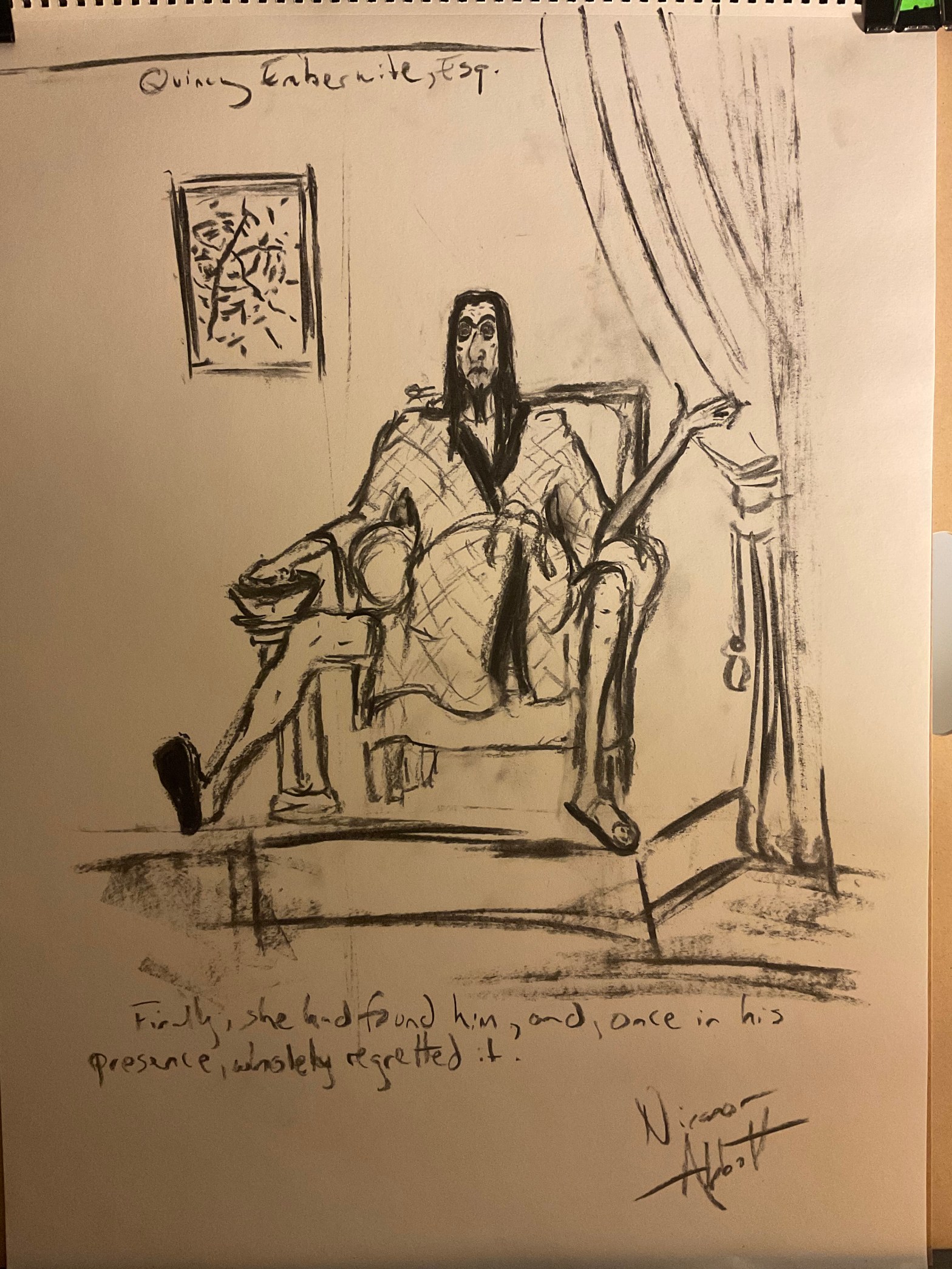
Character Sketch: Quincy Emberwite, Esq

The painted maidens escorted Alex, Jaycee, and Mina into a dim chamber. The drapes had been drawn; vertical slits of light revealed that it was day. In the dim, something moved. A juicy popping sound followed.

“Light,” whispered a low and gossamer voice.

One of the maidens turned up the sconces, revealing a greasy spider of a man. He slouched in his chair, limbs akimbo, his distended belly wrapped in a satin plaid smoking jacket, the knot tied atop his swollen gut like the bow of a present. Stringy black hair, long and lank, hung from a pasty skull. protuberant eyes lolled around. Alex wasn’t sure if Emberwite could even see. He reached out with a pale and spindly hand, plucked a cherry from a bowl beside his chair and ate it. The fruit burst in his mouth. He leaned over and spit out the pit. It bounced and rolled across the dusty floor. A third maiden emerged from behind a heavy curtain, picked it up, and put it in her pocket.

“Well, now.” He simpered and stroked his forked goatee. “The great Alexandra Hawthorne, I presume?”

“Alex.”

He shook his head, wide eyes searched her, then her friends.

“Alexandra, I think. You sought me out. That you found me…” he chuckled, “is by my will, not yours.”

Alex nodded. His voice seemed unnaturally high. Girlish. The door of her memory palace came to the fore. She could escape quickly and easily. Jaycee and Mina? Not so.

Emberwite bounced his tatty black slipper. Alex hoped he would fling it off his foot and forcibly break character to retrieve it.

“So, what brings you to me? My good looks?” He flicked his hair and posed. Someone had punched the mirror behind him, the web of cracks spreading across the glass.

Now he draped his leg over the arm of the chair, the robe shifted, but revealed nothing. “Desire? A job?” He motioned to the painted maiden standing silently nearby. “I could create an opening for you. You’d look so much better in porcelain.”

Jaycee made a retching sound. Mina whimpered. Alex kept her expression neutral.

“I seek the Man in the Golden Coat,” she said evenly.

Emberwite tsked. “So knowledge then. Boooriiing.”

Hide and Seek

Mel raced the wind, which picked up speed every second. He neared his goal, a little stone ruin—the remnants of a spring house—at the far edge of the cornfield. Behind him came shouts of warning, a girl’s scream. He pelted through the doorway, his lungs on fire.

Crouched in the most shadowy corner behind some grayed roof planks, he strained to listen. They could come at any moment. Cornstalks whispered and shushed when brushed against. Someone running would gasp for breath. Coughs. Whispers, should there be more than one pursuer.

But the wind worked against him. It drowned the sounds in a gray roar that matched the amassing clouds. Distant thunder rumbled.

He peeked through a broken window. No one. An ocean of cornstalks whipping in the wind. The sky a sickly green. Scattered droplets of rain turned into a deluge. Thunder rolled and fingers of lightning flashed. He counted the seconds between flash and boom, to estimate distance.

“One… Two…” he whispered.

Boom!

“One…”

BOOM!!

Then roared the sound of a freight train.

He grabbed a loose plank, pulled it toward him, and laid flat down. The sky roiled in angry black and sickly green. The world screamed.

When he awoke, the roofing that had given Mel shelter had fallen and swept everything against the wall. He crawled out on his belly, rusty roofing spikes scratched his back, butt, and thighs. He winced as he emerged, eyes blinking in the light.

One of the ruin walls had fallen in—he thanked the Maker he hadn’t been on that side of the spring house. The sky was blue, cloudless. Birds chirped in the border trees. He stepped back through the doorway. The corn had been swept flat.

“Who’re you?” asked a boy. Mel spun around to see someone who looked very much like himself peeking out from around the corner.

“Mel,” he coughed. “Who’re you?”

“Burt. You new?” the boy continued to eye him warily.

“No. You?”

“No. I lived her all my life.” Burt adjusted his Pirates ballcap and scowled at the sky. Finally he shrugged. “You wanna play hide and seek? We already got a game going.”

“That’s what I was doing,” Mel explained. “These ruins are great, aren’t they?”

“Yeah,” Burt agreed. “Best hiding place in the world.”

They hid there among the ruins, crouched below the window, until a third person—an older girl in a pair of overalls—peeked in and surprised them.

She swatted her hand downward through the window, slapping Bert on the head.

“Found you!” she yelled, then she turned and raced back through the corn.

“Bert’s it! Bert’s it!” she screamed.

The boys started back through the field. The Bert turned, a sly look on his face, and tagged Mel’s shoulder.

“You’re it!” he yelled and tore off between the rows.

Mel gave chase, back over the hill to the little dell with the big chestnut tree—home base. He ran as hard as he could, but the going became harder as he went. He broke into the clearing to find a group of eight kids gathered around the tree.

“Mel’s it! Mel’s it!” Bert yelled as he tagged the tree.

“Who’s Mel?” an older version of Bert asked.

“Him,” Bert pointed Mel’s way.

“Idiot,” said the older boy, slapping Bert in the head.

Poor Burt, Mel thought. The boy rubbed his scalp.

The older boy and the girl who had tagged Bert “it” approached him—not in the happy sprint of kids at play, but in the slow walk of those who had been chastened, or forced home at the end of the day.

“We’re sorry, sir,” the boy began.

“For what?” Mel asked. He coughed again. Paused. His voice sounded lower. Older. 

The two children exchanged nervous glances.

“For Burt… bothering you,” the girl said.

“It was no bother. I’m glad to finally—” Mel waved, then stopped. His hands were wrinkled and liver-spotted.

He looked to the pair. Burt. The others. The tree. Then back at his hand.

“I need to sit.” He sat with his back against the chestnut.

It came to pass, just as Mel suspected it would, that somehow he had been gone over seventy years.

“They still talk about the tornado as if it happened yesterday,” explained Allen, Burt’s older brother.

“It made the state news,” added another pudgy boy with a sheepish expression. “Especially because of the death toll—I mean, all the kids. everyone who died was a kid. My gram says she prays every day for those kids, and thanks heaven she got grounded for kissing Billy Blankenship the night before, or she might’ve been out there too—”

“Billy Blankenship?” Mel paused. “Your gram? Is her name Franny Dormont?”

“It was,” the boy seemed astonished. “But then she got married to Gramps, and now its Platt.”

“Platt, as in Mikey Platt?”

“No, sir. Marcus Platt. His little brother Mikey—my great uncle—died in the storm. He and two brothers who tried to outrun it.”

“—my guess is the boys who tried to run were the Farrelly brothers,” Mel said with a wistful smile. Gary and Greg were only a year apart. Daredevils. The bravest of their gang.

“A couple others were killed where they hid,” said the girl, whose name was Jolene. “The twister came right down the tree line, where all the kids were hiding. They still say the ridge and the spring house are haunted.”

“That’s why I hid there,” said Bert. “They’d never come looking—except for Jo, since she’s fearless.” Bert clearly adored the older girl.

“Funny,” said Mel. “I thought the same thing that day—they’d never come looking over there. Not that it was haunted, though I guess I must be the first ghost you’ve ever met.”

“But you can’t be dead,” Bert argued. “I mean, if you’re dead, we’re all in trouble.” 

“Seeing as how we can see you,” added Allen.

The other kids agreed.

“But what happened to Jeannie Anne? The little girl who was playing with us that day?” Mel asked.

Allen smiled. “She’s my grandma. Bert’s and Jolene’s, too. And she married Billy Blankenship.”

“She did? Why that rascal. I oughtta –” He stopped at the sight of the kids’ expressions.

“He passed on in 1997,” Allen said. “Heart attack.”

“And Jeannie Anne?” Mel asked, a hint of fear in his voice.

Allen smiled. “She’s still living in the same house her parents lived in.”

“Is she really?” He remembered the sounds and smells of that kitchen, especially on Sundays and holidays.

“She is.” Then Bert paused and studied Mel’s face. “You’re great uncle Melvin, aren’t you?”

Mel nodded.

The other children looked very serious. “She talks about you. They never found you. Great Gram — she never got over you.”

“Bert,” hissed Jolene.

“Well, that’s what Gram says,” Bert protested. “Never got over him, and died a year later. Left Gram and Great Grandpa alone in that house.”

Mel stared down at the dirt. A small beetle crawled alongside his foot. A slight shift, and he could crush it.

“So you’re coming home with us,” Jolene declared. “You’re living history. It’ll be a sensation. Our own ‘boy who lived!'”

“What?”

“Nothing,” Allen said. “Jolene spends too much time reading.”

“Oh, reading’s not such a bad thing,” she insisted. Mel agreed.

“But they’ll want to interview you, for sure,” Allen said. “Find out where you’ve been. Maybe even put you on the news. Meet the governor.”

“Or the president!” A little girl who had played with them exclaimed. “I’d love to see the First Lady.”

“And make a movie about you!” said Bert excitedly. “You’ll be famous!”

Mel smiled at the children’s excitement, then shook his head.

“When I left that day,” he said. “I really wanted to hide. I never wanted to be it, and I never wanted to be found.”

“What are you saying?” Jolene asked, not bothering to hide her frown. “You’re not coming home with us?”

“I don’t think it would be wise.” Mel watched the corn sway in the summer breeze. The town lay just over the hill. he wondered what Main Street would look like. If Corner General and the old school yard had changed much. But where would he even begin rebuilding a life that never really was.

“That’s not true,” Jo protested. “Gram would love to see you! You’re her brother!”

The other kids steadfastly agreed that Mel should go home with Allen, Jolene, and Bert, and accept the fame that was coming to him.

“I’ll tell you what,” said Mel. “We’ll make a deal. I want to visit the spring house one more time. Just once, and by myself. If I return, I’ll come home with you. Okay?”

“We’ll come with you,” Bert said quickly, but Mel shook his head.

“This is a game of Hide and Seek for one. Of course, if I come back, we’ll have a lot more time together. But think: everyone who loved me is gone, or has already mourned me and gone on with life. Would it be fair to dredge up the past on them, show up so late in the game? I don’t think so.”

“But we’ll miss you,” said Jolene.

“My dear,” said Mel, “take a lesson from Franny Dormont Platt, and don’t be so free with your heart. It’s easily broken.”

And the kids watched as he stood up, stiffly, and trudged his way toward the corn.

“We’ll wait for you!” called Bert.

Mel looked at the sky.

“Not past sundown. If I’m coming back, you’ll know by then. And if you’re late getting home, there’ll be hell to pay with your folks, I’m sure. Especially if they’re anything like my sister—like my parents.”

He paused once more.

“Besides,” he added, “you play here often, right? Whose to say I won’t be waiting at the spring house? Maybe even my old self—my young self—waiting for a game of Hide and Seek?”

Then he gave them a smile, and vanished between the rows.

The Box (Sick of Moving Variant)

AN: Hello readers: Sorry it’s been a while. The theme of the last three pieces–moving, is the tipoff. This is my last “moving” story for a while. I should be back to my regular writing schedule as of this week.

*****

“Sam!”

Toby eyed the box. Nondescript. Unlabeled, unmarred by packing tape or Sharpie. It wasn’t his. He was pretty certain it wasn’t his husband’s either.

“What?” Sam’s shout came from downstairs. He had been ensconced in the kitchen, unpacking ‘the most vital room in any house, according to Hart family ancestral tradition, thank you very much.’ That ancestral tradition Sam so espoused also meant that socks were folded, not knotted or rolled into an elastic-destroying ball, the windows were washed as part of the weekly cleaning, hyacinths were planted by the front door, and the Christmas tree went up on November twenty-sixth and came down on January seventh, hell or high water.

All this amused Toby, who left the socks in a pile on the bed, killed flowers by looking at them, and hadn’t celebrated his birthday since he was a kid. Christmas? What was Christmas? Well, it hadn’t been much before Sam.

His husband appeared in the doorway.

“Toby, love, we can’t have hot cocoa and snuggle by the fire until I find the hot cocoa. And I can’t find the hot cocoa if I’m standing up here worried because you called for me once then ignored all three of my replies.”

“Is that box yours?” Toby pointed.

“No. I don’t remember packing anything like that at all.” He picked it up. It was neither large nor heavy, about the size of a liquor box, but wasn’t exactly light either. It felt solid, more like a block than a container. He lifted the flap to see its contents.

“Wait!” Toby grabbed Sam’s arm.

“For what?”

“I just…” Toby took the box from him and set it on the bed. “I don’t think we should open it.”

“It’s hardly closed, honey.” Sam moved the flap as if it were a mouth and spoke in a high-pitched voice. “Open me, Toby! Open me!” 

“What if it’s something dangerous?”

Sam laughed. “The sellers probably left it. You think Old Lady Anderson left her portable meth lab behind?”

“Stop.”

Sam pulled Toby in close.

“Crack cocaine?” He said in that same playful tone.

“You’re mean,” Toby chuckled.

“Collection of severed fingers?” Sam whispered. “The murder weapon?” Now he sounded like a bad English butler. “She killed her husband in the bedroom with the mysterious cardboard box? Very good, sir. I’ll notify the guests.”

Still laughing, Toby pulled away. “Fine!” He flipped the flaps open and peered inside.

Sam looked over his shoulder.

“What the…”

“I know,” Toby whispered. Golden light emanated from within. He flipped it shut. The two exchanged glances. Toby leaned in and kissed his husband.

“Hide it,” Sam’s voice had gone hoarse. “We’ve got to protect it. We can’t let it be found.“

“Hide it… hide…” Toby glanced around the room. “Got it.”

The box ended up in the back of the closet, under a stack of spare pillows and comforters. Later that evening, as they watched the fire crackle, the couple discussed what to do with the sunroom, whether or not a sectional would work in the old house, and the success of a clean and organized kitchen. The box never entered the conversation; in truth, both men had forgotten about it completely.

*****

Sam found the box as he cleaned out the guest room closet.

“Toby?” He called out, then stopped. Sat on the bed. Cried again. Toby was everywhere in their house. Sam found it both comforting and stifling. Toby hadn’t believed in much, but after the diagnosis, warned Sam that if he didn’t move on, there would be a haunting until he did.

The box was unmarked, vaguely familiar. Sam flipped the lid up, peered inside, and smiled. 

“Oh,” he said as a gust of wind blew snow into his face. He smelled peppermint. “There you are.” The light inside twinkled. A familiar face beamed up at him. A rainbow scarf flapped as he pulled his hat lower. The figure motioned for Sam to join him.

Sam considered it.

The figure waved him in.

“I’d love to, honey. Really. But you also told me to live.”

The Toby-in-the-box encouraged him to enter.

“I wish I could. But it’s not time, is it?”

Toby-in-the-box offered a familiar look of frustration, then shrugged and turned. Beyond him, seated on a bench, was Old Lady Anderson, clutching her husband’s hand.  Sam cut off the jingle of sleigh bells when he closed the flaps.

“Keep it hidden,” Sam whispered. He put the box back in the closet, then pulled out everything else to pack or sell. 

*****

”Mom!” Kendra called. “Is this yours?”

She opened the flaps on the box that sat in the middle of her room. Inside, the silver and golden glitter and the twinkle of new fallen snow gave her a much needed sense of peace. There was an ice rink full of skaters, laughing racing and yelling and twirling and spinning. A couple held hands, one in a rainbow scarf. As she watched, he held tightly to the arm of his husband. Carolers sang on the bridge, and she smelled the pine.

Of course they are, she thought. How could they not be husbands.

“Is what mine?” her mother appeared in the doorway. Kendra closed the flaps quickly.

“Nothing,” Kendra said. “I didn’t recognize a box at first, but now I do. Sorry.”

Candace surveyed the room. The headboard and desk were scratched and chipped, a precious gift from their congregation. Kendra’s personal belongings filled three boxes taken from the shabby wine and spirits shop down from the charred ruin that had been home.

Whatever was in the box, Kendra would tell her in time. She hugged her daughter.

“You okay?”

Kendra nodded.

“We’ll replace what we can in time. It’s just gonna be tight for a while.” 

Candace felt the wetness of tears against her chest.

“I need to show you,” Kendra said, pulling away and picking the box off the desk.

“You sure?” 

She nodded, and showed her mother the secret.

“You gotta keep it safe,” Candace said, “but that doesn’t mean you shouldn’t look. Not if it gives you peace.”

So Kendra put the box in her closet, and added it to her calendar as a Tuesday night weekly event, so she would always remember to look. The old couple, the husbands, and a thousand other people lived in that box, and when she finally left home, she took it with her.