With this posting, my summertime project to apply the lessons from Ursula LeGuin’s Steering the Craft draws to a close. Apropos, I think, as I am also turning toward a new academic year. The calendar is already being booked. Syllabi must be revised. Teaching materials must be retrieved; the digital files have accumulated several months of digital dust. Tropical Storm Henri will make landfall later today and pass near me within the next 24 hours. Signs say change is afoot.
But before I get to LeGuin’s last assignment, I want to reflect on some of the lessons gained from this summer’s work. It strikes me that her advice is mostly about revision—re-seeing the story as you want the reader to receive it. Yes, there have been plenty of drafting moments, but those drafts purposefully forced me to reexamine how and why I generate text. Less tangent, more emphasis on the protagonist, and more keenly aware of the limits and freedoms that come with different perspectives.
Last spring, an editor colleague of mine read the first 50 pages of my most recent manuscript. Of my protagonist, she said, “Put a camera on his shoulder and a microphone in his head.” LeGuin has helped me understand how the camera and microphone better translate into words. And I’m certainly not done with her text. I’ll probably review it during early draft phase and again between drafting and revision, just so the lessons don’t fade.
To her assignment, then. LeGuin asks the writer to cut the manuscript by half. The exercise is titled “A Terrible Thing to Do.” Terrible? Yes, but oh, so necessary. And in the case of “Old Ghosts”, by now you must know what I have known for weeks as well: the story has changed so drastically that the title no longer fits and large chunks of text will be going.
But it’s also no longer about the same idea. I wrote the initial draft years ago while wondering what would happen if a ghost met another ghost, and if the time of their passing might affect what they can know and see and do. But that’s just an idea, with no easy perspective for the telling and no protagonist to connect with.
Then I discovered my characters—and more. I met Clayton Morrow and his wife and child, and several other neighbors to boot. I moved from literal ghosts to science fiction to that much more accessible and terrifying “What if?” we ask in our moments of regret. That I may be stopping off in the Twilight Zone is my own choosing, but it’s not about an idea. It’s about Clay, and the regrets dwelling in his head.
The original draft of “Old Ghosts” that appeared in my very first post in this sequence was 500 words. The draft from last week, incorporating both the sequence of story built around a single action, the room description, and the A/B character dialogue was 4,000 words. So today, for my last post, I’m going to assemble a 2,000 word draft from all those pieces. I won’t post the final version on this site right away, as I will be trying to get it published. But if that doesn’t work out, maybe I’ll post it down the road. If I can get it published, I’ll post the citation for you to go find it.
Next week, I’ll be back to posting other bits of fiction and poetry and other observations that tie LGBTQ writing to the supernatural, the haunted, and science fiction and fantasy. We’ll see if I’ve learned anything…
*****
“Ghosts”
Clay hiked home, tackle box and rod in one hand, five gallon bucket with a pair of large brook trout in the other. The Sunday and Wednesday hikes always looked the same: yard, orchard, woods, then stream in the morning; stream, woods, orchard, yard, in the evenings. His routine only changed when one of his hens stopped laying. Then he ate chicken instead of fish.
His nephew, Dwight, had the tractor in the lower field, tending the garden. Most days, Clay would be out in the sun with his nephew and the farm hands, though his niece-in-law, Annie, always fussed if he stayed in the heat too long.
“Where’s your hat?” She always asked. She didn’t even look up—just kept picking blueberries or snap peas, or filling bushel baskets with peaches.
Clay would doff and wave it before flopping it back on his head. She side-eyed it, treating him like one of her brood. Dwight and Annie’s children worked the farm as well.
“Alright Uncle Clay, but I’m watching you,” Annie always warned. “There’s a cooler of water on the truck. Make sure you use it.” She always parked her pickup near the job, and she always had water or tea or lemonade on hand.
She was at once a comfort and nuisance. “No need to look after me so close,” Clay told her. “Dwight’s getting the farm already.”
More side-eye, and sometimes crossed arms to boot. “It ain’t about that, Uncle Clay.”
No wonder Dwight loved her so.
Before climbing into the woods, he turned back to watch the afternoon sunlight play on the stream. There was his fishing log on the bank, where he camped out two days a week. Over there, the place he had taught Junior to skip stones, then to fish. Junior was never good at skipping stones. Or fishing. But they both loved the sunlight.
Something shushed into the tall grass behind him. Snake, probably, he thought, and turned toward the woods. A bullfrog croaked. Furry things scuttled off the trail, rustling the blanket of leaves. Chipmunks. Squirrels. Birds darted through the trees. A woodpecker hammered a poplar. High in the canopy or under the detritus, life lived just out of view.
Round the next turn, he would see the sugar maple, and the pile of rocks beside. When Junior was a boy, they had cleared the trail of the smaller, looser stones, piling them along the way. They hadn’t tapped the silver maples in years. Maybe Dwight would do it.
Best to pass it all quickly, Clay always thought. He hated rounding the corner. Hated that tree. Hated that pile of rocks. But someone was coming down the trail. Dwight and one of his boys? A couple of the hands? Annie’s boys, sent to check on him? Clay looked up. Rubbed his eyes.
Junior.
But that couldn’t be right.
Junior, still wearing that glossy black snakeskin print jacket and those flatlander, city-slicker silver-toed boots. Half-buzzed head and pierced ears. Clay winced.
“Pop?”
The boy was weighed down by his troubles.
“Pop, I got to tell you something.”
Clay focused on the path. The trees provided shade, but the sunlight still broke through. His fishing gear suddenly weighed him down. He clutched it, though, as if it would keep him from doing anything rash. Anything unforgivable. He set his bucket of trout on the ground to keep from dropping it.
“Pop?”
Clay sighed.
“I’m listening.”
“I… I’m gay.”
Well there it was. The rumors about his boy and Benjamin Grouse must’ve been true.
“You let Miss Grouse’s boy have you in the shed last fall?”
Silence. Junior studied the dirt, hands in his pockets.
“I asked you a question.” His grip on the gear tightened. This wasn’t an answer he needed; he didn’t even know why he asked. Grouse had let Clara know that their boys were confirmed bachelors, and wasn’t that dandy? Perhaps they’d open a flowershop on Main, by the diner?
“Yeah.” Junior’s eyes were wet.
“Were you in love?” He had meant the question to be genuine, but the anguish that overtook his son’s face suggested differently.
“Nevermind,” Clay said, working hard to be gentle. “Go on back up to the house and help your mama. I’ll be up in a couple hours.” He eyed the stones. It would be so easy to grab one of them…just side-arm it at him. But God would know. Clara would, too.
The world went hazy and tipped sideways. Clay dropped his gear, put his hands on his knees. If the heart attack came now, Mother Nature would be conducting the service.
He looked up. Junior stood in front of him.
“Pop, I got to tell you something.”
“You’re a queer.”
But that couldn’t be right. That wasn’t what happened was it? He could no longer deny Miss Grouse’s observations and the gossip that conveniently happened within earshot. Clara had come home crying. He pried it out of her. Dirk Markley had given her hell in the grocery store. Said something about Junior squealing like hog in the barn, his own boy Tom caught with his pants down behind. Dirk had intentionally fired his rifle upward; Tom hadn’t been seen since.
“I… yeah.”
“You let that Ben Grouse mount you like a dog in his Aunt’s garage?”
Silence.
“You let Tom Markley do the same in his daddy’s barn?”
More silence.
Clay appraised his son. The boy hunched, hands in his jeans pockets. Shiny blazer on a slender frame. How had he not known?
He dropped his gear; the tackle box landed on a rock and rolled over. trout water splashed his hip. He tapped his watch.
“I’ll be home in an hour. By the time I get back, you and anything you want should be gone from here. Got it?”
“Pop—“
“Don’t ‘Pop’ me. I don’t have any kids.”
Pain raced up his arm, his vision went hazy. He thought the trees leaned in… too close! Too close! And the buzzing in his ears… he reached out to a trunk. Steadied himself. Sap stickied his hand.
“Dad, I’m gay.”
“Your mother sent you down here to tell me that.”
The young man’s footsteps stopped.
Clay turned, set his gear down gently, and studied his son. Hunched. Downcast. Downtrodden. The boy had gone through a bit of emotional hell recently, if the rumors about Ben Grouse were true.
“You get your heart broken?”
Junior looked up, eyes wet, pleading.
Clay didn’t want to touch his son. Affection never suited him well. He disliked high drama, something four years of watching Junior on high school theatre had proven. God knew the boy excelled at it. He reached up, took his son by the shoulder.
“I take it that’s a yes.”
“Miss Grouse pulled me aside last Sunday…”
Clay shook his head.
“I don’t need to hear it, Junior. I just need to know if you’re going to go out there and try to love someone else now.”
“What do you mean?”
“I had it easy all these years,” Clay said. “Your mother’s the only woman I ever loved, and she loved me in return. But even as I say that, well, you know probably better than me, that love isn’t easy.”
Junior looked confused.
Clayton pressed onward. “I’m not good at this. I just want to know you’re not giving up on love. You may not have found it this time, but there will be other… eels?”
Junior sniffled and laughed.
“That what you go for? Eels? Well, the sea got plenty of them, too, I expect.” He squeezed his son’s shoulder. “It’ll be alright.”
He staggered, dizziness overtook him as the world went hazy. This might be it, he thought, and wondered who would find him. His gear tumbled away and he bent over, hands on his knees, breaking out in a cold sweat.
“Pop, I need to tell you something.”
“Anything different from what Miss Grouse and half the town is already telling me?”
His son had stopped. Clay set down his gear. Put his hands in his pockets, mirroring his boy’s posture.
“I guess not.”
Clay watched the light play across the path. The trees couldn’t block it all out. Shade. Light. Each had their place.
“Well,” he said. “At least, now that you told me, I can talk back to folks. Your Ma and I have been waiting for you to tell us so we can defend you properly, however you live your life. You told her yet?”
This wasn’t real. Junior hadn’t told her. He never had the chance, as far as Clay knew. When he came to the hospital in mascara and lipstick like a red light hussy, Clay hadn’t yelled or anything. He just told his boy to go home and clean up properly before his dying Ma saw what he was trying to become.
But now Junior stood here on the trail. For all the boy’s neatness—dress shirts and blazers and polished shoes—he looked a state, and not fit for the woods or the stream. Not fit for a farm, or the country.
“She told me to come talk to you.”
“You gonna leave home now?” Clay already knew the answer. After Ben Grouse and his batty old aunt, and with Dirk Markley thundering around, Junior had gained an unfortunate reputation.
Junior nodded but refused to look his father in the eye.
Clay gave him an awkward hug, puzzling over the origin of Junior’s penchant for drama. Didn’t seem to be an inherited thing, but who knew?
“Well, I guess your Ma and I are gonna see the world a little bit. Or at least, see whatever corner of it you end up in.”
His vision clouded. He dropped his gear, put his hands on his knees, tried to slow his racing heart.
he saw it again from outside himself. The fishing gear tumbled off. The water sloshed. He hesitated before grabbing a stone. The sugar maple lent its strength. I’m in Hell, he thought. I’ve died and gone to Hell. Preacher Holland would be pleased.
he hurried home, sweating. Not pausing when Annie waved from the orchard. She had planted Clara’s flowerbeds. Mums, begonias, pansies, snapdragons—he’d neglected them. The beds had grown patchy: wild in some places, barren in others. Yes, he would have to tend them better. Annie never said a word, but Clara would have chastised him for neglect.
“You are indeed losing it,” he announced. “Too much nostalgia. Not enough work.” He left the trout bucket on the porch, its contents still swimming in tight circles.
The house was always too quiet. He stood in the living room. The mantle clock ticked away the seconds. A porcelain dancer pirouetted beside a few pieces of carnival glass on little wooden stands. Clara’s crocheted doilies protected every surface. Her fresh bouquets routinely presented in the clear glass vase had been replaced once and for all by one of Annie’s artificial arrangements. The room lacked the smell of growing things, mostly, but the peace lily remained, still filling the stand by the window, bursting in lush green that drooped over the planter. A congregation of flowers: three white, each with a trim of brown, and a fourth, smaller, green one, stood tall amongst foliage, turned sunward. The drapes were open as always; the sheer curtains, yellowed, remained closed. A set of long-retired coasters sat neatly in a rack beneath an end table lamp. The pillows, the afghans, all handmade and handed down, remained in their proper places, stacked, leaning, folded, covering. Still. Unused. A thin layer of dust covered everything.
He pictured the stream in the hollow. Light played on the water today. A heron had swooped in, then swept away, gliding over the water. Can of peaches, beets, beans, and tomatoes lined the cellar pantry. Clara loved canning. The trout splashed on the porch. He mourned them, the old days, teaching Junior to skip stones. The three of them inviting the town to pick their own crops. Junior, Dwight, and some of the other kids carrying bushel baskets to the cars. Clara interfering with Preacher Holland so that Clay could take take of the real customers.
“Maybe it was a heart attack,” he mumbled. “Maybe I’m going.” The dancer on the mantle mourned at him with painted black eyes. That night he placed a call to New York. In the darkness of the hollow, the stream burbled along.
*****
2,086 words.
*****
Le Guin, Ursula K.. Steering the Craft: A Twenty-First-Century Guide to Sailing the Sea of Story (pp. 124). HMH Books. Kindle Edition.

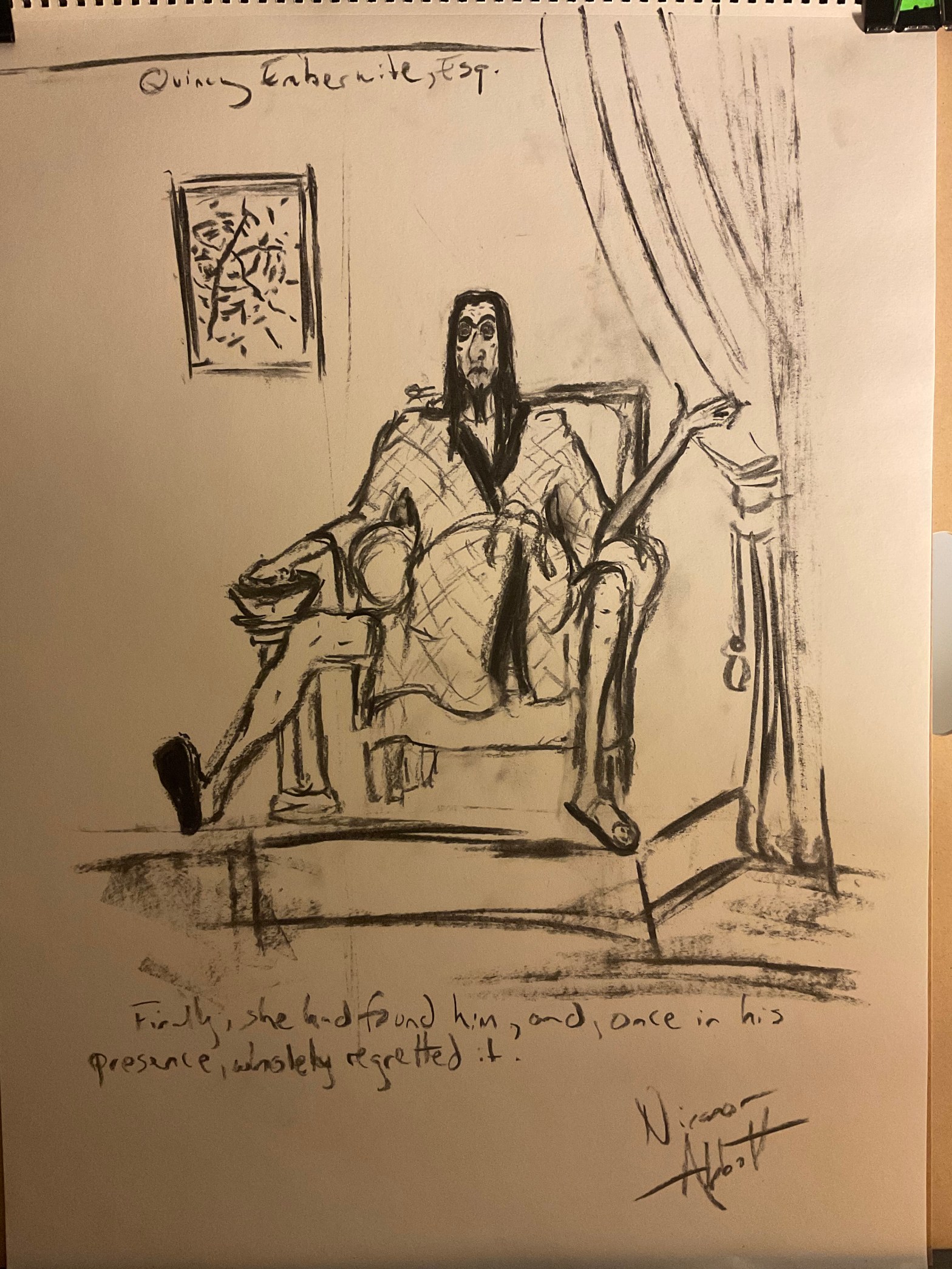
 Nicanor Abbott